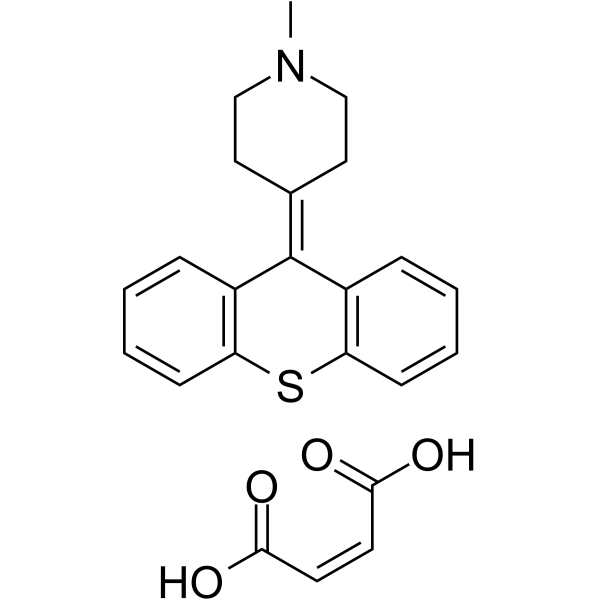
Physicochemical Properties
| Molecular Formula | C19H19NS.C4H4O4 |
| Molecular Weight | 409.49802 |
| Exact Mass | 409.135 |
| CAS # | 13187-06-9 |
| Related CAS # | Pimethixene;314-03-4 |
| PubChem CID | 5702167 |
| Appearance | White to off-white solid powder |
| Density | 1.192g/cm3 |
| Boiling Point | 439.7ºC at 760mmHg |
| Flash Point | 219.7ºC |
| Vapour Pressure | 5.08E-17mmHg at 25°C |
| LogP | 4.328 |
| Hydrogen Bond Donor Count | 2 |
| Hydrogen Bond Acceptor Count | 6 |
| Rotatable Bond Count | 2 |
| Heavy Atom Count | 29 |
| Complexity | 501 |
| Defined Atom Stereocenter Count | 0 |
| SMILES | CN1CCC(=C2C3=CC=CC=C3SC4=CC=CC=C42)CC1.C(=C\C(=O)O)\C(=O)O |
| InChi Key | IPANUAHQWFDVAG-BTJKTKAUSA-N |
| InChi Code | InChI=1S/C19H19NS.C4H4O4/c1-20-12-10-14(11-13-20)19-15-6-2-4-8-17(15)21-18-9-5-3-7-16(18)19;5-3(6)1-2-4(7)8/h2-9H,10-13H2,1H3;1-2H,(H,5,6)(H,7,8)/b;2-1- |
| Chemical Name | (Z)-but-2-enedioic acid;1-methyl-4-thioxanthen-9-ylidenepiperidine |
| HS Tariff Code | 2934.99.9001 |
| Storage |
Powder-20°C 3 years 4°C 2 years In solvent -80°C 6 months -20°C 1 month Note: Please store this product in a sealed and protected environment, avoid exposure to moisture. |
| Shipping Condition | Room temperature (This product is stable at ambient temperature for a few days during ordinary shipping and time spent in Customs) |
Biological Activity
| Targets |
5-HT2B receptor (pKi = 10.44 ± 0.77) 5-HT2A receptor (pKi = 10.22 ± 0.08) Histamine H1 receptor (pKi = 10.14 ± 0.77) Muscarinic M2 receptor (pKi = 9.38) Muscarinic M1 receptor (pKi = 8.61) Dopamine D2 receptor (pKi = 8.19) 5-HT2C receptor (pKi = 8.42 ± 0.20) Adrenergic α1A receptor (pKi = 7.61) 5-HT6 receptor (pKi = 7.30) 5-HT7 receptor (pKi = 7.28) 5-HT1A receptor (pKi = 7.63) Histamine H2 receptor (pKi = 7.54) Dopamine D1 receptor (pKi = 6.37) 5-HT1B receptor (pKi < 5) [1] |
| ln Vitro |
Pimethixene was identified as a highly potent but non-selective 5-HT2B receptor antagonist through a broad screen of monoaminergic antagonists using cell lines expressing recombinant human G protein-coupled receptors functionally linked to a luciferase reporter. It blocked serotonin-activated luciferase responses in cell lines with high affinity for multiple serotonin receptors, with the order of potency: 5-HT2 > 5-HT1A > 5-HT6 > 5-HT7 receptors. Within the 5-HT2 receptor group, it showed equally high potency at 5-HT2A and 5-HT2B receptors (pKi around 10.2 and 10.4, respectively), and lower affinity to 5-HT2C receptors. In addition to serotonergic receptors, pimethixene displayed high affinity to histamine H1, adrenaline α1A, dopamine D1/D2, and muscarinic M1/M2 receptors, demonstrating a broad spectrum of monoaminergic antagonistic properties.[1] In radioligand binding experiments on membrane preparations from CHO cells stably expressing human 5-HT2B receptors, pimethixene displaced radioligand [³H]-mesulergine with high affinity (pKi = 9.38 ± 0.72).[1] |
| ln Vivo |
Intravenous administration of pimethixene in a guinea pig model of neurogenic dural plasma protein extravasation (PPE) caused a highly effective, dose-dependent inhibition of PPE induced by the agonist mCPP. Complete inhibition of PPE was achieved at doses of 0.1 and 1 µg/kg i.v. A dose of 0.01 µg/kg i.v. resulted in 84% inhibition, and 0.001 µg/kg i.v. caused 18% inhibition. Its potency in preventing PPE was significantly stronger than that of reference antagonists methysergide and pizotifen, demonstrating up to a 1000-fold superiority in this model.[1] |
| Enzyme Assay |
Functional in vitro assays were performed using a panel of stable cell lines expressing individual human monoaminergic G protein-coupled receptors (e.g., 5-HT2A, 5-HT2B, 5-HT2C, H1, M1, M2, D2, etc.) linked to a luciferase reporter gene (SRE- or CRE-driven). Cells were seeded in 96-well plates, serum-starved, and pre-incubated with test compounds (antagonists) for 5 minutes before stimulation with their respective agonists (e.g., serotonin, histamine, dopamine, carbachol) at predetermined EC80 concentrations for 4 hours. Luciferase activity was measured after cell lysis as a readout for receptor activation. Antagonist potencies (pKi values) were calculated from concentration-response curves using the Cheng-Prusoff equation.[1] Radioligand binding assays for the 5-HT2B receptor were performed using membrane preparations from CHO-DUKX cells stably transfected with the human 5-HT2B receptor. Membranes were incubated with the radioligand [³H]-mesulergine (3 nM) in the presence or absence of competing test compounds. After incubation, bound radioactivity was separated by filtration through GF/B filters, and specific binding was determined. Ki values were calculated using the Cheng-Prusoff equation, with a previously determined KD for mesulergine.[1] |
| Cell Assay |
Chinese hamster ovary (CHO) cell lines and human neuroblastoma SHSY5Y cell lines were engineered to stably express individual human monoaminergic receptors (e.g., 5-HT2B in SHSY5Y-SRE-Luci cells) coupled to a luciferase reporter gene. For functional antagonist testing, cells were plated, starved, pre-treated with serial dilutions of pimethixene, and then stimulated with the appropriate agonist. Receptor activation was quantified by measuring luminescence after cell lysis and addition of luciferase assay reagent. Specific antagonists for each receptor (e.g., RS127445 for 5-HT2B, ketanserin for 5-HT2A) were used to confirm the functional identity of the expressed receptors in these cell lines.[1] |
| Animal Protocol |
Neurogenic dural plasma protein extravasation (PPE) model in guinea pigs: Male guinea pigs were anesthetized with sodium pentobarbital or isoflurane. A branch of the jugular vein was cannulated for intravenous injections. Pimethixene maleate (or vehicle) was administered intravenously at specified doses (e.g., 0.001 to 1 µg/kg). The agonist mCPP (1 µg/kg i.v.) was injected 2 minutes after the antagonist to induce PPE. Evans blue dye (50 mg/kg i.v.) was injected 2 minutes after mCPP as a marker for plasma protein extravasation. Fifteen minutes later, animals were perfused with saline, and a standardized area of the dura mater was removed. The dura was incubated in formamide to extract Evans blue, and the dye concentration in the supernatant was measured spectrophotometrically at 600 nm to quantify PPE. The inhibitory effect of pimethixene was calculated by comparing PPE in drug-treated groups to agonist-only controls.[1] |
| References |
[1]. BF-1--a novel selective 5-HT2B receptor antagonist blocking neurogenic dural plasma protein extravasation in guinea pigs. Eur J Pharmacol. 2015 Mar 15;751:73-80. |
| Additional Infomation |
See also: Pimethixene (annotation moved to). Pimethixene (1-methyl-4-(9H-thioxanthen-9-ylidene)piperidine) was identified as the lead compound from a screening effort aimed at finding high-affinity 5-HT2B receptor antagonists. It served as the chemical starting point for the development of the more selective derivative BF-1. Due to its high affinity for the histamine H1 receptor, pimethixene has been used clinically as an antihistamine and sedative. Historical clinical trials from the 1960s reported that pimethixene (at 2 mg daily oral dose) reduced the severity and frequency of migraine attacks in 64% of patients, supporting the role of antiserotonergic properties in migraine prophylaxis. However, its use was associated with significant side effects, notably weight gain, attributed to its broad receptor profile.[1] |
Solubility Data
| Solubility (In Vitro) | DMSO : ~100 mg/mL (~244.20 mM) |
| Solubility (In Vivo) |
Solubility in Formulation 1: ≥ 2.5 mg/mL (6.11 mM) (saturation unknown) in 10% DMSO + 40% PEG300 + 5% Tween80 + 45% Saline (add these co-solvents sequentially from left to right, and one by one), clear solution. For example, if 1 mL of working solution is to be prepared, you can add 100 μL of 25.0 mg/mL clear DMSO stock solution to 400 μL PEG300 and mix evenly; then add 50 μL Tween-80 to the above solution and mix evenly; then add 450 μL normal saline to adjust the volume to 1 mL. Preparation of saline: Dissolve 0.9 g of sodium chloride in 100 mL ddH₂ O to obtain a clear solution. Solubility in Formulation 2: ≥ 2.5 mg/mL (6.11 mM) (saturation unknown) in 10% DMSO + 90% (20% SBE-β-CD in Saline) (add these co-solvents sequentially from left to right, and one by one), clear solution. For example, if 1 mL of working solution is to be prepared, you can add 100 μL of 25.0 mg/mL clear DMSO stock solution to 900 μL of 20% SBE-β-CD physiological saline solution and mix evenly. Preparation of 20% SBE-β-CD in Saline (4°C,1 week): Dissolve 2 g SBE-β-CD in 10 mL saline to obtain a clear solution. Solubility in Formulation 3: ≥ 2.5 mg/mL (6.11 mM) (saturation unknown) in 10% DMSO + 90% Corn Oil (add these co-solvents sequentially from left to right, and one by one), clear solution. For example, if 1 mL of working solution is to be prepared, you can add 100 μL of 25.0 mg/mL clear DMSO stock solution to 900 μL of corn oil and mix evenly. (Please use freshly prepared in vivo formulations for optimal results.) |
| Preparing Stock Solutions | 1 mg | 5 mg | 10 mg | |
| 1 mM | 2.4420 mL | 12.2100 mL | 24.4200 mL | |
| 5 mM | 0.4884 mL | 2.4420 mL | 4.8840 mL | |
| 10 mM | 0.2442 mL | 1.2210 mL | 2.4420 mL |