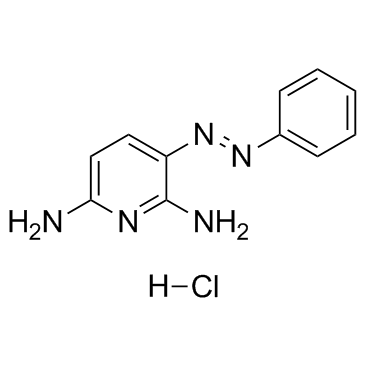
Description: Phenazopyridine HCl is a local analgesic agent used in the urinary tract infections/UTIs to alleviate the pain, irritation, discomfort, or urgency.
Physicochemical Properties
| Molecular Formula | C11H12CLN5 |
| Molecular Weight | 249.7 |
| Exact Mass | 249.078 |
| CAS # | 136-40-3 |
| Related CAS # | Phenazopyridine;94-78-0 |
| PubChem CID | 4756 |
| Appearance | Pink to red solid powder |
| Boiling Point | 442.3ºC at 760 mmHg |
| Melting Point | 139°C |
| Flash Point | 221.3ºC |
| Vapour Pressure | 5.66E-09mmHg at 25°C |
| LogP | 4.625 |
| Hydrogen Bond Donor Count | 2 |
| Hydrogen Bond Acceptor Count | 5 |
| Rotatable Bond Count | 2 |
| Heavy Atom Count | 16 |
| Complexity | 237 |
| Defined Atom Stereocenter Count | 0 |
| InChi Key | QPFYXYFORQJZEC-UHFFFAOYSA-N |
| InChi Code | InChI=1S/C11H11N5/c12-10-7-6-9(11(13)14-10)16-15-8-4-2-1-3-5-8/h1-7H,(H4,12,13,14) |
| Chemical Name | 3-phenyldiazenylpyridine-2,6-diamine |
| Synonyms | Urodine Phenazopyridine HCl Phenazopyridine Hydrochloride |
| HS Tariff Code | 2934.99.9001 |
| Storage |
Powder-20°C 3 years 4°C 2 years In solvent -80°C 6 months -20°C 1 month Note: Please store this product in a sealed and protected environment, avoid exposure to moisture. |
| Shipping Condition | Room temperature (This product is stable at ambient temperature for a few days during ordinary shipping and time spent in Customs) |
Biological Activity
| Toxicity/Toxicokinetics |
Effects During Pregnancy and Lactation ◉ Summary of Use during Lactation The safety of phenazopyridine is not established in infants or during breastfeeding. Because it can cause methemoglobinemia, sulfhemoglobinemia, and hemolytic anemia, it should be avoided while breastfeeding, especially with an infant under 1 month of age or with glucose-6-phosphate dehydrogenase (G6PD) deficiency. ◉ Effects in Breastfed Infants Relevant published information was not found as of the revision date. ◉ Effects on Lactation and Breastmilk Relevant published information was not found as of the revision date. |
| References |
[1]. Identification of the first noncompetitive SARM1 inhibitors. Bioorganic & Medicinal Chemistry, 2020, 28(18): 115644. [2]. Phenazopyridine promotes RPS23RG1/Rps23rg1 transcription and ameliorates Alzheimer-associated phenotypes in mice. Neuropsychopharmacology, 2022, 47(12): 2042-2050. [3]. Effects of phenazopyridine on rat bladder primary afferent activity, and comparison with lidocaine and acetaminophen. Neurourology and Urodynamics, 2010, 29(8): 1445-1450. [4]. Inhibition of TRPM8 by the urinary tract analgesic drug phenazopyridine. European Journal of Pharmacology, 2023, 942: 175512. [5]. Phenazopyridine hydrochlorideinduces and synchronizes neuronal differentiation of embryonic stem cells. Journal of cellular and molecular medicine vol. 13,9B (2009): 3517-27. |
| Additional Infomation |
Phenazopyridine can cause cancer according to an independent committee of scientific and health experts. Phenazopyridine is a diaminopyridine that is 2,6-diaminopyridine substituted at position 3 by a phenylazo group. A local anesthetic that has topical analgesic effect on mucosa lining of the urinary tract. Its use is limited by problems with toxicity (primarily blood disorders) and potential carcinogenicity. It has a role as a local anaesthetic, a non-narcotic analgesic, a carcinogenic agent and an anticoronaviral agent. It is a diaminopyridine and a monoazo compound. It is a conjugate base of a phenazopyridine(1+). A local anesthetic that has been used in urinary tract disorders. Its use is limited by problems with toxicity (primarily blood disorders) and potential carcinogenicity. See also: Phenazopyridine (annotation moved to). |
Solubility Data
| Solubility (In Vitro) |
DMSO : ~25 mg/mL (~100.12 mM) H2O : ~1 mg/mL (~4.00 mM) |
| Solubility (In Vivo) |
Solubility in Formulation 1: ≥ 2.5 mg/mL (10.01 mM) (saturation unknown) in 10% DMSO + 40% PEG300 + 5% Tween80 + 45% Saline (add these co-solvents sequentially from left to right, and one by one), clear solution. For example, if 1 mL of working solution is to be prepared, you can add 100 μL of 25.0 mg/mL clear DMSO stock solution to 400 μL PEG300 and mix evenly; then add 50 μL Tween-80 to the above solution and mix evenly; then add 450 μL normal saline to adjust the volume to 1 mL. Preparation of saline: Dissolve 0.9 g of sodium chloride in 100 mL ddH₂ O to obtain a clear solution. Solubility in Formulation 2: ≥ 2.5 mg/mL (10.01 mM) (saturation unknown) in 10% DMSO + 90% (20% SBE-β-CD in Saline) (add these co-solvents sequentially from left to right, and one by one), clear solution. For example, if 1 mL of working solution is to be prepared, you can add 100 μL of 25.0 mg/mL clear DMSO stock solution to 900 μL of 20% SBE-β-CD physiological saline solution and mix evenly. Preparation of 20% SBE-β-CD in Saline (4°C,1 week): Dissolve 2 g SBE-β-CD in 10 mL saline to obtain a clear solution. (Please use freshly prepared in vivo formulations for optimal results.) |
| Preparing Stock Solutions | 1 mg | 5 mg | 10 mg | |
| 1 mM | 4.0048 mL | 20.0240 mL | 40.0481 mL | |
| 5 mM | 0.8010 mL | 4.0048 mL | 8.0096 mL | |
| 10 mM | 0.4005 mL | 2.0024 mL | 4.0048 mL |