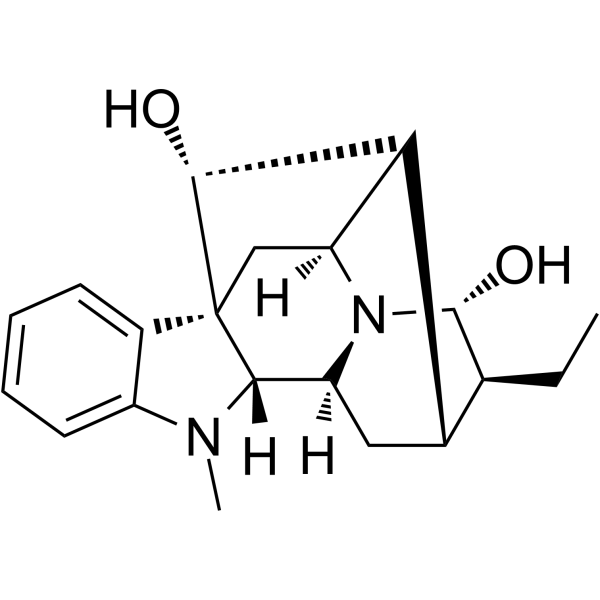
Ajmaline (also known as Gilurytmal and Ritmos) is a natual alkaloid and a sodium channel blocker. It belongs to class Ia antiarrhythmic agent that can be used to treat arrhythmia. Ajmaline is also often used to bring out typical findings of ST elevations in patients suspected of having Brugada syndrome.
Physicochemical Properties
| Molecular Formula | C20H26N2O2 |
| Molecular Weight | 326.44 |
| Exact Mass | 326.199 |
| CAS # | 4360-12-7 |
| Related CAS # | 4410-48-4 (HCl);4360-12-7; |
| PubChem CID | 6100671 |
| Appearance | White to off-white solid powder |
| Density | 1.373g/cm3 |
| Boiling Point | 519.406ºC at 760 mmHg |
| Melting Point | 189ºC |
| Flash Point | 285.155ºC |
| Index of Refraction | 1.701 |
| LogP | 1.557 |
| Hydrogen Bond Donor Count | 2 |
| Hydrogen Bond Acceptor Count | 4 |
| Rotatable Bond Count | 1 |
| Heavy Atom Count | 24 |
| Complexity | 570 |
| Defined Atom Stereocenter Count | 9 |
| SMILES | CC[C@H]1[C@@H]2C[C@H]3[C@H]4[C@@]5(C[C@@H]([C@H]2[C@H]5O)N3[C@@H]1O)C6=CC=CC=C6N4C |
| InChi Key | CJDRUOGAGYHKKD-KBPCXUENSA-N |
| InChi Code | InChI=1S/C20H26N2O2/c1-3-10-11-8-14-17-20(12-6-4-5-7-13(12)21(17)2)9-15(16(11)18(20)23)22(14)19(10)24/h4-7,10-11,14-19,23-24H,3,8-9H2,1-2H3/t10-,11-,14-,15-,16-,17-,18+,19-,20+/m0/s1 |
| Chemical Name | (5aR,6S,8S,9S,10R,11S,11aS,12aR,13R)-9-ethyl-5-methyl-5a,6,8,9,10,11,11a,12-octahydro-5H-6,10 |
| Synonyms | TachmalinSiddiqui Takycor CardiorythmineNSC 15627 Rauwolfin (+)-Ajmaline Raugalline Rauwolfine Ritmos Gilurytmal Merabitol Ignazin Rhytmaton Rytmalin |
| HS Tariff Code | 2934.99.9001 |
| Storage |
Powder-20°C 3 years 4°C 2 years In solvent -80°C 6 months -20°C 1 month |
| Shipping Condition | Room temperature (This product is stable at ambient temperature for a few days during ordinary shipping and time spent in Customs) |
Biological Activity
| ln Vitro | Human embryonic kidney (HEK) cells expressing wild-type and mutant HERG channels were used in electrophysiological investigations, as were Xenopus laevis oocytes (two-electrode voltage clamp). With an IC50 of 1.0μM in HEK cells and 42.3μM in Xenopus oocytes, ajmaline inhibits HERG current [2]. |
| References |
[1]. Liquid chromatographic assay with fluorescence detection to determine ajmaline in serum from patients with suspected Brugada syndrome. J Chromatogr B Analyt Technol Biomed Life Sci. 2010;878(23):2168-2172. [2]. Class Ia anti-arrhythmic drug ajmaline blocks HERG potassium channels: mode of action. Naunyn Schmiedebergs Arch Pharmacol. 2004;370(6):423-435. |
| Additional Infomation |
An alkaloid found in the root of Rauwolfia serpentina, among other plant sources. It is a class Ia antiarrhythmic agent that apparently acts by changing the shape and threshold of cardiac action potentials. Ajmaline produces potent sodium channel blocking effects and a very short half-life which makes it a very useful drug for acute intravenous treatments. The drug has been very popular in some countries for the treatment of atrial fibrillation in patients with the Wolff–Parkinson–White syndrome and in well tolerated monomorphic ventricular tachycardias. It has also been used for many years as a drug to challenge the conduction system of the heart in cases of bundle branch block and syncope. In these cases, abnormal prolongation of the HV interval has been taken as a proof for infrahisian conduction defects tributary for permanent pacemaker implantation. Ajmaline has been reported in Rauvolfia yunnanensis, Rauvolfia cubana, and other organisms with data available. An alkaloid found in the root of RAUWOLFIA SERPENTINA, among other plant sources. It is a class 1-A antiarrhythmic agent that apparently acts by changing the shape and threshold of cardiac action potentials. Drug Indication For use as an antiarrhythmic agent. Mechanism of Action The class I antiarrhythmic agents interfere with the sodium channel. A class IA agent lengthens the action potential (right shift) which brings about improvement in abnormal heart rhythms. This drug in particular has a high affinity for the Nav 1.5 sodium channel. |
Solubility Data
| Solubility (In Vitro) | DMSO : ≥ 100 mg/mL (~306.34 mM) |
| Solubility (In Vivo) |
Solubility in Formulation 1: ≥ 2.5 mg/mL (7.66 mM) (saturation unknown) in 10% DMSO + 40% PEG300 + 5% Tween80 + 45% Saline (add these co-solvents sequentially from left to right, and one by one), clear solution. For example, if 1 mL of working solution is to be prepared, you can add 100 μL of 25.0 mg/mL clear DMSO stock solution to 400 μL PEG300 and mix evenly; then add 50 μL Tween-80 to the above solution and mix evenly; then add 450 μL normal saline to adjust the volume to 1 mL. Preparation of saline: Dissolve 0.9 g of sodium chloride in 100 mL ddH₂ O to obtain a clear solution. Solubility in Formulation 2: ≥ 2.5 mg/mL (7.66 mM) (saturation unknown) in 10% DMSO + 90% (20% SBE-β-CD in Saline) (add these co-solvents sequentially from left to right, and one by one), clear solution. For example, if 1 mL of working solution is to be prepared, you can add 100 μL of 25.0 mg/mL clear DMSO stock solution to 900 μL of 20% SBE-β-CD physiological saline solution and mix evenly. Preparation of 20% SBE-β-CD in Saline (4°C,1 week): Dissolve 2 g SBE-β-CD in 10 mL saline to obtain a clear solution. Solubility in Formulation 3: ≥ 2.5 mg/mL (7.66 mM) (saturation unknown) in 10% DMSO + 90% Corn Oil (add these co-solvents sequentially from left to right, and one by one), clear solution. For example, if 1 mL of working solution is to be prepared, you can add 100 μL of 25.0 mg/mL clear DMSO stock solution to 900 μL of corn oil and mix evenly. (Please use freshly prepared in vivo formulations for optimal results.) |
| Preparing Stock Solutions | 1 mg | 5 mg | 10 mg | |
| 1 mM | 3.0634 mL | 15.3168 mL | 30.6335 mL | |
| 5 mM | 0.6127 mL | 3.0634 mL | 6.1267 mL | |
| 10 mM | 0.3063 mL | 1.5317 mL | 3.0634 mL |