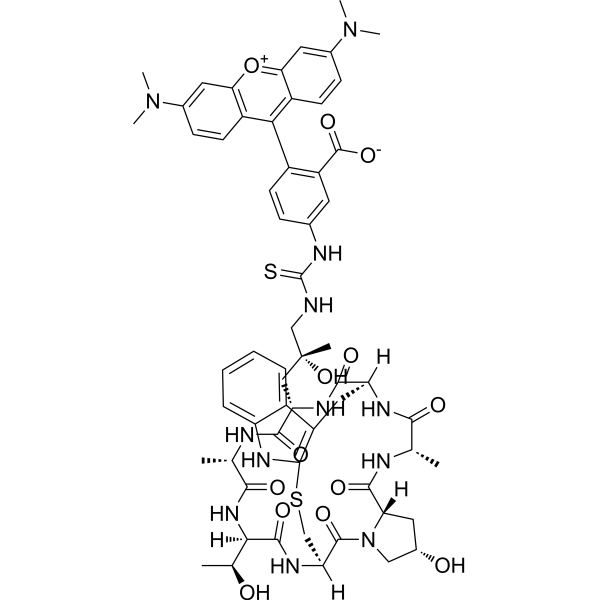
Physicochemical Properties
| Molecular Formula | C60H70N12O13S2 |
| Molecular Weight | 1231.400411129 |
| Exact Mass | 1230.462 |
| CAS # | 915013-10-4 |
| PubChem CID | 44140594 |
| Appearance | Purple to purplish red solid powder |
| LogP | 2.3 |
| Hydrogen Bond Donor Count | 12 |
| Hydrogen Bond Acceptor Count | 17 |
| Rotatable Bond Count | 8 |
| Heavy Atom Count | 87 |
| Complexity | 2780 |
| Defined Atom Stereocenter Count | 10 |
| SMILES | N(C)(C1=CC2=[O+]C3C=C(N(C)C)C=CC=3C(C3C=CC(NC(=S)NC[C@@](O)(C)C[C@@H]4NC(=O)[C@]5(NC([C@H](C)NC(=O)C6C[C@@H](CN6C(C(CSC6NC7C(=CC=CC=7)C=6C5)NC(=O)[C@@]([H])([C@@H](O)C)NC(=O)[C@H](C)NC4=O)=O)O)=O)[H])=CC=3C([O-])=O)=C2C=C1)C |
| InChi Key | VXNOAAMNRGBZOQ-RUTQKCGOSA-N |
| InChi Code | InChI=1S/C60H70N12O13S2/c1-28-50(75)65-42-23-39-35-11-9-10-12-41(35)68-56(39)87-26-44(57(81)72-25-34(74)22-45(72)54(79)63-28)67-55(80)49(30(3)73)69-51(76)29(2)62-53(78)43(66-52(42)77)24-60(4,84)27-61-59(86)64-31-13-16-36(40(19-31)58(82)83)48-37-17-14-32(70(5)6)20-46(37)85-47-21-33(71(7)8)15-18-38(47)48/h9-21,28-30,34,42-45,49,68,73-74,84H,22-27H2,1-8H3,(H,61,86)(H,62,78)(H,63,79)(H,65,75)(H,66,77)(H,67,80)(H,69,76)(H,82,83)/b64-31+/t28-,29-,30-,34-,42-,43-,44-,45-,49+,60+/m0/s1 |
| Chemical Name | (3E)-6-[3,6-bis(dimethylamino)xanthen-9-ylidene]-3-[[(2R)-2-hydroxy-3-[(1S,14R,18S,20S,23S,28S,31S,34R)-18-hydroxy-34-[(1S)-1-hydroxyethyl]-23,31-dimethyl-15,21,24,26,29,32,35-heptaoxo-12-thia-10,16,22,25,27,30,33,36-octazapentacyclo[12.11.11.03,11.04,9.016,20]hexatriaconta-3(11),4,6,8-tetraen-28-yl]-2-methylpropyl]carbamothioylimino]cyclohexa-1,4-diene-1-carboxylic acid |
| Synonyms | Rhodamine-phalloidin; 915013-10-4; starbld0003102; CHEBI:52313 |
| HS Tariff Code | 2934.99.9001 |
| Storage |
Powder-20°C 3 years 4°C 2 years In solvent -80°C 6 months -20°C 1 month Note: Please store this product in a sealed and protected environment (e.g. under nitrogen), avoid exposure to moisture and light. |
| Shipping Condition | Room temperature (This product is stable at ambient temperature for a few days during ordinary shipping and time spent in Customs) |
Biological Activity
| Targets | Fluorescent dye |
| ln Vitro |
1.1 Stock solution preparation Prepare a 1 mM stock solution using DMSO as the solvent. 1.2 Working solution preparation Dilute the stock solution with pre-warmed serum-free medium or PBS buffer to a final concentration of 200-1000 nM. Note: Adjust the working solution concentration according to experimental requirements, and prepare fresh before use. 2.1 Cell pretreatment For suspension cells: Collect cells by centrifugation, then wash twice with PBS (5 minutes each time). For adherent cells: Remove culture medium, digest cells with trypsin, centrifuge to remove supernatant, then wash twice with PBS (5 minutes each time). 2.2 Staining procedure Add 1 mL of prepared Phalloidin-TRITC working solution and incubate at room temperature in the dark for 5-10 minutes. 2.3 Post-treatment steps Centrifuge at 400g for 3-4 minutes at 4°C, then discard the staining solution. Wash cells twice with PBS (5 minutes each time). Finally, resuspend cells in 1 mL of serum-free medium or PBS. 2.4 Observation and detection Observe and analyze the stained cells using a fluorescence microscope. |
| Cell Assay | Phalloidin, the toxic drug from the mushroom Amanita phalloides, was injected into the cytoplasm of tissue culture cells and the changes in intracellular actin distribution were followed by immunofluorescence microscopy with actin antibody. At low concentrations, phalloidin recruits the non- or less highly polymerized forms of cytoplasmic actin into stable "islands" of aggregated actin polymers and does not interfere with the preexisting thick bundles of microfilaments (stress fibers). Differential focusing shows that these islands of phalloidin-induced actin polymers occur at a level in the cytoplasm that is above the submembranous bundles of microfilaments present on the adhesive side of the cells. The pattern of cytoplasmic microtubules remains unaffected by the injection of phalloidin; however, filamin, a protein usually associated with actin in the cytoplasm, is also recruited into the islands. At higher phalloidin concentrations, contraction of the cell is observed. These results are discussed in the light of previous biochemical studies by Wieland and Faulstich and their coworkers [for a review see Wieland, T. (1977) Naturwissenschaften 64, 303-309] on the in vitro interaction of phalloidin with muscle actin, which have documented that phalloidin reacts stoichiometrically with actin, promotes actin polymerization, and stabilizes actin polymers. In addition, we show that microinjection of phalloidin interferes in a concentration-dependent manner with cell locomotion and cell growth. These results indicate that a well-balanced controlled reversible equilibrium between different polymerization states of actin may be a necessary requirement for cell locomotion and may also influence other cellular functions such as growth [2]. |
| References |
[1]. Effects of cytochalasin and phalloidin on actin. J Cell Biol. 1987 Oct;105(4):1473-8. [2]. Phalloidin-induced actin polymerization in the cytoplasm of cultured cells interferes with cell locomotion and growth. Proc Natl Acad Sci U S A. 1977 Dec;74(12):5613-7. |
| Additional Infomation | Tetramethylrhodamine phalloidin is a tetramethylrhodium dye conjugated to the bicyclic peptide phalloidin via a thiourea linkage. It has a role as a fluorochrome. It is functionally related to a phalloidin and a tetramethylrhodamine. |
Solubility Data
| Solubility (In Vitro) | May dissolve in DMSO (in most cases), if not, try other solvents such as H2O, Ethanol, or DMF with a minute amount of products to avoid loss of samples |
| Solubility (In Vivo) |
Note: Listed below are some common formulations that may be used to formulate products with low water solubility (e.g. < 1 mg/mL), you may test these formulations using a minute amount of products to avoid loss of samples. Injection Formulations (e.g. IP/IV/IM/SC) Injection Formulation 1: DMSO : Tween 80: Saline = 10 : 5 : 85 (i.e. 100 μL DMSO stock solution → 50 μL Tween 80 → 850 μL Saline) *Preparation of saline: Dissolve 0.9 g of sodium chloride in 100 mL ddH ₂ O to obtain a clear solution. Injection Formulation 2: DMSO : PEG300 :Tween 80 : Saline = 10 : 40 : 5 : 45 (i.e. 100 μL DMSO → 400 μLPEG300 → 50 μL Tween 80 → 450 μL Saline) Injection Formulation 3: DMSO : Corn oil = 10 : 90 (i.e. 100 μL DMSO → 900 μL Corn oil) Example: Take the Injection Formulation 3 (DMSO : Corn oil = 10 : 90) as an example, if 1 mL of 2.5 mg/mL working solution is to be prepared, you can take 100 μL 25 mg/mL DMSO stock solution and add to 900 μL corn oil, mix well to obtain a clear or suspension solution (2.5 mg/mL, ready for use in animals). Injection Formulation 4: DMSO : 20% SBE-β-CD in saline = 10 : 90 [i.e. 100 μL DMSO → 900 μL (20% SBE-β-CD in saline)] *Preparation of 20% SBE-β-CD in Saline (4°C,1 week): Dissolve 2 g SBE-β-CD in 10 mL saline to obtain a clear solution. Injection Formulation 5: 2-Hydroxypropyl-β-cyclodextrin : Saline = 50 : 50 (i.e. 500 μL 2-Hydroxypropyl-β-cyclodextrin → 500 μL Saline) Injection Formulation 6: DMSO : PEG300 : castor oil : Saline = 5 : 10 : 20 : 65 (i.e. 50 μL DMSO → 100 μLPEG300 → 200 μL castor oil → 650 μL Saline) Injection Formulation 7: Ethanol : Cremophor : Saline = 10: 10 : 80 (i.e. 100 μL Ethanol → 100 μL Cremophor → 800 μL Saline) Injection Formulation 8: Dissolve in Cremophor/Ethanol (50 : 50), then diluted by Saline Injection Formulation 9: EtOH : Corn oil = 10 : 90 (i.e. 100 μL EtOH → 900 μL Corn oil) Injection Formulation 10: EtOH : PEG300:Tween 80 : Saline = 10 : 40 : 5 : 45 (i.e. 100 μL EtOH → 400 μLPEG300 → 50 μL Tween 80 → 450 μL Saline) Oral Formulations Oral Formulation 1: Suspend in 0.5% CMC Na (carboxymethylcellulose sodium) Oral Formulation 2: Suspend in 0.5% Carboxymethyl cellulose Example: Take the Oral Formulation 1 (Suspend in 0.5% CMC Na) as an example, if 100 mL of 2.5 mg/mL working solution is to be prepared, you can first prepare 0.5% CMC Na solution by measuring 0.5 g CMC Na and dissolve it in 100 mL ddH2O to obtain a clear solution; then add 250 mg of the product to 100 mL 0.5% CMC Na solution, to make the suspension solution (2.5 mg/mL, ready for use in animals). Oral Formulation 3: Dissolved in PEG400 Oral Formulation 4: Suspend in 0.2% Carboxymethyl cellulose Oral Formulation 5: Dissolve in 0.25% Tween 80 and 0.5% Carboxymethyl cellulose Oral Formulation 6: Mixing with food powders Note: Please be aware that the above formulations are for reference only. InvivoChem strongly recommends customers to read literature methods/protocols carefully before determining which formulation you should use for in vivo studies, as different compounds have different solubility properties and have to be formulated differently. (Please use freshly prepared in vivo formulations for optimal results.) |
| Preparing Stock Solutions | 1 mg | 5 mg | 10 mg | |
| 1 mM | 0.8121 mL | 4.0604 mL | 8.1208 mL | |
| 5 mM | 0.1624 mL | 0.8121 mL | 1.6242 mL | |
| 10 mM | 0.0812 mL | 0.4060 mL | 0.8121 mL |