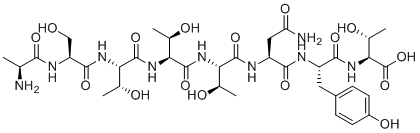
Physicochemical Properties
| Molecular Formula | C35H55N9O16 |
| Molecular Weight | 857.861900000001 |
| Exact Mass | 857.377 |
| CAS # | 106362-32-7 |
| Related CAS # | Peptide T TFA;1610056-01-3 |
| PubChem CID | 73352 |
| Appearance | White to off-white solid powder |
| Vapour Pressure | 0mmHg at 25°C |
| LogP | -8.6 |
| Hydrogen Bond Donor Count | 16 |
| Hydrogen Bond Acceptor Count | 17 |
| Rotatable Bond Count | 24 |
| Heavy Atom Count | 60 |
| Complexity | 1530 |
| Defined Atom Stereocenter Count | 12 |
| SMILES | C[C@H]([C@@H](C(=O)N[C@@H]([C@@H](C)O)C(=O)N[C@@H]([C@@H](C)O)C(=O)N[C@@H](CC(=O)N)C(=O)N[C@@H](CC1=CC=C(C=C1)O)C(=O)N[C@@H]([C@@H](C)O)C(=O)O)NC(=O)[C@H](CO)NC(=O)[C@H](C)N)O |
| InChi Key | IWHCAJPPWOMXNW-LYKMMFCUSA-N |
| InChi Code | InChI=1S/C35H55N9O16/c1-13(36)28(52)40-22(12-45)31(55)41-25(15(3)47)33(57)43-26(16(4)48)34(58)42-24(14(2)46)32(56)39-21(11-23(37)51)29(53)38-20(10-18-6-8-19(50)9-7-18)30(54)44-27(17(5)49)35(59)60/h6-9,13-17,20-22,24-27,45-50H,10-12,36H2,1-5H3,(H2,37,51)(H,38,53)(H,39,56)(H,40,52)(H,41,55)(H,42,58)(H,43,57)(H,44,54)(H,59,60)/t13-,14+,15+,16+,17+,20-,21-,22-,24-,25-,26-,27-/m0/s1 |
| Chemical Name | (2S,3R)-2-[[(2S)-2-[[(2S)-4-amino-2-[[(2S,3R)-2-[[(2S,3R)-2-[[(2S,3R)-2-[[(2S)-2-[[(2S)-2-aminopropanoyl]amino]-3-hydroxypropanoyl]amino]-3-hydroxybutanoyl]amino]-3-hydroxybutanoyl]amino]-3-hydroxybutanoyl]amino]-4-oxobutanoyl]amino]-3-(4-hydroxyphenyl)propanoyl]amino]-3-hydroxybutanoic acid |
| HS Tariff Code | 2934.99.9001 |
| Storage |
Powder-20°C 3 years 4°C 2 years In solvent -80°C 6 months -20°C 1 month Note: Please store this product in a sealed and protected environment, avoid exposure to moisture. |
| Shipping Condition | Room temperature (This product is stable at ambient temperature for a few days during ordinary shipping and time spent in Customs) |
Biological Activity
| ln Vitro | Using HIV virions pseudotyped with the ADA envelope, peptide T inhibits viral entry in the MAGI cell assay and prevents infection in the luciferase reporter experiment. Peptide T, in contrast to CXC4, exclusively inhibits HIV replication by binding to the chemokine receptor CCR5 [2]. Human Th2 cell lines and PBMC produce IL-10 when exposed to peptide T at a concentration of 10-8 M. Additionally, the generation of IFN-g by PBMC was markedly suppressed by peptide T at a dose of 10-9 M [3]. |
| ln Vivo | Subcutaneous injections of T-peptide are administered at varying doses and stages of experimental autoimmune encephalomyelitis (EAE) disease; nevertheless, T-peptide is not able to prevent or treat EAE [4]. |
| References |
[1]. Peptide T[4-8] is core HIV envelope sequence required for CD4 receptor attachment. Lancet. 1987 Sep 26;2(8561):751. [2]. Peptide T inhibits HIV-1 infection mediated by the chemokine receptor-5 (CCR5). Antiviral Res. 2001 Oct;52(1):63-75. [3]. Immunomodulatory effects of peptide T on Th 1/Th 2 cytokines. Int J Immunopharmacol. 1999 Sep;21(9):609-15. [4]. Peptide T does not ameliorate experimental autoimmune encephalomyelitis (EAE) in Lewis rats. Clin Exp Immunol. 2000 Jul;121(1):151-6. |
| Additional Infomation | N-(N-(N(2)-(N-(N-(N-(N-D-Alanyl L-seryl)-L-threonyl)-L-threonyl) L-threonyl)-L-asparaginyl)-L-tyrosyl) L-threonine. Octapeptide sharing sequence homology with HIV envelope protein gp120. It is potentially useful as antiviral agent in AIDS therapy. The core pentapeptide sequence, TTNYT, consisting of amino acids 4-8 in peptide T, is the HIV envelope sequence required for attachment to the CD4 receptor. |
Solubility Data
| Solubility (In Vitro) | H2O : ~100 mg/mL (~116.57 mM) |
| Solubility (In Vivo) |
Note: Listed below are some common formulations that may be used to formulate products with low water solubility (e.g. < 1 mg/mL), you may test these formulations using a minute amount of products to avoid loss of samples. Injection Formulations (e.g. IP/IV/IM/SC) Injection Formulation 1: DMSO : Tween 80: Saline = 10 : 5 : 85 (i.e. 100 μL DMSO stock solution → 50 μL Tween 80 → 850 μL Saline) *Preparation of saline: Dissolve 0.9 g of sodium chloride in 100 mL ddH ₂ O to obtain a clear solution. Injection Formulation 2: DMSO : PEG300 :Tween 80 : Saline = 10 : 40 : 5 : 45 (i.e. 100 μL DMSO → 400 μLPEG300 → 50 μL Tween 80 → 450 μL Saline) Injection Formulation 3: DMSO : Corn oil = 10 : 90 (i.e. 100 μL DMSO → 900 μL Corn oil) Example: Take the Injection Formulation 3 (DMSO : Corn oil = 10 : 90) as an example, if 1 mL of 2.5 mg/mL working solution is to be prepared, you can take 100 μL 25 mg/mL DMSO stock solution and add to 900 μL corn oil, mix well to obtain a clear or suspension solution (2.5 mg/mL, ready for use in animals). Injection Formulation 4: DMSO : 20% SBE-β-CD in saline = 10 : 90 [i.e. 100 μL DMSO → 900 μL (20% SBE-β-CD in saline)] *Preparation of 20% SBE-β-CD in Saline (4°C,1 week): Dissolve 2 g SBE-β-CD in 10 mL saline to obtain a clear solution. Injection Formulation 5: 2-Hydroxypropyl-β-cyclodextrin : Saline = 50 : 50 (i.e. 500 μL 2-Hydroxypropyl-β-cyclodextrin → 500 μL Saline) Injection Formulation 6: DMSO : PEG300 : castor oil : Saline = 5 : 10 : 20 : 65 (i.e. 50 μL DMSO → 100 μLPEG300 → 200 μL castor oil → 650 μL Saline) Injection Formulation 7: Ethanol : Cremophor : Saline = 10: 10 : 80 (i.e. 100 μL Ethanol → 100 μL Cremophor → 800 μL Saline) Injection Formulation 8: Dissolve in Cremophor/Ethanol (50 : 50), then diluted by Saline Injection Formulation 9: EtOH : Corn oil = 10 : 90 (i.e. 100 μL EtOH → 900 μL Corn oil) Injection Formulation 10: EtOH : PEG300:Tween 80 : Saline = 10 : 40 : 5 : 45 (i.e. 100 μL EtOH → 400 μLPEG300 → 50 μL Tween 80 → 450 μL Saline) Oral Formulations Oral Formulation 1: Suspend in 0.5% CMC Na (carboxymethylcellulose sodium) Oral Formulation 2: Suspend in 0.5% Carboxymethyl cellulose Example: Take the Oral Formulation 1 (Suspend in 0.5% CMC Na) as an example, if 100 mL of 2.5 mg/mL working solution is to be prepared, you can first prepare 0.5% CMC Na solution by measuring 0.5 g CMC Na and dissolve it in 100 mL ddH2O to obtain a clear solution; then add 250 mg of the product to 100 mL 0.5% CMC Na solution, to make the suspension solution (2.5 mg/mL, ready for use in animals). Oral Formulation 3: Dissolved in PEG400 Oral Formulation 4: Suspend in 0.2% Carboxymethyl cellulose Oral Formulation 5: Dissolve in 0.25% Tween 80 and 0.5% Carboxymethyl cellulose Oral Formulation 6: Mixing with food powders Note: Please be aware that the above formulations are for reference only. InvivoChem strongly recommends customers to read literature methods/protocols carefully before determining which formulation you should use for in vivo studies, as different compounds have different solubility properties and have to be formulated differently. (Please use freshly prepared in vivo formulations for optimal results.) |
| Preparing Stock Solutions | 1 mg | 5 mg | 10 mg | |
| 1 mM | 1.1657 mL | 5.8285 mL | 11.6569 mL | |
| 5 mM | 0.2331 mL | 1.1657 mL | 2.3314 mL | |
| 10 mM | 0.1166 mL | 0.5828 mL | 1.1657 mL |