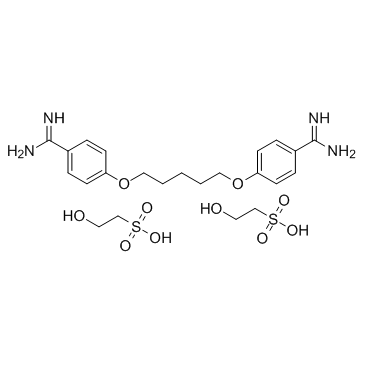
Description: Pentamidine Isethionate (MP-601205; MP601205) is an antimicrobial and annticancer agent that interferes with DNA biosynthesis. It exhibits antitumor and antibacterial activities by inhibiting protein tyrosine phosphatases (PTPases) and phosphatase of regenerating liver (PRL). It can be potentially used for Gambian trypanosomiasis, antimony-resistant leishmaniasis, and Pneumocystis carinii pneumonia treatment.
Physicochemical Properties
| Molecular Formula | C23H36N4O10S2 |
| Molecular Weight | 592.68 |
| Exact Mass | 592.187 |
| CAS # | 140-64-7 |
| Related CAS # | Pentamidine;100-33-4;Pentamidine dihydrochloride;50357-45-4;Pentamidine dimesylate;6823-79-6 |
| PubChem CID | 8813 |
| Appearance | White to off-white solid powder |
| Boiling Point | 539.4ºC at 760mmHg |
| Melting Point | 188-194 °C(lit.) |
| Flash Point | 280ºC |
| Vapour Pressure | 1.06E-11mmHg at 25°C |
| LogP | 4.377 |
| Hydrogen Bond Donor Count | 8 |
| Hydrogen Bond Acceptor Count | 12 |
| Rotatable Bond Count | 14 |
| Heavy Atom Count | 39 |
| Complexity | 493 |
| Defined Atom Stereocenter Count | 0 |
| InChi Key | YBVNFKZSMZGRAD-UHFFFAOYSA-N |
| InChi Code | InChI=1S/C19H24N4O2.2C2H6O4S/c20-18(21)14-4-8-16(9-5-14)24-12-2-1-3-13-25-17-10-6-15(7-11-17)19(22)23;2*3-1-2-7(4,5)6/h4-11H,1-3,12-13H2,(H3,20,21)(H3,22,23);2*3H,1-2H2,(H,4,5,6) |
| Chemical Name | 4-[5-(4-carbamimidoylphenoxy)pentoxy]benzenecarboximidamide;2-hydroxyethanesulfonic acid |
| Synonyms | Pentamidine diisethionate Pentamidine isethionate salt Pentamidine Isethionate |
| HS Tariff Code | 2934.99.9001 |
| Storage |
Powder-20°C 3 years 4°C 2 years In solvent -80°C 6 months -20°C 1 month Note: Please store this product in a sealed and protected environment (e.g. under nitrogen), avoid exposure to moisture and light. |
| Shipping Condition | Room temperature (This product is stable at ambient temperature for a few days during ordinary shipping and time spent in Customs) |
Biological Activity
| ln Vitro | Diabetes growth is inhibited in a concentration-regulated manner by pentamidine isethionate (0-10 μg/mL; 6 days; WM9, DU145, C4-2, Hey, WM480, and A549 cells) treatment [1]. It was established how harmful pentamidine isethionate is to promastigotes of the animal parasite Leishmania fanum. Pentamidine ethanesulfonate exhibited 60 times more leishmanicidal activity than cisplatin following a 72-hour period of sterility. The inhibition of DNA synthesis and cell cycle signaling in the G2/M phase is the reason why pentamidine isethionate causes more programmed cell death (PCD) than cisplatin. The calf thymus DNA (CT-DNA) undergoes a conformational change in response to pentamidine isethionate binding that is consistent with the B-->A transition. Pentamidine isethionate is equivalent to ubiquitin and causes a 6% rise in the protein's β-sheet content [2]. |
| ln Vivo | Intracellular WM9 human melanoma growth is considerably inhibited by pentamidine isethionate (0.25 mg/mouse; intramuscular injection; once every 2 days; for 4 weeks; athymic nude mice) treatment [1]. |
| Cell Assay |
Cell Viability Assay[1] Cell Types: WM9, DU145, C4-2, Hey, WM480, and A549 cells Tested Concentrations: 0-10 µg/mL Incubation Duration: 6 days Experimental Results: Growth of all six cell lines in culture Inhibited in a concentration-dependent manner, with complete inhibition of cell line growth at 10 µg/mL. |
| Animal Protocol |
Animal/Disease Models: Athymic nude mice (6 weeks old) were injected with WM9 cells [1]. Doses: 0.25 mg/mouse. Route of Administration: intramuscularinjection; once every 2 days; for 4 consecutive weeks. Experimental Results: Dramatically inhibited the growth of WM9 human melanoma in nude mice. Growth in mice. |
| References |
[1]. Pentamidine is an inhibitor of PRL phosphatases with anticancer activity. Mol Cancer Ther. 2002 Dec;1(14):1255-64. [2]. Pentamidine is an antiparasitic and apoptotic drug that selectively modifies ubiquitin. Chem Biodivers, 2005. 2(10): p. 1387-400. [3]. Pentamidine: a review. Rev Infect Dis. 1985 Sep-Oct;7(5):625-34. [4]. Pentamidine: a drug to consider re-purposing in the targeted treatment of multi-drug resistant bacterial infections? J Lab Precis Med 2017;2:49. |
| Additional Infomation |
Pentamidine isethionate appears as odorless white or almost white crystals or powder. Odor also reported as a slight butyric odor. Very bitter taste. pH (5% aqueous solution) 4.5-6.5. (NTP, 1992) Pentamidine isethionate is an organosulfonate salt obtained by reaction of pentamidine with two equivalents of 2-hydroxyethylsulfonic acid. It has a role as a trypanocidal drug. It contains a pentamidinium(2+). Pentamidine isethionate is an antifungal prescription medicine approved by the U.S. Food and Drug Administration (FDA) for the treatment and prevention of Pneumocystis pneumonia (PCP). The FDA-approved uses for pentamidine isethionate depend on the dosage form of the drug. Specifically, pentamidine isethionate injection is approved to treat PCP, and pentamidine isethionate inhalant is approved to prevent PCP in people with HIV who are at high risk of developing PCP. PCP can be an opportunistic infection (OI) of HIV. Pentamidine Isethionate is a synthetic amidine derivative, Pentamidine Isethionate is an antiprotozoal and antifungal agent that appears to interact with the minor groove of AT-rich DNA regions of the pathogen genome, interfering with DNA replication and function. It is effective in the treatment of trypanosomiasis, leishmaniasis, some fungal infections, and Pneumocystis carinii pneumonia in HIV-infected patients. (NCI04) Antiprotozoal agent effective in trypanosomiasis, leishmaniasis, and some fungal infections; used in treatment of PNEUMOCYSTIS pneumonia in HIV-infected patients. It may cause diabetes mellitus, central nervous system damage, and other toxic effects. See also: Pentamidine (has active moiety). |
Solubility Data
| Solubility (In Vitro) |
H2O : ~100 mg/mL (~168.73 mM) DMSO : ~100 mg/mL (~168.73 mM) |
| Solubility (In Vivo) |
Solubility in Formulation 1: ≥ 2.08 mg/mL (3.51 mM) (saturation unknown) in 10% DMSO + 40% PEG300 + 5% Tween80 + 45% Saline (add these co-solvents sequentially from left to right, and one by one), clear solution. For example, if 1 mL of working solution is to be prepared, you can add 100 μL of 20.8 mg/mL clear DMSO stock solution to 400 μL PEG300 and mix evenly; then add 50 μL Tween-80 to the above solution and mix evenly; then add 450 μL normal saline to adjust the volume to 1 mL. Preparation of saline: Dissolve 0.9 g of sodium chloride in 100 mL ddH₂ O to obtain a clear solution. Solubility in Formulation 2: ≥ 2.08 mg/mL (3.51 mM) (saturation unknown) in 10% DMSO + 90% (20% SBE-β-CD in Saline) (add these co-solvents sequentially from left to right, and one by one), clear solution. For example, if 1 mL of working solution is to be prepared, you can add 100 μL of 20.8 mg/mL clear DMSO stock solution to 900 μL of 20% SBE-β-CD physiological saline solution and mix evenly. Preparation of 20% SBE-β-CD in Saline (4°C,1 week): Dissolve 2 g SBE-β-CD in 10 mL saline to obtain a clear solution. Solubility in Formulation 3: ≥ 2.08 mg/mL (3.51 mM) (saturation unknown) in 10% DMSO + 90% Corn Oil (add these co-solvents sequentially from left to right, and one by one), clear solution. For example, if 1 mL of working solution is to be prepared, you can add 100 μL of 20.8 mg/mL clear DMSO stock solution to 900 μL of corn oil and mix evenly. (Please use freshly prepared in vivo formulations for optimal results.) |
| Preparing Stock Solutions | 1 mg | 5 mg | 10 mg | |
| 1 mM | 1.6873 mL | 8.4363 mL | 16.8725 mL | |
| 5 mM | 0.3375 mL | 1.6873 mL | 3.3745 mL | |
| 10 mM | 0.1687 mL | 0.8436 mL | 1.6873 mL |