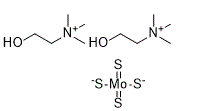
Bis-choline tetrathiomolybdate is a novel and potent inhibitor cytosolic superoxide dismutase (SOD1) with the potential for the treatment of Wilson's disease.
Physicochemical Properties
| Molecular Formula | C10H28MON2O2S4 |
| Molecular Weight | 434.5574 |
| Exact Mass | 436.024 |
| CAS # | 649749-10-0 |
| PubChem CID | 18442052 |
| Appearance | Pink to red solid powder |
| Hydrogen Bond Donor Count | 4 |
| Hydrogen Bond Acceptor Count | 6 |
| Rotatable Bond Count | 4 |
| Heavy Atom Count | 19 |
| Complexity | 65.7 |
| Defined Atom Stereocenter Count | 0 |
| SMILES | [Mo](=S)=S.[S-][H].[S-][H].O([H])C([H])([H])C([H])([H])[N+](C([H])([H])[H])(C([H])([H])[H])C([H])([H])[H].O([H])C([H])([H])C([H])([H])[N+](C([H])([H])[H])(C([H])([H])[H])C([H])([H])[H] |
| InChi Key | NEYVHGQOGHJAAD-UHFFFAOYSA-N |
| InChi Code | InChI=1S/2C5H14NO.Mo.4S/c2*1-6(2,3)4-5-7/h2*7H,4-5H2,1-3H3/q2*+12*-1 |
| Chemical Name | 2-hydroxy-N,N,N-trimethylethan-1-aminium tetrathiomolybdate |
| Synonyms | Bis-choline tetrathiomolybdate Decuprate ATN-224 ATN 224 ATN224 |
| HS Tariff Code | 2934.99.9001 |
| Storage |
Powder-20°C 3 years 4°C 2 years In solvent -80°C 6 months -20°C 1 month |
| Shipping Condition | Room temperature (This product is stable at ambient temperature for a few days during ordinary shipping and time spent in Customs) |
Biological Activity
| ln Vitro | According to isothermal titration calorimetry, ATN-224 has a high specific affinity for copper ions (108 mol/L-1) and does not bind calcium, iron, magnesium, zinc, or manganese ions at concentrations up to 1 mM. Both HUVECs' proliferation was decreased by ATN-224 (IC50=1.4±0.3 μM; n=5). Purified bovine SOD1 activity is also inhibited by ATN-224, with an IC50 of 0.33±0.03 μM during a 24-hour incubation period. The maximal inhibition of SOD1 by ATN-224 is reached after roughly 16 hours, and this effect is time-dependent. It seems that ATN-224 inhibits SOD1 by reducing copper enzyme levels. With an IC50 of 17.5±3.7 nM, ATN-224 can dose-dependently reduce SOD1 activity in endothelial cells. ATN-224 suppresses ERK1/2 phosphorylation produced by FGF-2 in a time- and dose-dependent manner; its IC50 ranges from 1.25 to 2.5 μM, which is in line with the IC50 for preventing proliferation [1]. ATN-224 is a tiny inorganic compound that can be taken orally that suppresses the activity of the copper/zinc-dependent enzyme superoxide dismutase 1 (Cu/Zn-SOD1) in tumor cells and endothelial cells [2]. |
| ln Vivo | In the mouse Matrigel plug model, ATN-224 also strongly (P<0.05) reduced angiogenesis when it was included into the plugs or given orally by gavage. Inhibition of angiogenesis happens prior to detectable copper depletion in the plasma or from the Matrigel plug when ATN-224 is given by oral gavage. This finding suggests that ATN-224 suppresses angiogenesis without requiring copper to be consumed [1]. |
| References |
[1]. Copper binding by tetrathiomolybdate attenuates angiogenesis and tumor cell proliferation through the inhibition of superoxide dismutase 1. Clin Cancer Res. 2006 Aug 15;12(16):4974-82. [2]. A non-comparative randomized phase II study of 2 doses of ATN-224, a copper/zinc superoxide dismutase inhibitor, in patients with biochemically recurrent hormone-na?ve prostate cancer. Urol Oncol. 2013 Jul;31(5):581-8. |
| Additional Infomation |
Tiomolibdate Choline is an orally active second generation tetrathiomolybdate analog with anti-angiogenic and antineoplastic activities. Tiomolibdate choline selectively chelates the copper ion in superoxide dismutase 1 (SOD1) in endothelial cells, thereby depleting SOD1 of copper and inhibiting its activity. Inhibition of SOD1 interferes with the activation of several signal transduction pathways required for cellular proliferation and angiogenesis, including those mediated by ERK1/2 and FAK and Src kinases. This results in an inhibition of cell proliferation and angiogenesis as well as induction of apoptosis. Drug Indication Treatment of Wilson Disease |
Solubility Data
| Solubility (In Vitro) | DMSO : ~50 mg/mL (~115.59 mM) |
| Solubility (In Vivo) |
Solubility in Formulation 1: ≥ 2.5 mg/mL (5.78 mM) (saturation unknown) in 10% DMSO + 40% PEG300 + 5% Tween80 + 45% Saline (add these co-solvents sequentially from left to right, and one by one), clear solution. For example, if 1 mL of working solution is to be prepared, you can add 100 μL of 25.0 mg/mL clear DMSO stock solution to 400 μL PEG300 and mix evenly; then add 50 μL Tween-80 to the above solution and mix evenly; then add 450 μL normal saline to adjust the volume to 1 mL. Preparation of saline: Dissolve 0.9 g of sodium chloride in 100 mL ddH₂ O to obtain a clear solution. Solubility in Formulation 2: ≥ 2.5 mg/mL (5.78 mM) (saturation unknown) in 10% DMSO + 90% (20% SBE-β-CD in Saline) (add these co-solvents sequentially from left to right, and one by one), clear solution. For example, if 1 mL of working solution is to be prepared, you can add 100 μL of 25.0 mg/mL clear DMSO stock solution to 900 μL of 20% SBE-β-CD physiological saline solution and mix evenly. Preparation of 20% SBE-β-CD in Saline (4°C,1 week): Dissolve 2 g SBE-β-CD in 10 mL saline to obtain a clear solution. (Please use freshly prepared in vivo formulations for optimal results.) |
| Preparing Stock Solutions | 1 mg | 5 mg | 10 mg | |
| 1 mM | 2.3012 mL | 11.5059 mL | 23.0118 mL | |
| 5 mM | 0.4602 mL | 2.3012 mL | 4.6024 mL | |
| 10 mM | 0.2301 mL | 1.1506 mL | 2.3012 mL |