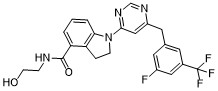
Physicochemical Properties
| Molecular Formula | C23H20F4N4O2 |
| Molecular Weight | 460.424118995667 |
| Exact Mass | 460.15 |
| Elemental Analysis | C, 60.00; H, 4.38; F, 16.50; N, 12.17; O, 6.95 |
| CAS # | 2624131-45-7 |
| PubChem CID | 155977949 |
| Appearance | Off-white to yellow solid powder |
| LogP | 3.8 |
| Hydrogen Bond Donor Count | 2 |
| Hydrogen Bond Acceptor Count | 9 |
| Rotatable Bond Count | 6 |
| Heavy Atom Count | 33 |
| Complexity | 667 |
| Defined Atom Stereocenter Count | 0 |
| InChi Key | OLNVWBLTVAPNME-UHFFFAOYSA-N |
| InChi Code | InChI=1S/C23H20F4N4O2/c24-16-9-14(8-15(11-16)23(25,26)27)10-17-12-21(30-13-29-17)31-6-4-18-19(2-1-3-20(18)31)22(33)28-5-7-32/h1-3,8-9,11-13,32H,4-7,10H2,(H,28,33) |
| Chemical Name | 1-(6-(3-fluoro-5-(trifluoromethyl)benzyl)pyrimidin-4-yl)-N-(2-hydroxyethyl)indoline-4-carboxamide |
| Synonyms | PW0787; PW 0787; PW-0787; |
| HS Tariff Code | 2934.99.9001 |
| Storage |
Powder-20°C 3 years 4°C 2 years In solvent -80°C 6 months -20°C 1 month Note: This product requires protection from light (avoid light exposure) during transportation and storage. |
| Shipping Condition | Room temperature (This product is stable at ambient temperature for a few days during ordinary shipping and time spent in Customs) |
Biological Activity
| ln Vivo | PW0787 (0.3, 1, 3 or 10 mg/kg; IP) displays antipsychotic-like activity by significantly inhibiting amphetamine-induced hyperlocomotor behavior in mice [1]. PW0787 was evaluated in rats following a single oral (PO) dose of 20 mg/kg or intravenous (IV) administration of 10 mg/kg. PW0787 has excellent plasma exposure after PO (AUC0-inf = 13,749 ng·h/mL) and IV administration (AUC0-inf=9030 ng·h/mL), as well as high post-PO maximum serum concentration (Cmax= 3407 ng/mL). mL) and IV administration (Cmax=6726 ng/mL). In addition, PW0787 showed good plasma volume of distribution (Vss=1.5 L/kg) and acceptable plasma clearance (CL=1.1 L/h/kg) after 10 mg/kg IV. Excellent oral bioavailability (F) was observed, with a value of 76% [1]. |
| Animal Protocol |
Animal/Disease Models: Naive male C57/BL6 black mouse weighing between 24 and 31 g Doses: 0.3, 1, 3 or 10 mg/kg (dissolve in 0.9% saline containing 20% HP-β-CD, adjust solution (final pH) to 7.4) Route of Administration: IP Experimental Results: Both the 3 mg/kg and 10 mg/kg doses inhibited amphetamine (AMPH)-induced horizontal activity. |
| References |
[1]. Discovery of Potent and Brain-Penetrant GPR52 Agonist that Suppresses Psychostimulant Behavior. J Med Chem. 2020;63(22):13951-13972. |
Solubility Data
| Solubility (In Vitro) | DMSO : ~50 mg/mL (~108.60 mM) |
| Solubility (In Vivo) |
Solubility in Formulation 1: ≥ 2.5 mg/mL (5.43 mM) (saturation unknown) in 10% DMSO + 40% PEG300 + 5% Tween80 + 45% Saline (add these co-solvents sequentially from left to right, and one by one), clear solution. For example, if 1 mL of working solution is to be prepared, you can add 100 μL of 25.0 mg/mL clear DMSO stock solution to 400 μL PEG300 and mix evenly; then add 50 μL Tween-80 to the above solution and mix evenly; then add 450 μL normal saline to adjust the volume to 1 mL. Preparation of saline: Dissolve 0.9 g of sodium chloride in 100 mL ddH₂ O to obtain a clear solution. Solubility in Formulation 2: ≥ 2.5 mg/mL (5.43 mM) (saturation unknown) in 10% DMSO + 90% Corn Oil (add these co-solvents sequentially from left to right, and one by one), clear solution. For example, if 1 mL of working solution is to be prepared, you can add 100 μL of 25.0 mg/mL clear DMSO stock solution to 900 μL of corn oil and mix evenly. (Please use freshly prepared in vivo formulations for optimal results.) |
| Preparing Stock Solutions | 1 mg | 5 mg | 10 mg | |
| 1 mM | 2.1719 mL | 10.8596 mL | 21.7193 mL | |
| 5 mM | 0.4344 mL | 2.1719 mL | 4.3439 mL | |
| 10 mM | 0.2172 mL | 1.0860 mL | 2.1719 mL |