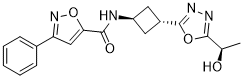
PTI-428 is a novel, potent CFTR amplifier being developed byProteostasis Therapeutics, Inc. for the treatment of CF in patients who are homozygous for the F508del mutation in the CFTR gene as an add-on therapy to approved CFTR modulators or as part of PTI’s proprietary triple combination regimen that includes PTI-808, a potentiator, and PTI-801, a corrector. PTI-428 works early during CFTR biogenesis to increase levels of newly synthesized CFTR protein, suggesting potential therapeutic benefits in combination with CFTR correctors and potentiators. TheU.S. Food and Drug Administration(FDA) has granted Breakthrough Therapy Designation for PTI-428, the Company’s cystic fibrosis transmembrane conductance regulator (CFTR) amplifier.
Physicochemical Properties
| Molecular Formula | C18H18N4O4 |
| Molecular Weight | 354.359923839569 |
| Exact Mass | 354.132 |
| CAS # | 1953130-87-4 |
| Related CAS # | 1953130-87-4; |
| PubChem CID | 121439966 |
| Appearance | White to off-white solid powder |
| LogP | 1.4 |
| Hydrogen Bond Donor Count | 2 |
| Hydrogen Bond Acceptor Count | 7 |
| Rotatable Bond Count | 5 |
| Heavy Atom Count | 26 |
| Complexity | 496 |
| Defined Atom Stereocenter Count | 1 |
| SMILES | O1C([C@@H](C)O)=NN=C1C1CC(C1)NC(C1=CC(C2C=CC=CC=2)=NO1)=O |
| InChi Key | XPEHHUISIBFLHX-QFWMXSHPSA-N |
| InChi Code | InChI=1S/C18H18N4O4/c1-10(23)17-20-21-18(25-17)12-7-13(8-12)19-16(24)15-9-14(22-26-15)11-5-3-2-4-6-11/h2-6,9-10,12-13,23H,7-8H2,1H3,(H,19,24)/t10-,12?,13?/m1/s1 |
| Chemical Name | N-[3-[5-[(1R)-1-hydroxyethyl]-1,3,4-oxadiazol-2-yl]cyclobutyl]-3-phenyl-1,2-oxazole-5-carboxamide |
| Synonyms | PTI-428; PTI 428; PTI428 |
| HS Tariff Code | 2934.99.9001 |
| Storage |
Powder-20°C 3 years 4°C 2 years In solvent -80°C 6 months -20°C 1 month |
| Shipping Condition | Room temperature (This product is stable at ambient temperature for a few days during ordinary shipping and time spent in Customs) |
Biological Activity
| Targets |
PTI-428 targets the ribosomal machinery to promote nonsense mutation readthrough of the cystic fibrosis transmembrane conductance regulator (CFTR) gene/protein [2] PTI-428 acts on CFTR proteins carrying nonsense mutations (e.g., G542X, W1282X) by restoring full-length CFTR protein expression and function [2] |
| ln Vitro |
Nesolicaftor (PTI-428) (30 µM, 24 h) can enhance CFTR function. For example, it can significantly alter inh-172 in 16HBE14o cells that express G542X-CFTR and enhance F508del-CFTR function in CFBE41o cells. Dose dependence is observed in F508del-CFTR [2]. 1. In human bronchial epithelial (HBE) cells expressing CFTR-G542X nonsense mutation, PTI-428 (5 μM) alone induces a modest increase in CFTR channel function (measured by Ussing chamber assay), with a change in short-circuit current (ΔIsc) of ~5 μA/cm²; combination with the CFTR corrector VX-809 (3 μM) and potentiator VX-770 (1 μM) significantly enhances CFTR function, with ΔIsc reaching ~15 μA/cm² [2] 2. In HBE cells expressing CFTR-W1282X nonsense mutation, PTI-428 (5 μM) alone has minimal effect on CFTR channel function (ΔIsc < 3 μA/cm²), but combination with VX-809 (3 μM) and VX-770 (1 μM) increases ΔIsc to ~10 μA/cm² [2] 3. PTI-428 (1–10 μM) dose-dependently increases the expression of full-length CFTR protein in CFTR-G542X transfected HEK293 cells (detected by Western blot), with maximal expression at 5 μM; no significant increase in CFTR mRNA levels is observed, confirming its action via translational readthrough rather than transcriptional upregulation [2] 4. Co-treatment of PTI-428 (5 μM) with the aminoglycoside gentamicin (100 μM) in CFTR-G542X HBE cells shows additive effects on CFTR readthrough and channel function, with ΔIsc increasing to ~20 μA/cm² [2] |
| Cell Assay |
1. CFTR channel function assay in HBE cells (Ussing chamber): Primary human bronchial epithelial cells expressing CFTR-G542X or W1282X nonsense mutations were cultured on permeable supports until confluent and differentiated into a polarized monolayer. Cells were pre-treated with PTI-428 (5 μM) alone or in combination with VX-809 (3 μM) and VX-770 (1 μM) for 48 hours. The short-circuit current (Isc) was measured using an Ussing chamber system, with sequential addition of forskolin (10 μM) and IBMX (100 μM) to activate CFTR, and CFTRinh-172 (10 μM) to inhibit CFTR-specific current; the change in Isc (ΔIsc) was calculated to quantify CFTR channel function [2] 2. CFTR protein expression Western blot assay in HEK293 cells: HEK293 cells were transiently transfected with a plasmid encoding CFTR-G542X. After 24 hours of transfection, cells were treated with different concentrations of PTI-428 (1–10 μM) for 24 hours. Cells were lysed, and protein extracts were separated by SDS-PAGE, transferred to a membrane, and probed with anti-CFTR and anti-GAPDH (loading control) antibodies. Band intensity was quantified by densitometry to assess full-length CFTR protein expression; RT-qPCR was performed to measure CFTR mRNA levels and rule out transcriptional effects [2] 3. Combination drug treatment assay in HBE cells: CFTR-G542X HBE cells were cultured as polarized monolayers and treated with PTI-428 (5 μM) in combination with gentamicin (100 μM), VX-809 (3 μM), and VX-770 (1 μM) for 48 hours. CFTR channel function was assessed by Ussing chamber assay as described above, and the additive effects of combined drugs on ΔIsc were calculated and compared with single-drug treatment [2] |
| References |
[1]. Correcting CFTR folding defects by small-molecule correctors to cure cystic fibrosis. Curr Opin Pharmacol. 2017 Jun;34:83-90. [2]. Comprehensive Analysis of Combinatorial Pharmacological Treatments to Correct Nonsense Mutations in the CFTR Gene. Int J Mol Sci. 2021 Nov 4;22(21):11972. |
| Additional Infomation |
Nesolicaftor (PTI-428) is under investigation in clinical trial NCT03258424 (Study Assessing PTI-428 Safety, Tolerability, and Pharmacokinetics in Subjects With Cystic Fibrosis on KALYDECO® as Background Therapy). 1. PTI-428 is a small-molecule nonsense mutation readthrough agent developed for the treatment of cystic fibrosis (CF) caused by nonsense mutations in the CFTR gene [2] 2. PTI-428 exerts its therapeutic effect by promoting ribosomal readthrough of premature termination codons (PTCs) in the CFTR mRNA, thereby restoring the synthesis of full-length, functional CFTR protein [2] 3. PTI-428 shows synergistic effects with CFTR correctors (e.g., VX-809) and potentiators (e.g., VX-770), as well as aminoglycoside antibiotics (e.g., gentamicin), in restoring CFTR function in CF models with nonsense mutations [2] 4. PTI-428 is part of a new generation of non-aminoglycoside readthrough agents with improved potency and selectivity for CFTR nonsense mutations compared to traditional aminoglycosides [2] 5. Nonsense mutations in CFTR (e.g., G542X, W1282X) account for ~10% of all CF-causing mutations, and PTI-428 is a promising candidate for treating this subset of CF patients [1][2] |
Solubility Data
| Solubility (In Vitro) | DMSO:10 mM Water:N/A Ethanol:N/A |
| Solubility (In Vivo) |
Solubility in Formulation 1: ≥ 2.08 mg/mL (5.87 mM) (saturation unknown) in 10% DMSO + 40% PEG300 + 5% Tween80 + 45% Saline (add these co-solvents sequentially from left to right, and one by one), clear solution. For example, if 1 mL of working solution is to be prepared, you can add 100 μL of 20.8 mg/mL clear DMSO stock solution to 400 μL PEG300 and mix evenly; then add 50 μL Tween-80 to the above solution and mix evenly; then add 450 μL normal saline to adjust the volume to 1 mL. Preparation of saline: Dissolve 0.9 g of sodium chloride in 100 mL ddH₂ O to obtain a clear solution. Solubility in Formulation 2: ≥ 2.08 mg/mL (5.87 mM) (saturation unknown) in 10% DMSO + 90% (20% SBE-β-CD in Saline) (add these co-solvents sequentially from left to right, and one by one), clear solution. For example, if 1 mL of working solution is to be prepared, you can add 100 μL of 20.8 mg/mL clear DMSO stock solution to 900 μL of 20% SBE-β-CD physiological saline solution and mix evenly. Preparation of 20% SBE-β-CD in Saline (4°C,1 week): Dissolve 2 g SBE-β-CD in 10 mL saline to obtain a clear solution. Solubility in Formulation 3: ≥ 2.08 mg/mL (5.87 mM) (saturation unknown) in 10% DMSO + 90% Corn Oil (add these co-solvents sequentially from left to right, and one by one), clear solution. For example, if 1 mL of working solution is to be prepared, you can add 100 μL of 20.8 mg/mL clear DMSO stock solution to 900 μL of corn oil and mix evenly. (Please use freshly prepared in vivo formulations for optimal results.) |
| Preparing Stock Solutions | 1 mg | 5 mg | 10 mg | |
| 1 mM | 2.8220 mL | 14.1099 mL | 28.2199 mL | |
| 5 mM | 0.5644 mL | 2.8220 mL | 5.6440 mL | |
| 10 mM | 0.2822 mL | 1.4110 mL | 2.8220 mL |