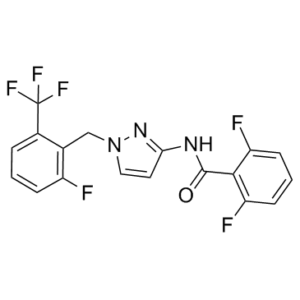
GSK-5498A is a novel, potent and selective small molecule blocker of Calcium-Release Activated Calcium (CRAC) channel with IC50 of 1 uM; It inhibits mediator release from mast cells, and pro-inflammatory cytokine release from T-cells in a variety of species. Loss of function mutations in the two key proteins which constitute Calcium-Release Activated Calcium (CRAC) channels demonstrate the critical role of this ion channel in immune cell function. GSK-5498A was tested to demonstrate their ability to inhibit mediator release from mast cells, and pro-inflammatory cytokine release from T-cells in a variety of species. GSK-5498A completely inhibited calcium influx through CRAC channels. This led to inhibition of the release of mast cell mediators and T-cell cytokines from multiple human and rat preparations. Mast cells from guinea-pig and mouse preparations were not inhibited by GSK-5498A; however cytokine release was fully blocked from T-cells in a mouse preparation. GSK-5498A confirmed the critical role of CRAC channels in human mast cell and T-cell function, and that inhibition can be achieved in vitro. The rat displays a similar pharmacology to human, promoting this species for future in vivo research with this series of molecules. Together these observations provide a critical forward step in the identification of CRAC blockers suitable for clinical development in the treatment of inflammatory disorders.
Physicochemical Properties
| Molecular Formula | C18H11F6N3O |
| Molecular Weight | 399.2899 |
| Exact Mass | 399.08 |
| CAS # | 1253186-49-0 |
| PubChem CID | 46945384 |
| Appearance | White to off-white solid powder |
| Density | 1.4±0.1 g/cm3 |
| Boiling Point | 403.3±45.0 °C at 760 mmHg |
| Flash Point | 197.7±28.7 °C |
| Vapour Pressure | 0.0±0.9 mmHg at 25°C |
| Index of Refraction | 1.552 |
| LogP | 2.62 |
| Hydrogen Bond Donor Count | 1 |
| Hydrogen Bond Acceptor Count | 8 |
| Rotatable Bond Count | 4 |
| Heavy Atom Count | 28 |
| Complexity | 538 |
| Defined Atom Stereocenter Count | 0 |
| InChi Key | AUBGZAJDHUHMAE-UHFFFAOYSA-N |
| InChi Code | InChI=1S/C18H11F6N3O/c19-12-4-1-3-11(18(22,23)24)10(12)9-27-8-7-15(26-27)25-17(28)16-13(20)5-2-6-14(16)21/h1-8H,9H2,(H,25,26,28) |
| Chemical Name | 2,6-difluoro-N-[1-[[2-fluoro-6-(trifluoromethyl)phenyl]methyl]pyrazol-3-yl]benzamide |
| Synonyms | GSK-5498A; GSK 5498A; GSK5498A |
| HS Tariff Code | 2934.99.9001 |
| Storage |
Powder-20°C 3 years 4°C 2 years In solvent -80°C 6 months -20°C 1 month |
| Shipping Condition | Room temperature (This product is stable at ambient temperature for a few days during ordinary shipping and time spent in Customs) |
Biological Activity
| Targets |
Calcium-Release Activated Calcium (CRAC) channels [1] |
| ln Vitro |
In human embryonic kidney cells, GSK-5498A (1 and 10 μM) blocks calcium influx through CRAC channels [1]. Using the calcium-sensitive dye Fluo4-AM, GSK-5498A (1 nM-10 μM) suppresses the thapsigargin-induced fluorescence signal in Jurkat cells (pIC50: 6.3) [1]. Cytostim-induced production of interferon-γ and IL-5 in PBMC is inhibited in a concentration-dependent manner by GSK-5498A (1 nM-10 μM) [1]. Rat tissue-resident mast cell degranulation is inhibited by GSK-5498A (1 μM–10 μM) [1]. In mice and rats, GSK-5498A (10 nM–10 μM) suppresses the release of T cell cytokines (IL-2) [1]. CRAC channels are more selectively bound by GSK-5498A (0-10 μM) than by other ion channels, enzymes, or G protein-coupled receptors [1]. 1. Calcium influx inhibition: GSK-5498A completely inhibited calcium influx through CRAC channels in immune cells from multiple species [1] 2. Mast cell mediator release inhibition: The drug effectively inhibited mediator release from mast cells isolated from human and rat preparations, while mast cells from guinea-pig and mouse preparations were not inhibited [1] 3. T-cell cytokine release inhibition: GSK-5498A fully blocked the release of pro-inflammatory cytokines from T-cells in human, rat, and mouse preparations [1] 4. Species-specific pharmacology: The pharmacology of GSK-5498A in rats was similar to that in humans, confirming the critical role of CRAC channels in human mast cell and T-cell function [1] |
| Enzyme Assay |
1. CRAC channel calcium influx detection assay: Immune cells (mast cells or T-cells) from human, rat, mouse, or guinea-pig were isolated and seeded in appropriate culture systems. Cells were loaded with a calcium-sensitive fluorescent probe and pretreated with GSK-5498A at specified concentrations. Calcium release was induced by appropriate stimuli to activate CRAC channels. The fluorescence intensity was monitored in real-time to measure calcium influx through CRAC channels, and the inhibitory effect of GSK-5498A was evaluated by comparing the fluorescence signal with the vehicle control group [1] |
| Cell Assay |
1. Mast cell mediator release assay: Mast cells were isolated from the tissues of human, rat, mouse, or guinea-pig. The cells were suspended in culture medium and pretreated with GSK-5498A for a certain period. Mast cell activation was induced by specific stimuli, and the cells were incubated for a specified time. The supernatant was collected, and the amount of released mediators was detected using relevant assay methods to assess the inhibitory effect of GSK-5498A [1] 2. T-cell pro-inflammatory cytokine release assay: T-cells were isolated from the spleen or other immune tissues of different species. The cells were activated with appropriate stimulants under culture conditions and treated with GSK-5498A simultaneously. After incubation for a certain period, the cell culture supernatant was collected. The concentration of pro-inflammatory cytokines in the supernatant was measured using specific detection methods to determine the inhibitory effect of GSK-5498A on cytokine release [1] |
| References |
[1]. Characterization of selective Calcium-Release Activated Calcium channel blockers in mast cells and T-cells from human, rat, mouse and guinea-pig preparations. Eur J Pharmacol. 2013 Mar 15;704(1-3):49-57. |
| Additional Infomation |
GSK-5498A is a member of the class of pyrazoles that is 1H-pyrazole substituted by 2-fluoro-6-(trifluoromethyl)benzyl and (2,6-difluorobenzoyl)amino groups at positions 1 and 3, respectively. It is a inhibitor of Ca(2+) release-activated Ca(2+) (CRAC) channel and inhibits the release of mast cell mediators and T-cell cytokines in human and rat preparations. It has a role as a calcium channel blocker. It is a member of pyrazoles, a secondary carboxamide, a difluorobenzene and a member of (trifluoromethyl)benzenes. 1. Drug classification and characteristics: GSK-5498A is a highly selective small-molecule blocker of CRAC channels [1] 2. Mechanism of action: The drug exerts its inhibitory effect on immune cell activation by completely blocking calcium influx through CRAC channels, which is critical for mast cell mediator release and T-cell pro-inflammatory cytokine production [1] 3. Therapeutic potential: GSK-5498A is a promising candidate for clinical development in the treatment of inflammatory disorders, as it effectively inhibits immune cell activation in vitro [1] 4. Preclinical research value: Rats display similar pharmacology to humans for GSK-5498A, making this species suitable for future in vivo research with this series of CRAC channel blockers [1] |
Solubility Data
| Solubility (In Vitro) | DMSO : ≥ 100 mg/mL (~250.44 mM) |
| Solubility (In Vivo) |
Solubility in Formulation 1: ≥ 3 mg/mL (7.51 mM) (saturation unknown) in 10% DMSO + 40% PEG300 + 5% Tween80 + 45% Saline (add these co-solvents sequentially from left to right, and one by one), clear solution. For example, if 1 mL of working solution is to be prepared, you can add 100 μL of 30.0 mg/mL clear DMSO stock solution to 400 μL PEG300 and mix evenly; then add 50 μL Tween-80 to the above solution and mix evenly; then add 450 μL normal saline to adjust the volume to 1 mL. Preparation of saline: Dissolve 0.9 g of sodium chloride in 100 mL ddH₂ O to obtain a clear solution. Solubility in Formulation 2: ≥ 3 mg/mL (7.51 mM) (saturation unknown) in 10% DMSO + 90% Corn Oil (add these co-solvents sequentially from left to right, and one by one), clear solution. For example, if 1 mL of working solution is to be prepared, you can add 100 μL of 30.0 mg/mL clear DMSO stock solution to 900 μL of corn oil and mix evenly. (Please use freshly prepared in vivo formulations for optimal results.) |
| Preparing Stock Solutions | 1 mg | 5 mg | 10 mg | |
| 1 mM | 2.5044 mL | 12.5222 mL | 25.0445 mL | |
| 5 mM | 0.5009 mL | 2.5044 mL | 5.0089 mL | |
| 10 mM | 0.2504 mL | 1.2522 mL | 2.5044 mL |