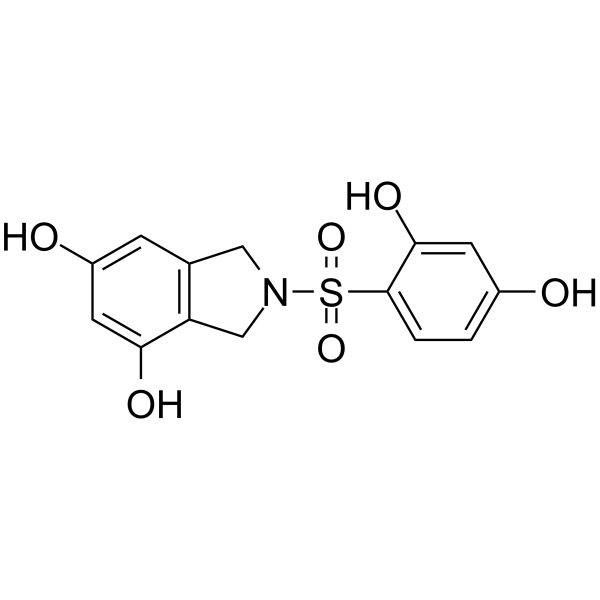
Physicochemical Properties
| Molecular Formula | C14H13NO6S |
| Molecular Weight | 323.32112288475 |
| Exact Mass | 323.046 |
| CAS # | 1564265-82-2 |
| PubChem CID | 72376512 |
| Appearance | Light yellow to khaki solid powder |
| LogP | 1.3 |
| Hydrogen Bond Donor Count | 4 |
| Hydrogen Bond Acceptor Count | 7 |
| Rotatable Bond Count | 2 |
| Heavy Atom Count | 22 |
| Complexity | 506 |
| Defined Atom Stereocenter Count | 0 |
| SMILES | S(C1C=CC(=CC=1O)O)(N1CC2C=C(C=C(C=2C1)O)O)(=O)=O |
| InChi Key | SVUZJWAAXPEMKJ-UHFFFAOYSA-N |
| InChi Code | InChI=1S/C14H13NO6S/c16-9-1-2-14(13(19)4-9)22(20,21)15-6-8-3-10(17)5-12(18)11(8)7-15/h1-5,16-19H,6-7H2 |
| Chemical Name | 2-(2,4-dihydroxyphenyl)sulfonyl-1,3-dihydroisoindole-4,6-diol |
| Synonyms | PS-10; PS 10 |
| HS Tariff Code | 2934.99.9001 |
| Storage |
Powder-20°C 3 years 4°C 2 years In solvent -80°C 6 months -20°C 1 month |
| Shipping Condition | Room temperature (This product is stable at ambient temperature for a few days during ordinary shipping and time spent in Customs) |
Biological Activity
| ln Vitro | Compared to Hsp90 (Kd= 47,000 nM), PS10 exhibits a higher affinity for PDK2 (Kd= 239 nM) [1]. With an IC50 value of 284 μM for growth inhibition in HeLa cells, PS10 is less toxic and less powerful than cycloheximide [1]. |
| ln Vivo | Treatment with PS10 (ip; 70 mg/kg; single dosage) boosted PDC activity in the liver and heart by 23 and 11 times, respectively. Concurrently, the kidney's PDC activity increased by 1.4 times in comparison to the vehicle group [1]. The PDC activity profiles and phospho-E1α subunit levels were similar to single doses after three days of PS10 (ip; 70 mg/kg). Remarkably, the elevation of PDK activity in the heart was decreased after three days of therapy [1]. After receiving PS10 (ip; 70 mg/kg) for four weeks, mice were tested for glucose tolerance. The plasma glucose levels in the vehicle-treated controls peaked at 482 mg/dl at 30 minutes after being challenged with 1.5 g/kg glucose, and then dropped to 210 mg/dl after 120 minutes. Compared to animals treated with a vehicle, the glucose levels in PS10-treated DIO mice were lower at 0 min, measuring 168 mg/dl. After 30 min, the levels rose to 312 mg/dl, and after 120 min, they were back to 163 mg/dl. [1]. PDC flow is stimulated by both PS10 (ip; 70 mg/kg) and DCA (measured by the emergence of hyperpolarizing [13C]bicarbonate). It has a comparable reaction to glucose, and a glucose stimulus can reinstate PDC activity in DIO mice's hearts [2]. |
| Animal Protocol |
Animal/Disease Models: 6 to 8 weeks old C57BL/6J male mice [2] Doses: 70 mg/kg/day Route of Administration: intraperitoneal (ip) injection Experimental Results: Improved glucose tolerance in intact animals. |
| References |
[1]. Structure-guided development of specific pyruvate dehydrogenase kinase inhibitors targeting the ATP-binding pocket.J Biol Chem. 2014 Feb 14;289(7):4432-43. [2]. A novel inhibitor of pyruvate dehydrogenase kinase stimulates myocardial carbohydrate oxidation in diet-induced obesity.J Biol Chem. 2018 Jun 22;293(25):9604-9613. |
Solubility Data
| Solubility (In Vitro) | DMSO : ~62.5 mg/mL (~193.31 mM) |
| Solubility (In Vivo) |
Solubility in Formulation 1: ≥ 6.25 mg/mL (19.33 mM) (saturation unknown) in 10% DMSO + 40% PEG300 + 5% Tween80 + 45% Saline (add these co-solvents sequentially from left to right, and one by one), clear solution. For example, if 1 mL of working solution is to be prepared, you can add 100 μL of 62.5 mg/mL clear DMSO stock solution to 400 μL PEG300 and mix evenly; then add 50 μL Tween-80 to the above solution and mix evenly; then add 450 μL normal saline to adjust the volume to 1 mL. Preparation of saline: Dissolve 0.9 g of sodium chloride in 100 mL ddH₂ O to obtain a clear solution. Solubility in Formulation 2: ≥ 6.25 mg/mL (19.33 mM) (saturation unknown) in 10% DMSO + 90% (20% SBE-β-CD in Saline) (add these co-solvents sequentially from left to right, and one by one), clear solution. For example, if 1 mL of working solution is to be prepared, you can add 100 μL of 62.5 mg/mL clear DMSO stock solution to 900 μL of 20% SBE-β-CD physiological saline solution and mix evenly. Preparation of 20% SBE-β-CD in Saline (4°C,1 week): Dissolve 2 g SBE-β-CD in 10 mL saline to obtain a clear solution. (Please use freshly prepared in vivo formulations for optimal results.) |
| Preparing Stock Solutions | 1 mg | 5 mg | 10 mg | |
| 1 mM | 3.0929 mL | 15.4646 mL | 30.9291 mL | |
| 5 mM | 0.6186 mL | 3.0929 mL | 6.1858 mL | |
| 10 mM | 0.3093 mL | 1.5465 mL | 3.0929 mL |