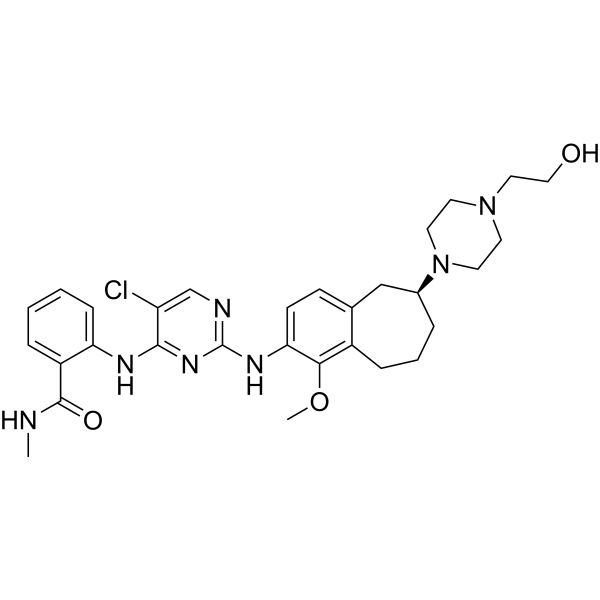
Physicochemical Properties
| Molecular Formula | C30H38CLN7O3 |
| Molecular Weight | 580.12 |
| Exact Mass | 579.272 |
| CAS # | 1391712-60-9 |
| PubChem CID | 71721648 |
| Appearance | Light yellow to yellow solid powder |
| Density | 1.3±0.1 g/cm3 |
| Index of Refraction | 1.648 |
| LogP | 3.4 |
| Hydrogen Bond Donor Count | 4 |
| Hydrogen Bond Acceptor Count | 9 |
| Rotatable Bond Count | 9 |
| Heavy Atom Count | 41 |
| Complexity | 819 |
| Defined Atom Stereocenter Count | 1 |
| SMILES | CNC(=O)C1=CC=CC=C1NC2=NC(=NC=C2Cl)NC3=C(C4=C(C[C@H](CCC4)N5CCN(CC5)CCO)C=C3)OC |
| InChi Key | BCSHRERPHLTPEE-NRFANRHFSA-N |
| InChi Code | InChI=1S/C30H38ClN7O3/c1-32-29(40)23-7-3-4-9-25(23)34-28-24(31)19-33-30(36-28)35-26-11-10-20-18-21(6-5-8-22(20)27(26)41-2)38-14-12-37(13-15-38)16-17-39/h3-4,7,9-11,19,21,39H,5-6,8,12-18H2,1-2H3,(H,32,40)(H2,33,34,35,36)/t21-/m0/s1 |
| Chemical Name | 2-[[5-chloro-2-[[(6S)-6-[4-(2-hydroxyethyl)piperazin-1-yl]-1-methoxy-6,7,8,9-tetrahydro-5H-benzo[7]annulen-2-yl]amino]pyrimidin-4-yl]amino]-N-methylbenzamide |
| Synonyms | CEP-37440; CEP 37440; CEP37440 |
| HS Tariff Code | 2934.99.9001 |
| Storage |
Powder-20°C 3 years 4°C 2 years In solvent -80°C 6 months -20°C 1 month |
| Shipping Condition | Room temperature (This product is stable at ambient temperature for a few days during ordinary shipping and time spent in Customs) |
Biological Activity
| ln Vitro | In a dose-dependent manner, CEP-37440 (0-3000 nM; 0-192 h) inhibits the growth of IBC cells [1]. In FC-IBC02, SUM 190, and KPL4, CEP-37440 (1000 nM; 0-120 h) decreases phosphorylated FAK1 (Tyr 397) and keeps levels low over time[1]. To encourage CEP-37440 (0-3000 nM; Sup-M2 and Karpas-299 cells), dose-dependent induction was used. |
| ln Vivo | In Sup-M2 xenograft protein SCID mice, CEP-37440 (3-55 mg/kg; sidewall bid and qd for 12 days) suppresses the formation of breast tumors [2]. In Sup-M2 xenograft mouse tumors, CEP-37440 (30 mg/kg; once lateral for 24 hours) suppresses tyrosine phosphorylation [2]. CEP-37440 (1-10 mg/kg; po and i.v.; CD-1 model, Sprague-Dawley (SD) form) has acceptable pharmacokinetic properties and suppresses FAK phosphorylation in nude CWR22 xenograft mice tumors (55 mg/kg; once lateral for 24 hours) [2]. |
| Cell Assay |
cell viability assay [1] Cell Types: FC-IBC02, KPL4, SUM190, MDA-IBC03 and SUM149 Cell Tested Concentrations: 0, 300, 1000, 2000 and 3000 nM Incubation Duration: 0. , 24, 48, 72, 96, 120, 144, 168 and 192 hrs (hours) Experimental Results: diminished proliferation of IBC cell lines by three-fifths at low concentrations. Proliferation is almost completely inhibited at a concentration of 3000 nM. Western Blot Analysis[1] Cell Types: FC-IBC02, SUM 190 and KPL4 Cell Tested Concentrations: 1000 nM Incubation Duration: 0, 48, 72, 96 and 120 hrs (hours) Experimental Results: Phospho-FAK1 in FC-IBC02, SUM190 diminished by half and KPL4 cells after 48 hrs (hours). |
| References |
[1]. The effects of CEP-37440, an inhibitor of focal adhesion kinase, in vitro and in vivo on inflammatory breast cancer cells. Breast Cancer Res. 2016 Mar 24;18(1):37. [2]. Discovery of Clinical Candidate CEP-37440, a Selective Inhibitor of Focal Adhesion Kinase (FAK) and Anaplastic Lymphoma Kinase (ALK). J Med Chem. 2016 Aug 25;59(16):7478-96. |
| Additional Infomation |
CEP-37440 has been used in trials studying the treatment of Solid Tumors. ALK-FAK Inhibitor CEP-37440 is an orally available dual kinase inhibitor of the receptor tyrosine kinase anaplastic lymphoma kinase (ALK) and focal adhesion kinase (FAK), with potential antineoplastic activity. Upon administration, ALK-FAK inhibitor CEP-37440 selectively binds to and inhibits ALK kinase and FAK kinase. The inhibition leads to disruption of ALK- and FAK-mediated signal transduction pathways and eventually inhibits tumor cell growth in ALK- and FAK-overexpressing tumor cells. ALK belongs to the insulin receptor superfamily and plays an important role in nervous system development; its dysregulation and gene rearrangements are associated with a variety of tumors. The cytoplasmic tyrosine kinase FAK, a signal transducer for integrins, is upregulated and constitutively activated in various tumor types; it plays a key role in tumor cell migration, proliferation, survival, and tumor angiogenesis. |
Solubility Data
| Solubility (In Vitro) | DMSO : ~100 mg/mL (~172.38 mM) |
| Solubility (In Vivo) |
Solubility in Formulation 1: ≥ 2.5 mg/mL (4.31 mM) (saturation unknown) in 10% DMSO + 40% PEG300 + 5% Tween80 + 45% Saline (add these co-solvents sequentially from left to right, and one by one), clear solution. For example, if 1 mL of working solution is to be prepared, you can add 100 μL of 25.0 mg/mL clear DMSO stock solution to 400 μL PEG300 and mix evenly; then add 50 μL Tween-80 to the above solution and mix evenly; then add 450 μL normal saline to adjust the volume to 1 mL. Preparation of saline: Dissolve 0.9 g of sodium chloride in 100 mL ddH₂ O to obtain a clear solution. Solubility in Formulation 2: ≥ 2.5 mg/mL (4.31 mM) (saturation unknown) in 10% DMSO + 90% (20% SBE-β-CD in Saline) (add these co-solvents sequentially from left to right, and one by one), clear solution. For example, if 1 mL of working solution is to be prepared, you can add 100 μL of 25.0 mg/mL clear DMSO stock solution to 900 μL of 20% SBE-β-CD physiological saline solution and mix evenly. Preparation of 20% SBE-β-CD in Saline (4°C,1 week): Dissolve 2 g SBE-β-CD in 10 mL saline to obtain a clear solution. Solubility in Formulation 3: ≥ 2.5 mg/mL (4.31 mM) (saturation unknown) in 10% DMSO + 90% Corn Oil (add these co-solvents sequentially from left to right, and one by one), clear solution. For example, if 1 mL of working solution is to be prepared, you can add 100 μL of 25.0 mg/mL clear DMSO stock solution to 900 μL of corn oil and mix evenly. (Please use freshly prepared in vivo formulations for optimal results.) |
| Preparing Stock Solutions | 1 mg | 5 mg | 10 mg | |
| 1 mM | 1.7238 mL | 8.6189 mL | 17.2378 mL | |
| 5 mM | 0.3448 mL | 1.7238 mL | 3.4476 mL | |
| 10 mM | 0.1724 mL | 0.8619 mL | 1.7238 mL |