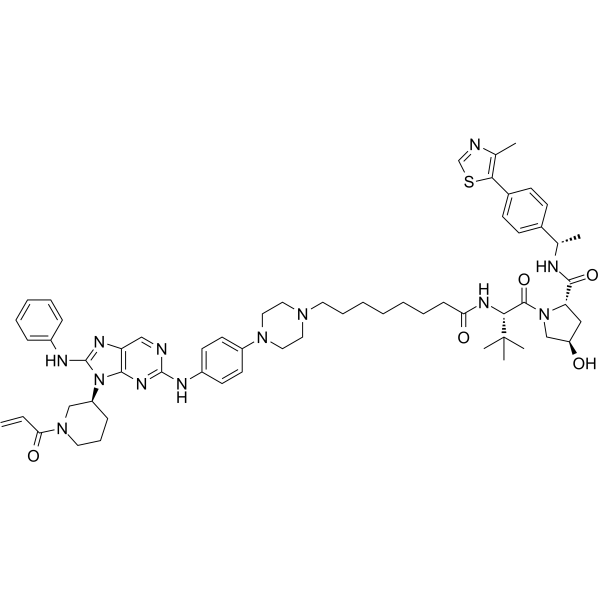
Physicochemical Properties
| Molecular Formula | C60H77N13O5S |
| Molecular Weight | 1092.40 |
| CAS # | 2768472-28-0 |
| PubChem CID | 162513220 |
| Appearance | Off-white to light yellow solid powder |
| Density | 1.31±0.1 g/cm3(Predicted) |
| LogP | 0 |
| Hydrogen Bond Donor Count | 5 |
| Hydrogen Bond Acceptor Count | 14 |
| Rotatable Bond Count | 22 |
| Heavy Atom Count | 79 |
| Complexity | 1970 |
| Defined Atom Stereocenter Count | 5 |
| HS Tariff Code | 2934.99.9001 |
| Storage |
Powder-20°C 3 years 4°C 2 years In solvent -80°C 6 months -20°C 1 month |
| Shipping Condition | Room temperature (This product is stable at ambient temperature for a few days during ordinary shipping and time spent in Customs) |
Biological Activity
| ln Vitro | The anti-proliferative efficacy of PROTAC is demonstrated by PROTAC EGFR degrader 3 (compound CP17), which has an IC50 of 32 nM, 1.60 nM, and >10000 nM for H1975 (EGFRL858/T790M), HCC827 (EGFRdel19), and A431 (EGFRWT) cells, respectively [1]. Poor cellular activity was seen with PROTAC EGFR Degrader 3 (0, 10, 100, 1000, and 10,000 nM), with an IC50 of 481 for Ba/F3 (EGFRdel19/T790M/C797S) and Ba/F3 (EGFRL858/T790M/C797S). nM and 669 nM cells, in that order [1]. The growth of PC9 (EGFRdel19/T790M/C797S) and H1975 (EGFRL858/T790M/C797S) cells is inhibited by PROTAC EGFR degrader 3 (0-10000 nM), respectively [1]. EGFRL858/T790M expression is reduced by PROTAC EGFR Degrader 3 (30 nM; 0-72 hours) after 8 hours, and the degradation rate reaches its peak after 48 hours [1]. EGFRL858/T790M and EGFRdel19 are degraded by PROTAC EGFR degrader 3 (0.3, 1, 3, 10, 100, 300 nM; 24, 48 h), with a DC50 of 1.56 nM and 0.49 nM, respectively [1]. In H1975 and HCC827 cells, PROTAC EGFR Degrader 3 (100, 1000 nM; 24 hours) exhibits selectivity against mutant EGFR [1]. Cell growth is inhibited by PROTAC EGFR degrader 3 (0.3, 1, 3, 10, 100, and 300 nM; 24 hours), which efficiently suppresses EGFR signal transduction [1]. EGFR mutations are degraded by PROTAC EGFR degrader 3 (30 nM), and lysosomes take part in this process [1]. |
| Cell Assay |
Cell Proliferation Assay[1] Cell Types: H1975 (EGFRL858/T790M), HCC827 (EGFRdel19), A431 (EGFRWT) Cell Tested Concentrations: Incubation Duration: 72 hrs (hours) Experimental Results: PROTAC demonstrated anti-proliferative activity with IC50 of 32 nM, 1.60 nM for H1975 (EGFRL858/T790M), HCC827 (EGFRdel19), A431 (EGFRWT) cells, >10000nM respectively. Western Blot Analysis [1] Cell Types: H1975, HCC827 Cell Tested Concentrations: 0.3, 1, 3, 10, 30 nM Incubation Duration: 24 h Experimental Results: Phosphorylated EGFR, ERK, and AKT were Dramatically diminished in H1975 and HCC827 cells. |
| References |
[1]. Discovery of Potent PROTACs Targeting EGFR Mutants through the Optimization of Covalent EGFR Ligands. J Med Chem. 2022; 65(6):4709-4726. |
Solubility Data
| Solubility (In Vitro) | DMSO : ~100 mg/mL (~91.54 mM) |
| Solubility (In Vivo) |
Solubility in Formulation 1: ≥ 2.5 mg/mL (2.29 mM) (saturation unknown) in 10% DMSO + 90% Corn Oil (add these co-solvents sequentially from left to right, and one by one), clear solution. For example, if 1 mL of working solution is to be prepared, you can add 100 μL of 25.0 mg/mL clear DMSO stock solution to 900 μL of corn oil and mix evenly. (Please use freshly prepared in vivo formulations for optimal results.) |
| Preparing Stock Solutions | 1 mg | 5 mg | 10 mg | |
| 1 mM | 0.9154 mL | 4.5771 mL | 9.1542 mL | |
| 5 mM | 0.1831 mL | 0.9154 mL | 1.8308 mL | |
| 10 mM | 0.0915 mL | 0.4577 mL | 0.9154 mL |