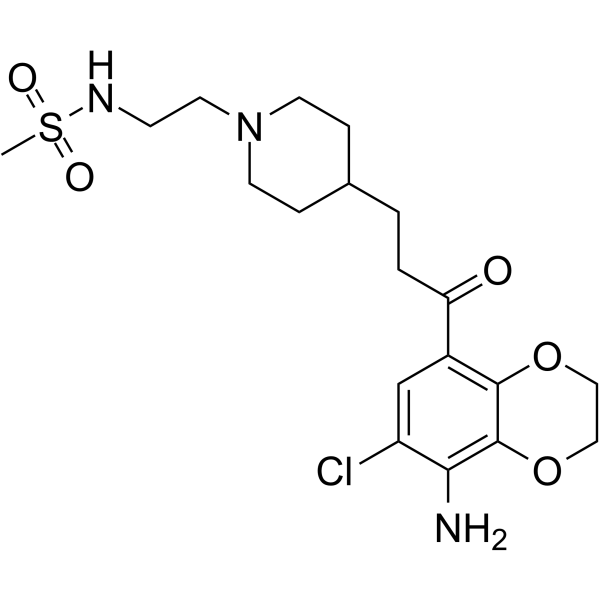
Physicochemical Properties
| Molecular Formula | C19H28CLN3O5S |
| Molecular Weight | 445.9607 |
| Exact Mass | 445.144 |
| CAS # | 219757-90-1 |
| PubChem CID | 9805252 |
| Appearance | Typically exists as solid at room temperature |
| LogP | 3.908 |
| Hydrogen Bond Donor Count | 2 |
| Hydrogen Bond Acceptor Count | 8 |
| Rotatable Bond Count | 8 |
| Heavy Atom Count | 29 |
| Complexity | 651 |
| Defined Atom Stereocenter Count | 0 |
| SMILES | ClC1=C(C2=C(C(=C1[H])C(C([H])([H])C([H])([H])C1([H])C([H])([H])C([H])([H])N(C([H])([H])C([H])([H])N([H])S(C([H])([H])[H])(=O)=O)C([H])([H])C1([H])[H])=O)OC([H])([H])C([H])([H])O2)N([H])[H] |
| InChi Key | NBUGBCTWXCXBQD-UHFFFAOYSA-N |
| InChi Code | InChI=1S/C19H28ClN3O5S/c1-29(25,26)22-6-9-23-7-4-13(5-8-23)2-3-16(24)14-12-15(20)17(21)19-18(14)27-10-11-28-19/h12-13,22H,2-11,21H2,1H3 |
| Chemical Name | N-[2-[4-[3-(5-amino-6-chloro-2,3-dihydro-1,4-benzodioxin-8-yl)-3-oxopropyl]piperidin-1-yl]ethyl]methanesulfonamide |
| HS Tariff Code | 2934.99.9001 |
| Storage |
Powder-20°C 3 years 4°C 2 years In solvent -80°C 6 months -20°C 1 month |
| Shipping Condition | Room temperature (This product is stable at ambient temperature for a few days during ordinary shipping and time spent in Customs) |
Biological Activity
| Targets | Sulamserod (RS-100302) targets the 5-hydroxytryptamine 4 (5-HT₄) receptor, acting as a selective antagonist with a Ki of 0.8 nM [1] |
| ln Vitro |
Sulamserod (RS-100302) (1 nM–100 nM) dose-dependently antagonized 5-HT-induced positive chronotropic and inotropic responses in isolated canine right atria: 10 nM inhibited the 5-HT (1 μM)-mediated heart rate increase by 78% and contractile force increase by 72% [1] In isolated canine left ventricles, Sulamserod (RS-100302) (up to 100 nM) had no significant effect on 5-HT-induced or baseline inotropic/chronotropic responses, demonstrating atrial selectivity [1] Sulamserod (RS-100302) (10 nM–100 nM) prolonged the atrial effective refractory period (AERP) in isolated canine atria by 22%–45% without affecting ventricular effective refractory period (VERP) [1] In patch-clamp studies on isolated canine atrial myocytes, Sulamserod (RS-100302) (50 nM) inhibited the 5-HT₄ receptor-mediated cyclic AMP-dependent potassium current (I_K,ACh) activation by 68% [1] |
| ln Vivo |
Sulamserod (30 mg/kg) decreased the ERP dispersion (1565 vs. 861 ms, P,0.01), lengthened the wavelength (8.360.9 vs. 9.960.8 cm, P,0.01), and only slightly slowed down the pigs' conduction velocity (7264 vs. 6765 cm/s, P, 0.01). There are no ventricular electrical effects associated with sulamserod. Sulamserod prevented reinduction of persistent tachycardia in all animals and ended atrial fibrillation in 8 of 9 animals and 6 of 8 animals [1]. In anesthetized dogs with pacing-induced atrial flutter (AFlu), intravenous administration of Sulamserod (RS-100302) (0.1 mg/kg, 0.3 mg/kg, 1.0 mg/kg) dose-dependently terminated AFlu: 1.0 mg/kg achieved a termination rate of 90% within 5 minutes, with no recurrence for 30 minutes [1] In conscious dogs with electrically induced atrial fibrillation (AF), Sulamserod (RS-100302) (0.3 mg/kg, i.v.) reduced AF duration from 240 ± 35 seconds to 42 ± 12 seconds and decreased AF inducibility from 85% to 20% [1] Sulamserod (RS-100302) (0.1 mg/kg–1.0 mg/kg, i.v.) had no significant effect on systemic blood pressure, ventricular heart rate, or QRS complex duration in anesthetized or conscious dogs, confirming lack of ventricular electrophysiological effects [1] |
| Enzyme Assay |
5-HT₄ receptor binding assay: Membrane preparations from cells expressing human recombinant 5-HT₄ receptors were incubated with Sulamserod (RS-100302) (0.01 nM–100 nM) and a radiolabeled 5-HT₄ agonist. The mixture was incubated at 25°C for 60 minutes, then filtered to separate bound and free ligand. Radioactivity of the bound ligand was measured, and Ki values were calculated using competitive binding curves [1] 5-HT₄ receptor functional antagonism assay: Isolated canine right atria were mounted in organ baths and superfused with physiological buffer. Sulamserod (RS-100302) (1 nM–100 nM) was preincubated for 15 minutes, followed by addition of 5-HT (1 μM) to induce chronotropic/inotropic responses. Heart rate and contractile force were recorded, and inhibition rates were calculated [1] |
| Cell Assay |
Atrial myocyte patch-clamp assay: Isolated canine atrial myocytes were enzymatically dissociated and maintained in physiological solution. Sulamserod (RS-100302) (50 nM) was applied to the cells, followed by 5-HT (1 μM) to activate I_K,ACh. Whole-cell patch-clamp recordings were performed to measure current amplitude changes, and inhibition of I_K,ACh activation was quantified [1] Atrial/ventricular refractory period assay: Isolated canine atrial and ventricular tissue strips were mounted in organ baths. Sulamserod (RS-100302) (10 nM–100 nM) was superfused for 30 minutes, and effective refractory periods (AERP/VERP) were measured using programmed electrical stimulation at different cycle lengths [1] |
| Animal Protocol |
Pacing-induced atrial flutter (AFlu) dog model: Anesthetized mongrel dogs were instrumented with epicardial electrodes on the right atrium. AFlu was induced by rapid atrial pacing (600 beats/min) for 10 minutes. Sulamserod (RS-100302) was dissolved in physiological saline and administered intravenously at 0.1 mg/kg, 0.3 mg/kg, or 1.0 mg/kg. AFlu termination time and recurrence were monitored for 30 minutes post-administration [1] Electrically induced atrial fibrillation (AF) conscious dog model: Conscious dogs were implanted with a telemetry device and atrial pacing electrodes. After a 7-day recovery period, AF was induced by burst atrial pacing (20 Hz for 2 seconds). Sulamserod (RS-100302) (0.3 mg/kg) or vehicle was administered intravenously, and AF inducibility and duration were recorded for 2 hours post-dosing [1] Electrophysiological and hemodynamic monitoring: In both anesthetized and conscious dog models, systemic blood pressure, ventricular heart rate, QRS duration, and atrial/ventricular electrograms were continuously recorded before and after Sulamserod (RS-100302) administration to assess safety and selectivity [1] |
| Toxicity/Toxicokinetics |
In acute toxicity testing in anesthetized dogs, intravenous administration of Sulamserod (RS-100302) at doses up to 3.0 mg/kg did not cause arrhythmias, hypotension, or organ dysfunction. No significant changes in hematological or biochemical parameters were observed [1] Sulamserod (RS-100302) showed no ventricular proarrhythmic effects at therapeutic or supratherapeutic doses, as evidenced by unchanged VERP, QRS duration, and ventricular heart rate [1] |
| References | [1]. Rahme MM, et al. Electrophysiological and antiarrhythmic effects of the atrial selective 5-HT(4) receptor antagonist RS-100302 in experimental atrial flutter and fibrillation. Circulation. 1999 Nov 9;100(19):2010-7 |
| Additional Infomation |
Sulamserod (RS-100302) is a selective, high-affinity 5-HT₄ receptor antagonist with atrial-specific electrophysiological effects [1] Its antiarrhythmic mechanism involves blocking 5-HT₄ receptor-mediated activation of cyclic AMP-dependent signaling, which inhibits atrial electrical remodeling (prolongs AERP) and suppresses the induction/maintenance of atrial flutter and fibrillation [1] The atrial selectivity of Sulamserod (RS-100302) avoids ventricular side effects, making it a potential therapeutic agent for the treatment of atrial fibrillation and atrial flutter [1] Sulamserod (RS-100302) does not affect baseline cardiac function or hemodynamics at therapeutic doses, contributing to its favorable safety profile [1] |
Solubility Data
| Solubility (In Vitro) | May dissolve in DMSO (in most cases), if not, try other solvents such as H2O, Ethanol, or DMF with a minute amount of products to avoid loss of samples |
| Solubility (In Vivo) |
Note: Listed below are some common formulations that may be used to formulate products with low water solubility (e.g. < 1 mg/mL), you may test these formulations using a minute amount of products to avoid loss of samples. Injection Formulations (e.g. IP/IV/IM/SC) Injection Formulation 1: DMSO : Tween 80: Saline = 10 : 5 : 85 (i.e. 100 μL DMSO stock solution → 50 μL Tween 80 → 850 μL Saline) *Preparation of saline: Dissolve 0.9 g of sodium chloride in 100 mL ddH ₂ O to obtain a clear solution. Injection Formulation 2: DMSO : PEG300 :Tween 80 : Saline = 10 : 40 : 5 : 45 (i.e. 100 μL DMSO → 400 μLPEG300 → 50 μL Tween 80 → 450 μL Saline) Injection Formulation 3: DMSO : Corn oil = 10 : 90 (i.e. 100 μL DMSO → 900 μL Corn oil) Example: Take the Injection Formulation 3 (DMSO : Corn oil = 10 : 90) as an example, if 1 mL of 2.5 mg/mL working solution is to be prepared, you can take 100 μL 25 mg/mL DMSO stock solution and add to 900 μL corn oil, mix well to obtain a clear or suspension solution (2.5 mg/mL, ready for use in animals). Injection Formulation 4: DMSO : 20% SBE-β-CD in saline = 10 : 90 [i.e. 100 μL DMSO → 900 μL (20% SBE-β-CD in saline)] *Preparation of 20% SBE-β-CD in Saline (4°C,1 week): Dissolve 2 g SBE-β-CD in 10 mL saline to obtain a clear solution. Injection Formulation 5: 2-Hydroxypropyl-β-cyclodextrin : Saline = 50 : 50 (i.e. 500 μL 2-Hydroxypropyl-β-cyclodextrin → 500 μL Saline) Injection Formulation 6: DMSO : PEG300 : castor oil : Saline = 5 : 10 : 20 : 65 (i.e. 50 μL DMSO → 100 μLPEG300 → 200 μL castor oil → 650 μL Saline) Injection Formulation 7: Ethanol : Cremophor : Saline = 10: 10 : 80 (i.e. 100 μL Ethanol → 100 μL Cremophor → 800 μL Saline) Injection Formulation 8: Dissolve in Cremophor/Ethanol (50 : 50), then diluted by Saline Injection Formulation 9: EtOH : Corn oil = 10 : 90 (i.e. 100 μL EtOH → 900 μL Corn oil) Injection Formulation 10: EtOH : PEG300:Tween 80 : Saline = 10 : 40 : 5 : 45 (i.e. 100 μL EtOH → 400 μLPEG300 → 50 μL Tween 80 → 450 μL Saline) Oral Formulations Oral Formulation 1: Suspend in 0.5% CMC Na (carboxymethylcellulose sodium) Oral Formulation 2: Suspend in 0.5% Carboxymethyl cellulose Example: Take the Oral Formulation 1 (Suspend in 0.5% CMC Na) as an example, if 100 mL of 2.5 mg/mL working solution is to be prepared, you can first prepare 0.5% CMC Na solution by measuring 0.5 g CMC Na and dissolve it in 100 mL ddH2O to obtain a clear solution; then add 250 mg of the product to 100 mL 0.5% CMC Na solution, to make the suspension solution (2.5 mg/mL, ready for use in animals). Oral Formulation 3: Dissolved in PEG400 Oral Formulation 4: Suspend in 0.2% Carboxymethyl cellulose Oral Formulation 5: Dissolve in 0.25% Tween 80 and 0.5% Carboxymethyl cellulose Oral Formulation 6: Mixing with food powders Note: Please be aware that the above formulations are for reference only. InvivoChem strongly recommends customers to read literature methods/protocols carefully before determining which formulation you should use for in vivo studies, as different compounds have different solubility properties and have to be formulated differently. (Please use freshly prepared in vivo formulations for optimal results.) |
| Preparing Stock Solutions | 1 mg | 5 mg | 10 mg | |
| 1 mM | 2.2424 mL | 11.2118 mL | 22.4235 mL | |
| 5 mM | 0.4485 mL | 2.2424 mL | 4.4847 mL | |
| 10 mM | 0.2242 mL | 1.1212 mL | 2.2424 mL |