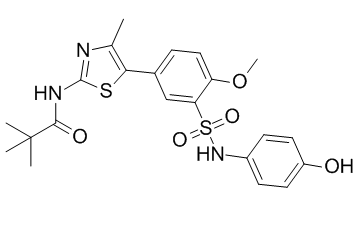
PI4KIIIβ-IN-10 (PI4KIIIbeta-IN-10) is a novel, potent and selective PI4KIIIβ (Type III phosphatidylinositol 4-kinase) inhibitor with an IC50 of 3.6 nM with >1000-fold over class I and class III PI3Ks. Type III phosphatidylinositol 4-kinase (PI4KIIIβ) is an essential enzyme in mediating membrane trafficking and is implicated in a variety of pathogenic processes. It is a crucial host factor that facilitates the replication of RNA viruses. The development of effective and targeted inhibitors of this enzyme will be crucial for defining its cellular functions and could result in brand-new antiviral therapeutics. Hepatitis C virus infection was inhibited by PI4KIIIβ-IN-9.
Physicochemical Properties
| Molecular Formula | C22H25N3O5S2 |
| Molecular Weight | 475.5810 |
| Exact Mass | 475.123 |
| Elemental Analysis | C, 55.56; H, 5.30; N, 8.84; O, 16.82; S, 13.48 |
| CAS # | 1881233-39-1 |
| Related CAS # | 1881233-39-1; 1429624-84-9 (PI4KIIIβ-IN-9); 1429624-84-9 (PI4KIIIβ-IN-9) |
| PubChem CID | 71549093 |
| Appearance | White to off-white solid powder |
| Density | 1.4±0.1 g/cm3 |
| Index of Refraction | 1.631 |
| LogP | 3.64 |
| Hydrogen Bond Donor Count | 3 |
| Hydrogen Bond Acceptor Count | 8 |
| Rotatable Bond Count | 7 |
| Heavy Atom Count | 32 |
| Complexity | 744 |
| Defined Atom Stereocenter Count | 0 |
| SMILES | S(C1=C(C([H])=C([H])C(=C1[H])C1=C(C([H])([H])[H])N=C(N([H])C(C(C([H])([H])[H])(C([H])([H])[H])C([H])([H])[H])=O)S1)OC([H])([H])[H])(N([H])C1C([H])=C([H])C(=C([H])C=1[H])O[H])(=O)=O |
| InChi Key | PLUYFBRIGUAKBR-UHFFFAOYSA-N |
| InChi Code | InChI=1S/C22H25N3O5S2/c1-13-19(31-21(23-13)24-20(27)22(2,3)4)14-6-11-17(30-5)18(12-14)32(28,29)25-15-7-9-16(26)10-8-15/h6-12,25-26H,1-5H3,(H,23,24,27) |
| Chemical Name | N-[5-[3-[(4-hydroxyphenyl)sulfamoyl]-4-methoxyphenyl]-4-methyl-1,3-thiazol-2-yl]-2,2-dimethylpropanamide |
| Synonyms | PI4KIIIβ-IN-10; PI4KIIIbeta-IN-10; PI4KIIIβ-IN 10; PI4KIIIbeta-IN 10; PI4KIIIβ-IN10; PI4KIIIbeta-IN10 |
| HS Tariff Code | 2934.99.9001 |
| Storage |
Powder-20°C 3 years 4°C 2 years In solvent -80°C 6 months -20°C 1 month |
| Shipping Condition | Room temperature (This product is stable at ambient temperature for a few days during ordinary shipping and time spent in Customs) |
Biological Activity
| Targets |
PI4KIIIβ (IC50 = 3.6 nM); PI4KIIIα (IC50 = 3 μM); PI3Kδ (IC50 = 720 nM); PI3KC2γ (IC50 = 1 μM); PI3Kα (IC50 = 10 μM); PI3Kγ (IC50 = 20 μM) PI4KIIIbeta-IN-10 is a highly potent and selective inhibitor of phosphatidylinositol 4-kinase IIIβ (PI4KIIIβ). It inhibits PI4KIIIβ with an IC50 of 3.6 nM. It shows >1000-fold selectivity over PI3Kγ, >200-fold selectivity over PI3Kδ (PI3K6), and no inhibition of vps34 at concentrations up to 20 μM. When screened against a panel of nine related lipid kinases, it showed weak inhibition of PI3KC2γ (IC50 ~1 μM), PI3Kα (IC50 ~10 μM), and PI4KIIIα (IC50 ~3 μM), and <20% inhibition at 20 μM for PI4KIIα, PI4KIIβ, and PI3Kβ. It is described as the most potent PI4KIIIβ inhibitor reported in the study. [1] |
| ln Vitro |
PI4KIIIbeta-IN-10 (Compound 10) is a potent PI4KIIIβ inhibitor with very minor off-target inhibition of PI4KIIIβ related lipid kinases. PI4KIIIbeta-IN-10 exhibits weak inhibition of PI3KC2γ (IC50 ~1 µM), PI3Kα (~10 µM), and PI4KIIIα (~3 µM), and <20% inhibition of PI4K2α, PI4K2β, and PI3Kβ at concentrations up to 20 µM[1]. In a biochemical kinase assay, PI4KIIIbeta-IN-10 potently inhibits PI4KIIIβ with an IC50 of 3.6 nM. [1] In a cellular Hepatitis C virus (HCV) replication assay using a Huh7.5 cell line stably infected with a Gaussia luciferase-reporting HCV clone (J6/JFH1-GLuc), PI4KIIIbeta-IN-10 exhibits anti-viral activity. [1] A cell viability assay (Presto Blue) performed alongside the HCV replication assay indicated that PI4KIIIbeta-IN-10 had low cellular toxicity in this model. Together with compound 9, it showed the best combination of antiviral efficacy and low cellular toxicity among the tested derivatives. [1] |
| Enzyme Assay |
Lipid kinase assays are preformed using recombinant enzyme, phosphoinositides and γ32P-ATP in a membrane capture assay. Every inhibitor (for instance, PI4KIIIbeta-IN-10) is diluted with 10% DMSO and kinase assay buffer. As soon as the reaction is finished, 4 µL is spotted onto nitrocellulose with a 0.2 µm thickness. After drying for 5 minutes under a heat lamp, the membrane is washed in 1M NaCl/1% Phosphoric Acid for 1 minute, then 6 times for 5 minutes. The membrane is dried for 20 minutes using a heat lamp, then exposed to a phosphor screen overnight, followed by phosphorimaging on a Typhoon 9500. SPOT is used to measure intensity. Following are the details for each enzyme. To create 1 mg/mL PI:, L--phosphotidylinositol and DOPS:DOPC lipids are sonicated in water. DOPS:DOPC. Reaction is set-up as follows 1) kinase assay buffer, PI:DOPS:DOPC, BSA and PI4KIIIβ, are combined in a total volume of 10 µL (2.5x solution); 2) 5 µL of inhibitor solution is added (5x solution) and incubated with enzyme mixture for 15 minutes; 3) 10 µL cold ATP and γ32P-ATP are added (2.5x solution) to initiate the reaction which ran for 30 minutes. Final conditions are as follows: 20 mM Bis-Tris Propane pH 7.5, 10 mM MgCl2, 0.075 mM Triton X-100, 0.5 mM EGTA, 1 mM DTT, 100 µM PI, 500 ng/µL BSA, 2.5 nM PI4KIIIβ, 2% DMSO, 10 µM ATP and 1 uCi γ32P-ATP[1]. Lipid kinase assays were performed using recombinant enzymes in a membrane capture format. For PI4KIIIβ, the reaction mixture contained the enzyme, phosphatidylinositol (PI) substrate presented in liposomes (with DOPS and DOPC lipids), BSA, MgCl2, Triton X-100, EGTA, DTT, and ATP (including γ32P-ATP for detection). The reaction was initiated by adding the ATP mixture to the pre-incubated enzyme-inhibitor-substrate complex and proceeded for 30 minutes. Reactions were stopped, and the phosphorylated product was captured on a nitrocellulose membrane, washed extensively, and quantified using phosphorimaging. Inhibitors were diluted in DMSO and assay buffer and pre-incubated with the enzyme and substrate before reaction initiation. [1] Assays for other lipid kinases (PI3Kγ, PI3Kδ, vps34, PI4KIIIα, PI4KIIα, PI4KIIβ, PI3Kα, PI3Kβ, PI3KC2γ) followed a similar membrane capture principle but with modifications to buffer composition, substrate (PI or PIP2), divalent cation (MgCl2 or MnCl2), and reaction time as detailed in the experimental section. [1] |
| Cell Assay |
The anti-HCV activity of PI4KIIIbeta-IN-10 was evaluated using Huh7.5 cells stably harboring a fully infectious HCV reporter virus (J6/JFH1-GLuc) that encodes Gaussia luciferase. Cells were seeded in 96-well plates and treated with serially diluted compounds one hour after plating. Following a three-day incubation period, cell viability was assessed using a Presto Blue cell viability reagent according to the manufacturer's instructions. HCV replication was quantified by measuring the activity of Gaussia luciferase secreted into the cell culture supernatant using a luciferase assay reagent. Luminescence (viral replication) and fluorescence/absorbance (cell viability) signals were read using a plate reader. Data were analyzed to calculate EC50 (half-maximal effective concentration for antiviral activity) and CC50 (half-maximal cytotoxic concentration) values. [1] |
| Toxicity/Toxicokinetics |
In the cellular HCV replication assay, the cell viability test indicated that PI4KIIIbeta-IN-10 exhibited low cellular toxicity, contributing to a favorable therapeutic window in this in vitro model. [1] The literature discusses general concerns about the potential toxicity of PI4KIIIβ inhibitors from other studies . [1] |
| References |
[1]. Design and Structural Characterization of Potent and Selective Inhibitors of Phosphatidylinositol 4 Kinase IIIβ. J Med Chem. 2016 Mar 10;59(5):1830-9. |
| Additional Infomation |
PI4KIIIbeta-IN-10 is a derivative of the inhibitor PIK93 (compound 1), optimized through structure-based drug design. Key modifications include a methoxy group on the central phenyl ring, a para-hydroxy phenol group attached to the sulfonamide, and a tert-butyl group (l-butyl) at the acetamide position off the central thiazole. These modifications collectively confer high potency and exceptional selectivity for PI4KIIIβ over closely related lipid kinases like PI3Kγ and vps34. [1] PI4KIIIβ is a host factor crucial for the replication of multiple pathogenic RNA viruses, including Hepatitis C Virus (HCV), by generating PI4P-rich membrane platforms for viral replication complexes. Therefore, potent and selective inhibitors like PI4KIIIbeta-IN-10 represent promising candidates for the development of broad-spectrum antiviral therapeutics. [1] |
Solubility Data
| Solubility (In Vitro) | DMSO: ~125 mg/mL (~262.8 mM) |
| Solubility (In Vivo) |
Solubility in Formulation 1: ≥ 2.5 mg/mL (5.26 mM) (saturation unknown) in 10% DMSO + 40% PEG300 + 5% Tween80 + 45% Saline (add these co-solvents sequentially from left to right, and one by one), clear solution. For example, if 1 mL of working solution is to be prepared, you can add 100 μL of 25.0 mg/mL clear DMSO stock solution to 400 μL PEG300 and mix evenly; then add 50 μL Tween-80 to the above solution and mix evenly; then add 450 μL normal saline to adjust the volume to 1 mL. Preparation of saline: Dissolve 0.9 g of sodium chloride in 100 mL ddH₂ O to obtain a clear solution. Solubility in Formulation 2: ≥ 2.5 mg/mL (5.26 mM) (saturation unknown) in 10% DMSO + 90% (20% SBE-β-CD in Saline) (add these co-solvents sequentially from left to right, and one by one), clear solution. For example, if 1 mL of working solution is to be prepared, you can add 100 μL of 25.0 mg/mL clear DMSO stock solution to 900 μL of 20% SBE-β-CD physiological saline solution and mix evenly. Preparation of 20% SBE-β-CD in Saline (4°C,1 week): Dissolve 2 g SBE-β-CD in 10 mL saline to obtain a clear solution. Solubility in Formulation 3: ≥ 2.5 mg/mL (5.26 mM) (saturation unknown) in 10% DMSO + 90% Corn Oil (add these co-solvents sequentially from left to right, and one by one), clear solution. For example, if 1 mL of working solution is to be prepared, you can add 100 μL of 25.0 mg/mL clear DMSO stock solution to 900 μL of corn oil and mix evenly. (Please use freshly prepared in vivo formulations for optimal results.) |
| Preparing Stock Solutions | 1 mg | 5 mg | 10 mg | |
| 1 mM | 2.1027 mL | 10.5135 mL | 21.0270 mL | |
| 5 mM | 0.4205 mL | 2.1027 mL | 4.2054 mL | |
| 10 mM | 0.2103 mL | 1.0513 mL | 2.1027 mL |