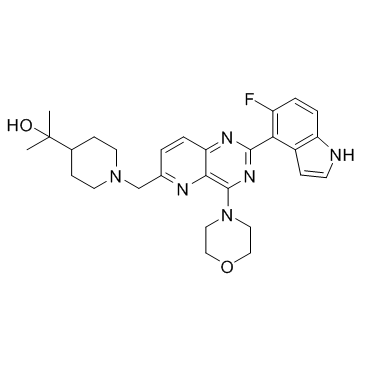
PI3kδ inhibitor 1 is a novel, potent and selective PI3Kδ inhibitor with an IC50 of 3.8 nM. It is ≥ 200 fold selective for the remaining three Class I PI3K isoforms and additional kinases. It was identified based on the idea that isoform selectivity from the affinity pocket and tryptophan shelf can be obained.The hypothesis for selectivity is illustrated through structure activity relationships and crystal structures of compounds bound to a K802T mutant of PI3Kγ. Pharmacokinetic data in rats and mice support the use of PI3kδ inhibitor 1 as a useful tool compound to use for in vivo studies.
Physicochemical Properties
| Molecular Formula | C28H33N6O2F |
| Molecular Weight | 504.59902 |
| Exact Mass | 504.265 |
| CAS # | 1332075-63-4 |
| PubChem CID | 53378051 |
| Appearance | Typically exists as solid at room temperature |
| LogP | 4.134 |
| Hydrogen Bond Donor Count | 2 |
| Hydrogen Bond Acceptor Count | 8 |
| Rotatable Bond Count | 5 |
| Heavy Atom Count | 37 |
| Complexity | 761 |
| Defined Atom Stereocenter Count | 0 |
| SMILES | CC(O)(C1CCN(CC2=NC3=C(N4CCOCC4)N=C(C5=C(F)C=CC6=C5C=CN6)N=C3C=C2)CC1)C |
| InChi Key | ONEJEIKQLAZPNN-UHFFFAOYSA-N |
| InChi Code | InChI=1S/C28H33FN6O2/c1-28(2,36)18-8-11-34(12-9-18)17-19-3-5-23-25(31-19)27(35-13-15-37-16-14-35)33-26(32-23)24-20-7-10-30-22(20)6-4-21(24)29/h3-7,10,18,30,36H,8-9,11-17H2,1-2H3 |
| Chemical Name | 2-[1-[[2-(5-fluoro-1H-indol-4-yl)-4-morpholin-4-ylpyrido[3,2-d]pyrimidin-6-yl]methyl]piperidin-4-yl]propan-2-ol |
| Synonyms | PI3kδ inhibitor 1 |
| HS Tariff Code | 2934.99.9001 |
| Storage |
Powder-20°C 3 years 4°C 2 years In solvent -80°C 6 months -20°C 1 month |
| Shipping Condition | Room temperature (This product is stable at ambient temperature for a few days during ordinary shipping and time spent in Customs) |
Biological Activity
| ln Vitro | PI3Kδ Inhibitor 1 (Compound 3) is a potent PI3Kδ inhibitor that exhibits 200-400-fold selectivity for all three remaining class I PI3K isoforms and over the 239 kinases tested in the SelectScreen service. Extremely high selectivity (0/239 kinases tested at 1 μM; mTOR, DNA-PK, VPS34, PI4Kα, and PI4Kβ were all inhibited by 10% or less when tested at 1 μM; at the same concentration, PIKC2A and PIKC2B were inhibited by 11% and 42%, respectively, and demonstrated less than 10% inhibition when tested at 0.1 μM; the PIKK family kinases ATM and ATR were not evaluated [1]. |
| ln Vivo | In mice and rats, the pharmacokinetic characteristics of compound 3, or PI3kδ inhibitor 1, were assessed both orally and intravenously. Following oral administration, good plasma exposure and a tolerable half-life were noted, indicating excellent oral bioavailability (80% and 90% in mice and rats, respectively at low dosages), a moderate volume of distribution, and a moderate clearance. The terminal elimination half-life of PI3kδ inhibitor 1 is moderate and ranges from 2.6 h to 4.8 h in mice (5 mg/kg, oral), mice (20 mg/kg, oral), mice (40 mg/kg, oral), rats (5 mg/kg, oral), rats (10 mg/kg, oral), and rats (30 mg/kg, oral). It is crucial to use plasma exposure and Cmax levels in mice and rats that increased with dosage when using these two species' models for inflammatory diseases. Rats' plasma protein binding of PI3kδ inhibitor 1 ranges from 80–88%, which is in line with the figure seen in human plasma (86%) [1]. |
| References | [1]. Sutherlin DP, et al. Potent and selective inhibitors of PI3Kδ: obtaining isoform selectivity from the affinity pocket and tryptophan shelf. Bioorg Med Chem Lett. 2012 Jul 1;22(13):4296-302 |
Solubility Data
| Solubility (In Vitro) | May dissolve in DMSO (in most cases), if not, try other solvents such as H2O, Ethanol, or DMF with a minute amount of products to avoid loss of samples |
| Solubility (In Vivo) |
Note: Listed below are some common formulations that may be used to formulate products with low water solubility (e.g. < 1 mg/mL), you may test these formulations using a minute amount of products to avoid loss of samples. Injection Formulations (e.g. IP/IV/IM/SC) Injection Formulation 1: DMSO : Tween 80: Saline = 10 : 5 : 85 (i.e. 100 μL DMSO stock solution → 50 μL Tween 80 → 850 μL Saline) *Preparation of saline: Dissolve 0.9 g of sodium chloride in 100 mL ddH ₂ O to obtain a clear solution. Injection Formulation 2: DMSO : PEG300 :Tween 80 : Saline = 10 : 40 : 5 : 45 (i.e. 100 μL DMSO → 400 μLPEG300 → 50 μL Tween 80 → 450 μL Saline) Injection Formulation 3: DMSO : Corn oil = 10 : 90 (i.e. 100 μL DMSO → 900 μL Corn oil) Example: Take the Injection Formulation 3 (DMSO : Corn oil = 10 : 90) as an example, if 1 mL of 2.5 mg/mL working solution is to be prepared, you can take 100 μL 25 mg/mL DMSO stock solution and add to 900 μL corn oil, mix well to obtain a clear or suspension solution (2.5 mg/mL, ready for use in animals). Injection Formulation 4: DMSO : 20% SBE-β-CD in saline = 10 : 90 [i.e. 100 μL DMSO → 900 μL (20% SBE-β-CD in saline)] *Preparation of 20% SBE-β-CD in Saline (4°C,1 week): Dissolve 2 g SBE-β-CD in 10 mL saline to obtain a clear solution. Injection Formulation 5: 2-Hydroxypropyl-β-cyclodextrin : Saline = 50 : 50 (i.e. 500 μL 2-Hydroxypropyl-β-cyclodextrin → 500 μL Saline) Injection Formulation 6: DMSO : PEG300 : castor oil : Saline = 5 : 10 : 20 : 65 (i.e. 50 μL DMSO → 100 μLPEG300 → 200 μL castor oil → 650 μL Saline) Injection Formulation 7: Ethanol : Cremophor : Saline = 10: 10 : 80 (i.e. 100 μL Ethanol → 100 μL Cremophor → 800 μL Saline) Injection Formulation 8: Dissolve in Cremophor/Ethanol (50 : 50), then diluted by Saline Injection Formulation 9: EtOH : Corn oil = 10 : 90 (i.e. 100 μL EtOH → 900 μL Corn oil) Injection Formulation 10: EtOH : PEG300:Tween 80 : Saline = 10 : 40 : 5 : 45 (i.e. 100 μL EtOH → 400 μLPEG300 → 50 μL Tween 80 → 450 μL Saline) Oral Formulations Oral Formulation 1: Suspend in 0.5% CMC Na (carboxymethylcellulose sodium) Oral Formulation 2: Suspend in 0.5% Carboxymethyl cellulose Example: Take the Oral Formulation 1 (Suspend in 0.5% CMC Na) as an example, if 100 mL of 2.5 mg/mL working solution is to be prepared, you can first prepare 0.5% CMC Na solution by measuring 0.5 g CMC Na and dissolve it in 100 mL ddH2O to obtain a clear solution; then add 250 mg of the product to 100 mL 0.5% CMC Na solution, to make the suspension solution (2.5 mg/mL, ready for use in animals). Oral Formulation 3: Dissolved in PEG400 Oral Formulation 4: Suspend in 0.2% Carboxymethyl cellulose Oral Formulation 5: Dissolve in 0.25% Tween 80 and 0.5% Carboxymethyl cellulose Oral Formulation 6: Mixing with food powders Note: Please be aware that the above formulations are for reference only. InvivoChem strongly recommends customers to read literature methods/protocols carefully before determining which formulation you should use for in vivo studies, as different compounds have different solubility properties and have to be formulated differently. (Please use freshly prepared in vivo formulations for optimal results.) |
| Preparing Stock Solutions | 1 mg | 5 mg | 10 mg | |
| 1 mM | 1.9818 mL | 9.9088 mL | 19.8177 mL | |
| 5 mM | 0.3964 mL | 1.9818 mL | 3.9635 mL | |
| 10 mM | 0.1982 mL | 0.9909 mL | 1.9818 mL |