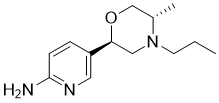
PF-592379 (PF592379) is a novel, potent and selective agonist of dopamine D3 receptor agonist (EC50 = 21 nM) with the potential for the treatment of male erectile dysfunction and female sexual dysfunction. opamine receptor antagonism is a compelling molecular target for the treatment of a range of psychiatric disorders, including substance use disorders. In vivo, PF-592379 has low-moderate clearance relative to liver blood flow of 6.3 and 8.5 ml/min/kg in dog and 44.8 and 58.2 ml/min/kg in rat. It has high permeability in Caco-2 cells and was completely absorbed in rat and dog pharmacokinetic studies with an oral bioavailability of 28% in both rats and 61 and 87% in the dogs. These data are consistent with the physicochemical properties of PF-592379, which indicate complete absorption by the transcellular route. Elimination of PF-592379 was predominantly metabolic in nature. In vitro routes of metabolism studies indicate that metabolism in the rat is a combination of P450 mechanisms and N-glucuronidation, whereas in dog and human, N-glucuronidation is the major route. NMR analysis indicates that N-glucuronidation is non-quaternary in nature and occurs on both the pyridyl amine and ring nitrogen. Rates of clearance via N-glucuronidation were predicted to be low in humans compared with acyl or phenolic glucuronidation. PF-592379 was predicted to have complete absorption from the gastrointestinal tract and an oral bioavailability of >60% in the clinic. Clinical data verified that PF-592379 is a low clearance compound in human, with a mean oral clearance of 6.5 ml/min/kg following a 200 mg oral dose. PF-592379 has ideal pharmacokinetic properties for an oral D3 agonist, intended for on demand dosing.
Physicochemical Properties
| Molecular Formula | C13H21N3O |
| Molecular Weight | 235.3253428936 |
| Exact Mass | 235.168 |
| CAS # | 710655-15-5 |
| PubChem CID | 10263487 |
| Appearance | Typically exists as solid at room temperature |
| LogP | 1.3 |
| Hydrogen Bond Donor Count | 1 |
| Hydrogen Bond Acceptor Count | 4 |
| Rotatable Bond Count | 3 |
| Heavy Atom Count | 17 |
| Complexity | 237 |
| Defined Atom Stereocenter Count | 2 |
| SMILES | CCCN1C[C@H](OC[C@@H]1C)C2=CN=C(C=C2)N |
| InChi Key | DFTCYTDJDXZFSK-JQWIXIFHSA-N |
| InChi Code | InChI=1S/C13H21N3O/c1-3-6-16-8-12(17-9-10(16)2)11-4-5-13(14)15-7-11/h4-5,7,10,12H,3,6,8-9H2,1-2H3,(H2,14,15)/t10-,12-/m0/s1 |
| Chemical Name | 5-[(2R,5S)-5-methyl-4-propylmorpholin-2-yl]pyridin-2-amine |
| Synonyms | PF592379; PF 592379; PF-592379. |
| HS Tariff Code | 2934.99.9001 |
| Storage |
Powder-20°C 3 years 4°C 2 years In solvent -80°C 6 months -20°C 1 month |
| Shipping Condition | Room temperature (This product is stable at ambient temperature for a few days during ordinary shipping and time spent in Customs) |
Biological Activity
| ln Vitro | PF-592379 appears to be a complete agonist (Emax=95%) in comparison to normal pramipexole, a D2/D3 receptor agonist used to treat Parkinson's disease [1]. The dopamine 3 agonist PF-592379 is a strong and selective one, with EC50 and Ki values of 21 nM and 322 nM, respectively[2]. PF-592379 (PF-592,379) preferentially and highly affinitively binds to the human D3 receptor (Ki=215 nM), according to in vitro binding studies. PF-592379 has binding selectivity for the human D3 receptor that is 19 times larger than that of the D4 receptor, despite the fact that it also binds to the human D4 receptor (Ki=4165 nM). At dosages up to 10 µM, PF-592379 is preferred to D3 over D2, D1, and D5 receptors since it is unable to bind human D2 (Ki≥10 μM), D1 (Ki≥10 μM), or D5 (Ki≥10 μM) receptors [3]. |
| ln Vivo | PF-592379 is an oral dopamine-3 agonist for rats and dogs. PF-592379 has low-to-moderate clearance relative to hepatic blood flow in dogs, ranging from 6.3 and 8.5 mL/min/kg in dogs to 44.8 and 58.2 mL/min/kg in rats. It is extremely permeable in Caco-2 cells and was entirely absorbed in pharmacokinetic experiments in rats and dogs, with oral bioavailability of 28% in rats and 61% in dogs, respectively. 87%[1]. |
| References |
[1]. Attkins N, et al. Pharmacokinetics and elucidation of the rates and routes of N-glucuronidation of PF-592379, an oral dopamine 3 agonist in rat, dog, and human. Xenobiotica. 2010 Nov;40(11):730-42. [2]. Wager TT, et al. Dopamine D3/D2 Receptor Antagonist PF-4363467 Attenuates Opioid Drug-Seeking Behavior without Concomitant D2 Side Effects. ACS Chem Neurosci. 2017 Jan 18;8(1):165-177. [3]. Collins GT, et al. Lack of abuse potential in a highly selective dopamine D3 agonist, PF-592,379, in drug self-administration and drug discrimination in rats. Behav Pharmacol. 2012 Jun;23(3):280-91 |
Solubility Data
| Solubility (In Vitro) | May dissolve in DMSO (in most cases), if not, try other solvents such as H2O, Ethanol, or DMF with a minute amount of products to avoid loss of samples |
| Solubility (In Vivo) |
Note: Listed below are some common formulations that may be used to formulate products with low water solubility (e.g. < 1 mg/mL), you may test these formulations using a minute amount of products to avoid loss of samples. Injection Formulations (e.g. IP/IV/IM/SC) Injection Formulation 1: DMSO : Tween 80: Saline = 10 : 5 : 85 (i.e. 100 μL DMSO stock solution → 50 μL Tween 80 → 850 μL Saline) *Preparation of saline: Dissolve 0.9 g of sodium chloride in 100 mL ddH ₂ O to obtain a clear solution. Injection Formulation 2: DMSO : PEG300 :Tween 80 : Saline = 10 : 40 : 5 : 45 (i.e. 100 μL DMSO → 400 μLPEG300 → 50 μL Tween 80 → 450 μL Saline) Injection Formulation 3: DMSO : Corn oil = 10 : 90 (i.e. 100 μL DMSO → 900 μL Corn oil) Example: Take the Injection Formulation 3 (DMSO : Corn oil = 10 : 90) as an example, if 1 mL of 2.5 mg/mL working solution is to be prepared, you can take 100 μL 25 mg/mL DMSO stock solution and add to 900 μL corn oil, mix well to obtain a clear or suspension solution (2.5 mg/mL, ready for use in animals). Injection Formulation 4: DMSO : 20% SBE-β-CD in saline = 10 : 90 [i.e. 100 μL DMSO → 900 μL (20% SBE-β-CD in saline)] *Preparation of 20% SBE-β-CD in Saline (4°C,1 week): Dissolve 2 g SBE-β-CD in 10 mL saline to obtain a clear solution. Injection Formulation 5: 2-Hydroxypropyl-β-cyclodextrin : Saline = 50 : 50 (i.e. 500 μL 2-Hydroxypropyl-β-cyclodextrin → 500 μL Saline) Injection Formulation 6: DMSO : PEG300 : castor oil : Saline = 5 : 10 : 20 : 65 (i.e. 50 μL DMSO → 100 μLPEG300 → 200 μL castor oil → 650 μL Saline) Injection Formulation 7: Ethanol : Cremophor : Saline = 10: 10 : 80 (i.e. 100 μL Ethanol → 100 μL Cremophor → 800 μL Saline) Injection Formulation 8: Dissolve in Cremophor/Ethanol (50 : 50), then diluted by Saline Injection Formulation 9: EtOH : Corn oil = 10 : 90 (i.e. 100 μL EtOH → 900 μL Corn oil) Injection Formulation 10: EtOH : PEG300:Tween 80 : Saline = 10 : 40 : 5 : 45 (i.e. 100 μL EtOH → 400 μLPEG300 → 50 μL Tween 80 → 450 μL Saline) Oral Formulations Oral Formulation 1: Suspend in 0.5% CMC Na (carboxymethylcellulose sodium) Oral Formulation 2: Suspend in 0.5% Carboxymethyl cellulose Example: Take the Oral Formulation 1 (Suspend in 0.5% CMC Na) as an example, if 100 mL of 2.5 mg/mL working solution is to be prepared, you can first prepare 0.5% CMC Na solution by measuring 0.5 g CMC Na and dissolve it in 100 mL ddH2O to obtain a clear solution; then add 250 mg of the product to 100 mL 0.5% CMC Na solution, to make the suspension solution (2.5 mg/mL, ready for use in animals). Oral Formulation 3: Dissolved in PEG400 Oral Formulation 4: Suspend in 0.2% Carboxymethyl cellulose Oral Formulation 5: Dissolve in 0.25% Tween 80 and 0.5% Carboxymethyl cellulose Oral Formulation 6: Mixing with food powders Note: Please be aware that the above formulations are for reference only. InvivoChem strongly recommends customers to read literature methods/protocols carefully before determining which formulation you should use for in vivo studies, as different compounds have different solubility properties and have to be formulated differently. (Please use freshly prepared in vivo formulations for optimal results.) |
| Preparing Stock Solutions | 1 mg | 5 mg | 10 mg | |
| 1 mM | 4.2494 mL | 21.2468 mL | 42.4935 mL | |
| 5 mM | 0.8499 mL | 4.2494 mL | 8.4987 mL | |
| 10 mM | 0.4249 mL | 2.1247 mL | 4.2494 mL |