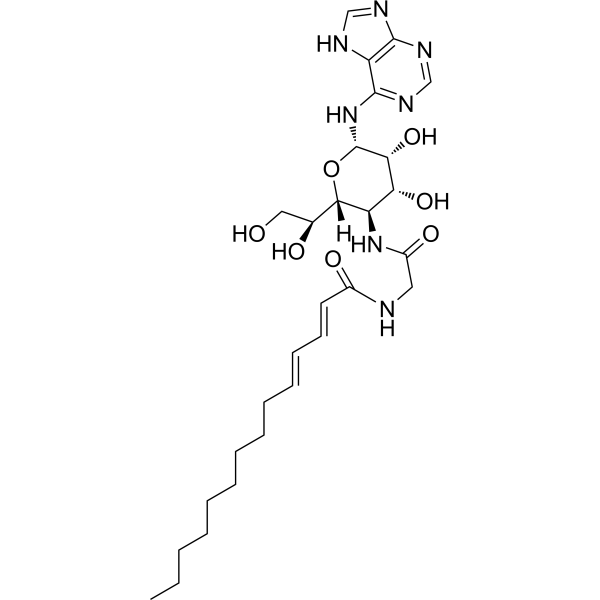
Physicochemical Properties
| Molecular Formula | C28H43N7O7 |
| Molecular Weight | 589.69 |
| Exact Mass | 589.322 |
| CAS # | 151276-95-8 |
| PubChem CID | 5459220 |
| Appearance | Typically exists as solid at room temperature |
| Density | 1.34g/cm3 |
| Boiling Point | 1007.6ºC at 760 mmHg |
| Flash Point | 563.2ºC |
| Vapour Pressure | 0mmHg at 25°C |
| Index of Refraction | 1.623 |
| LogP | 1.273 |
| Hydrogen Bond Donor Count | 8 |
| Hydrogen Bond Acceptor Count | 11 |
| Rotatable Bond Count | 17 |
| Heavy Atom Count | 42 |
| Complexity | 880 |
| Defined Atom Stereocenter Count | 0 |
| SMILES | CCCCCCCCC/C=C/C=C/C(NCC(N[C@@H]1[C@@H](O)[C@@H](O)[C@H](O[C@H]1[C@@H](O)CO)NC2=NC=NC3=C2N=CN3)=O)=O |
| InChi Key | LQIPDFIUPOYMPR-AQASXUMVSA-N |
| InChi Code | InChI=1S/C28H43N7O7/c1-2-3-4-5-6-7-8-9-10-11-12-13-19(38)29-14-20(39)34-21-23(40)24(41)28(42-25(21)18(37)15-36)35-27-22-26(31-16-30-22)32-17-33-27/h10-13,16-18,21,23-25,28,36-37,40-41H,2-9,14-15H2,1H3,(H,29,38)(H,34,39)(H2,30,31,32,33,35)/b11-10+,13-12+ |
| Chemical Name | (2E,4E)-N-[2-[[2-(1,2-dihydroxyethyl)-4,5-dihydroxy-6-(7H-purin-6-ylamino)oxan-3-yl]amino]-2-oxoethyl]tetradeca-2,4-dienamide |
| Synonyms | NSC-650426; KRN-5500; SPK-241 |
| HS Tariff Code | 2934.99.9001 |
| Storage |
Powder-20°C 3 years 4°C 2 years In solvent -80°C 6 months -20°C 1 month |
| Shipping Condition | Room temperature (This product is stable at ambient temperature for a few days during ordinary shipping and time spent in Customs) |
Biological Activity
| ln Vitro | KRN5500 (10-160 ng/mL; 0-5 d) efficiently suppresses NB4, NKM-1, and HL-60 cell survival and proliferation [1]. The Bcl-2 expression in NB4 cells is induced by KRN5500 (40 ng/mL, 160 ng/mL; 48 h) and KRN5500 (40 ng/mL, 80 ng/mL; 36 h) instructions [1]. |
| ln Vivo | In various tumor models and human tumor xenosuppression models, KRN5500 (4 mg/kg; i.p.; once daily for 5 days) demonstrated anti-activity, leading to decreased tumor weight [2]. |
| Cell Assay |
Cell Viability Assay[1]. Cell Types: NB4, HL-60, NKM-1, NOP-1 and Daudi Cell Tested Concentrations: 10 ng/mL, 20 ng/mL, 40 ng/mL, 80 ng/mL, 160 ng/mL Incubation Duration: 0, Results at 1, 2, 3, 4, 5 days or 72 hrs (hours): Approximately 80 ng/mL of NB4 and NKM-1 and 160 ng/mL of HL-60 completely inhibited cell proliferation and viability. The IC50s for inhibiting cell viability are 51.6 ng/mL, 89.7 ng/mL, 66.5 ng/mL, 277.0 ng/mL, and 242.1 ng/mL respectively. Western Blot Analysis [1] Cell Types: NB4 Cell Tested Concentrations: 40 ng/mL, 80 ng/mL Incubation Duration: 36 h Experimental Results: diminished Bcl-2 expression, but did not affect Bcl-xL and Bax expression. |
| Animal Protocol |
Animal/Disease Models: Mouse model tumors and human tumor xenografts [2] Doses: 4 mg/kg Route of Administration: intraperitoneal (ip) injection; one time/day for 5 days Experimental Results: Prolonged survival in mice with P388 leukemia and B16 melanoma survival, but has limited effect on colon adenocarcinoma. Tumor weight was diminished in 10 gastric cancers, 14 colon cancers, and 2 esophageal cancers. |
| References |
[1]. Zhang WJ, et al. Spicamycin and KRN5500 induce apoptosis in myeloid and lymphoid cell lines with down-regulation of bcl-2 expression and modulation of promyelocytic leukemia protein. Jpn J Cancer Res. 2000 Jun;91(6):604-11. [2]. Kamishohara M, et al. Antitumor activity of a spicamycin derivative, KRN5500, and its active metabolite in tumor cells. Oncol Res. 1994;6(8):383-90. |
| Additional Infomation |
KRN-5500 is under investigation in clinical trial NCT00002923 (KRN5500 in Treating Patients With Metastatic Solid Tumors). KRN5500 is a semisynthetic derivative of the nucleoside-like antineoplastic antibiotic spicamycin, originally isolated from the bacterium Streptomyces alanosinicus. KRN 5500 inhibits protein synthesis by interfering with endoplasmic reticulum and Golgi apparatus functions. This agent also induces cell differentiation and caspase-dependent apoptosis. (NCI04) See also: Krn-5500 (annotation moved to). |
Solubility Data
| Solubility (In Vitro) | May dissolve in DMSO (in most cases), if not, try other solvents such as H2O, Ethanol, or DMF with a minute amount of products to avoid loss of samples |
| Solubility (In Vivo) |
Note: Listed below are some common formulations that may be used to formulate products with low water solubility (e.g. < 1 mg/mL), you may test these formulations using a minute amount of products to avoid loss of samples. Injection Formulations (e.g. IP/IV/IM/SC) Injection Formulation 1: DMSO : Tween 80: Saline = 10 : 5 : 85 (i.e. 100 μL DMSO stock solution → 50 μL Tween 80 → 850 μL Saline) *Preparation of saline: Dissolve 0.9 g of sodium chloride in 100 mL ddH ₂ O to obtain a clear solution. Injection Formulation 2: DMSO : PEG300 :Tween 80 : Saline = 10 : 40 : 5 : 45 (i.e. 100 μL DMSO → 400 μLPEG300 → 50 μL Tween 80 → 450 μL Saline) Injection Formulation 3: DMSO : Corn oil = 10 : 90 (i.e. 100 μL DMSO → 900 μL Corn oil) Example: Take the Injection Formulation 3 (DMSO : Corn oil = 10 : 90) as an example, if 1 mL of 2.5 mg/mL working solution is to be prepared, you can take 100 μL 25 mg/mL DMSO stock solution and add to 900 μL corn oil, mix well to obtain a clear or suspension solution (2.5 mg/mL, ready for use in animals). Injection Formulation 4: DMSO : 20% SBE-β-CD in saline = 10 : 90 [i.e. 100 μL DMSO → 900 μL (20% SBE-β-CD in saline)] *Preparation of 20% SBE-β-CD in Saline (4°C,1 week): Dissolve 2 g SBE-β-CD in 10 mL saline to obtain a clear solution. Injection Formulation 5: 2-Hydroxypropyl-β-cyclodextrin : Saline = 50 : 50 (i.e. 500 μL 2-Hydroxypropyl-β-cyclodextrin → 500 μL Saline) Injection Formulation 6: DMSO : PEG300 : castor oil : Saline = 5 : 10 : 20 : 65 (i.e. 50 μL DMSO → 100 μLPEG300 → 200 μL castor oil → 650 μL Saline) Injection Formulation 7: Ethanol : Cremophor : Saline = 10: 10 : 80 (i.e. 100 μL Ethanol → 100 μL Cremophor → 800 μL Saline) Injection Formulation 8: Dissolve in Cremophor/Ethanol (50 : 50), then diluted by Saline Injection Formulation 9: EtOH : Corn oil = 10 : 90 (i.e. 100 μL EtOH → 900 μL Corn oil) Injection Formulation 10: EtOH : PEG300:Tween 80 : Saline = 10 : 40 : 5 : 45 (i.e. 100 μL EtOH → 400 μLPEG300 → 50 μL Tween 80 → 450 μL Saline) Oral Formulations Oral Formulation 1: Suspend in 0.5% CMC Na (carboxymethylcellulose sodium) Oral Formulation 2: Suspend in 0.5% Carboxymethyl cellulose Example: Take the Oral Formulation 1 (Suspend in 0.5% CMC Na) as an example, if 100 mL of 2.5 mg/mL working solution is to be prepared, you can first prepare 0.5% CMC Na solution by measuring 0.5 g CMC Na and dissolve it in 100 mL ddH2O to obtain a clear solution; then add 250 mg of the product to 100 mL 0.5% CMC Na solution, to make the suspension solution (2.5 mg/mL, ready for use in animals). Oral Formulation 3: Dissolved in PEG400 Oral Formulation 4: Suspend in 0.2% Carboxymethyl cellulose Oral Formulation 5: Dissolve in 0.25% Tween 80 and 0.5% Carboxymethyl cellulose Oral Formulation 6: Mixing with food powders Note: Please be aware that the above formulations are for reference only. InvivoChem strongly recommends customers to read literature methods/protocols carefully before determining which formulation you should use for in vivo studies, as different compounds have different solubility properties and have to be formulated differently. (Please use freshly prepared in vivo formulations for optimal results.) |
| Preparing Stock Solutions | 1 mg | 5 mg | 10 mg | |
| 1 mM | 1.6958 mL | 8.4790 mL | 16.9581 mL | |
| 5 mM | 0.3392 mL | 1.6958 mL | 3.3916 mL | |
| 10 mM | 0.1696 mL | 0.8479 mL | 1.6958 mL |