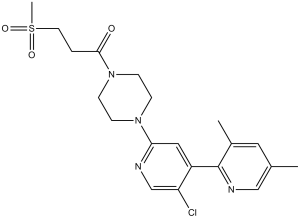
PF-5274857 (PF5274857; PF 5274857) is a novel, potent, orally bioavailable and selective Smoothened (Smo) antagonist with potential antineoplastic activity. Its IC50s and Ki values for the Hedgehog (Hh) signaling pathway are 5.8 nM and 4.6 nM, respectively.
Physicochemical Properties
| Molecular Formula | C20H25CLN4O3S | |
| Molecular Weight | 436.96 | |
| Exact Mass | 436.133 | |
| Elemental Analysis | C, 54.98; H, 5.77; Cl, 8.11; N, 12.82; O, 10.98; S, 7.34 | |
| CAS # | 1373615-35-0 | |
| Related CAS # | PF-5274857 hydrochloride; 1613439-62-5 | |
| PubChem CID | 56956240 | |
| Appearance | Light yellow to yellow solid powder | |
| Density | 1.3±0.1 g/cm3 | |
| Boiling Point | 686.0±55.0 °C at 760 mmHg | |
| Flash Point | 368.7±31.5 °C | |
| Vapour Pressure | 0.0±2.1 mmHg at 25°C | |
| Index of Refraction | 1.590 | |
| LogP | 1.44 | |
| Hydrogen Bond Donor Count | 0 | |
| Hydrogen Bond Acceptor Count | 6 | |
| Rotatable Bond Count | 5 | |
| Heavy Atom Count | 29 | |
| Complexity | 663 | |
| Defined Atom Stereocenter Count | 0 | |
| SMILES | ClC1=C([H])N=C(C([H])=C1C1=C(C([H])([H])[H])C([H])=C(C([H])([H])[H])C([H])=N1)N1C([H])([H])C([H])([H])N(C(C([H])([H])C([H])([H])S(C([H])([H])[H])(=O)=O)=O)C([H])([H])C1([H])[H] |
|
| InChi Key | BBVNTTZIOTWDSV-UHFFFAOYSA-N | |
| InChi Code | InChI=1S/C20H25ClN4O3S/c1-14-10-15(2)20(23-12-14)16-11-18(22-13-17(16)21)24-5-7-25(8-6-24)19(26)4-9-29(3,27)28/h10-13H,4-9H2,1-3H3 | |
| Chemical Name | 1-[4-[5-chloro-4-(3,5-dimethylpyridin-2-yl)pyridin-2-yl]piperazin-1-yl]-3-methylsulfonylpropan-1-one | |
| Synonyms |
|
|
| HS Tariff Code | 2934.99.9001 | |
| Storage |
Powder-20°C 3 years 4°C 2 years In solvent -80°C 6 months -20°C 1 month |
|
| Shipping Condition | Room temperature (This product is stable at ambient temperature for a few days during ordinary shipping and time spent in Customs) |
Biological Activity
| Targets | Smo ( IC50 = 5.8 nM ); Smo ( Ki = 4.6 nM ) | ||
| ln Vitro |
|
||
| ln Vivo |
|
||
| Enzyme Assay | In Dulbecco's Modified Eagles Medium (DMEM) supplemented with 10% FBS, Pen–Strep, and 0.1 mg/mL hygromycin, HEK293 cells overexpressing human Smo (amino acids 181–787) are grown to 90% confluence. The cell pellet is resuspended in membrane preparation buffer (50 mM Tris-HCl, pH 7.5, 250 mM sucrose with Roche complete protease cocktail) and homogenized following washing with cold Dulbeccos PBS. After centrifuging the homogenate, the cell pellet is resuspended in assay buffer, which contains 0.1% protease-free bovine serum albumin, 50 mM Tris-HCl, pH 7.5, 100 mM NaCl, 25 mM MgCl2, and 1 mM EDTA. The homogenization process is carried out in a glass tissue grinder. The Pierce BCA protein assay is used to determine the total protein in the membrane preparation that contains Smo. In order to perform the competitive binding assay, 96-well GF/B filter plates are pre-wetted with 100 μL of assay buffer for ten minutes, after which the filter is removed. After that, the following reagents are added: 50 μL of membrane preparation (40 μg total protein), 10 μL serial dilutions of compound, 20 μL of 3H-Smo antagonist (3 nM final concentration), and 20 μL of assay buffer. After two hours of room temperature incubation, the plates are cleaned and vacuum dried. Following an hour-long drying process in an oven set at 60°C, 45 μL of Microscint 20 is added to the plates, which are then incubated for 30 to 1 hour at room temperature before being counted using a TopCount scintillation counter. Software called GraphPad Prism is used to analyze the data. | ||
| Cell Assay | The knockout DMEM containing 10% heat-inactive FBS, 2 mM l-glutamine, and 0.55 mM β-mercaptoethanol is added to Gli-Luc/MEF cells during growth until 90% confluence. Day 1: Trypsinized cells are seeded at a concentration of 7,500 cells per well in white 384-well plates using 20 μL of OptiMEM media per well, supplemented with 1% heat-inactive FBS and 1 mM sodium pyruvate. Overnight, plates are incubated at 37 °C with 5% CO2. On day 2, recombinant mouse Sonic Hedgehog is added to the cells at a final concentration of 2 μg/mL, after PF-5274857 is added at a final concentration ranging from 3 μM to 50 pM at a 3-fold serial dilution. PF-5274857 and Shh are added to the cells and incubated for 48 hours at 37 °C with 5% CO2. Day 4 luciferase assays using the Bright-Glo Luciferase Assay System are carried out. To summarise, 25 μL of Bright-Glo luciferase reagent is introduced into every well of the 384-well plate holding media. After five minutes of room temperature storage, plates are read using a luminescence plate reader. PF-5274857's IC50 value is computed. | ||
| Animal Protocol |
|
||
| References |
[1]. Effective targeting of Hedgehog signaling in a medulloblastoma model with PF-5274857, a potent and selective Smoothened antagonist that penetrates the blood-brain barrier. Mol Cancer Ther. 2012, 11(1), 57-65. |
Solubility Data
| Solubility (In Vitro) |
|
|||
| Solubility (In Vivo) |
Solubility in Formulation 1: ≥ 2.08 mg/mL (4.76 mM) (saturation unknown) in 10% DMSO + 40% PEG300 + 5% Tween80 + 45% Saline (add these co-solvents sequentially from left to right, and one by one), clear solution. For example, if 1 mL of working solution is to be prepared, you can add 100 μL of 20.8 mg/mL clear DMSO stock solution to 400 μL PEG300 and mix evenly; then add 50 μL Tween-80 to the above solution and mix evenly; then add 450 μL normal saline to adjust the volume to 1 mL. Preparation of saline: Dissolve 0.9 g of sodium chloride in 100 mL ddH₂ O to obtain a clear solution. Solubility in Formulation 2: ≥ 2.08 mg/mL (4.76 mM) (saturation unknown) in 10% DMSO + 90% (20% SBE-β-CD in Saline) (add these co-solvents sequentially from left to right, and one by one), clear solution. For example, if 1 mL of working solution is to be prepared, you can add 100 μL of 20.8 mg/mL clear DMSO stock solution to 900 μL of 20% SBE-β-CD physiological saline solution and mix evenly. Preparation of 20% SBE-β-CD in Saline (4°C,1 week): Dissolve 2 g SBE-β-CD in 10 mL saline to obtain a clear solution. Solubility in Formulation 3: ≥ 2.08 mg/mL (4.76 mM) (saturation unknown) in 10% DMSO + 90% Corn Oil (add these co-solvents sequentially from left to right, and one by one), clear solution. For example, if 1 mL of working solution is to be prepared, you can add 100 μL of 20.8 mg/mL clear DMSO stock solution to 900 μL of corn oil and mix evenly. Solubility in Formulation 4: Saline: 30 mg/mL (Please use freshly prepared in vivo formulations for optimal results.) |
| Preparing Stock Solutions | 1 mg | 5 mg | 10 mg | |
| 1 mM | 2.2885 mL | 11.4427 mL | 22.8854 mL | |
| 5 mM | 0.4577 mL | 2.2885 mL | 4.5771 mL | |
| 10 mM | 0.2289 mL | 1.1443 mL | 2.2885 mL |