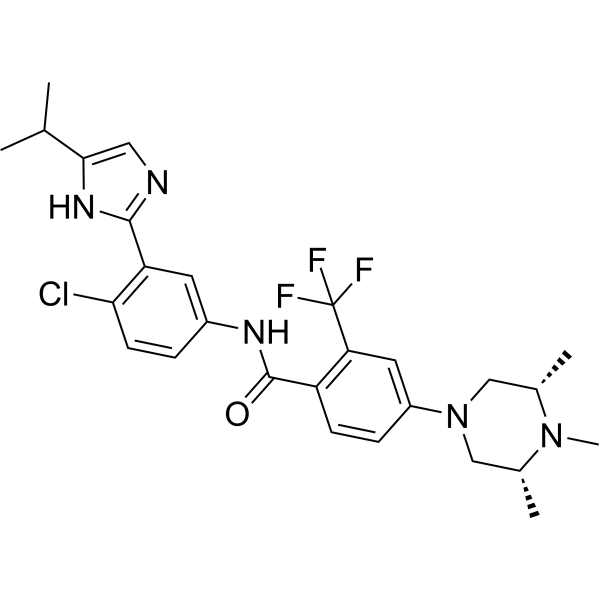
Physicochemical Properties
| Molecular Formula | C27H31CLF3N5O |
| Molecular Weight | 534.02 |
| CAS # | 1544681-93-7 |
| Appearance | Typically exists as solid at room temperature |
| HS Tariff Code | 2934.99.9001 |
| Storage |
Powder-20°C 3 years 4°C 2 years In solvent -80°C 6 months -20°C 1 month |
| Shipping Condition | Room temperature (This product is stable at ambient temperature for a few days during ordinary shipping and time spent in Customs) |
Biological Activity
| ln Vivo | Method of modeling: rat pulmonary fibrosis model caused by bleomycin (3 mg/kg; intratracheal injection; repeated for 8 days). In the Bleomycin-induced rat pulmonary fibrosis model, Hedgehog IN-5 (5-30 mg/kg; administered orally 8 days after modeling; once daily for 2 weeks) effectively prevented lung fibrosis on several pathological assessment indicators. The process's therapeutic impact[1]. The model was created by injecting CCL4 (dissolved in olive oil) into C57BL/6 mice three times a week for four weeks, causing liver fibrosis. In the CCL4-induced C57BL/6 mouse liver fibrosis model, Hedgehog IN-5 (5–20 mg/kg; administered orally on the day of modeling; once daily for 4 weeks) has a certain propensity to suppress CCl4-induced liver fibrosis. primarily shown as a decrease in the extent of hepatocyte necrosis and degeneration as well as a reduction in the fibrosis area[1]. Hedgehog IN-5 (10–20 mg/kg, or 20 mg/kg when combined with BIBF1120; oral; once daily for 20 days)) considerably reduced the inflammation and fibrosis caused by bleomycin-induced lung tissue damage[1]. |
| Animal Protocol |
Animal/Disease Models: Unilateral pulmonary fibrosis in SD rat model[1] Doses: 5 mg/kg, 15 mg/kg, 30 mg/kg Route of Administration: Oral administration after 8 days of molding; one time/day for 2 weeks Experimental Results: decreased the scores of Bleomycin treated mice, Dramatically. Collagen content in the lungs as well as myofibroblasts were quantified to assess the antifibrotic effect of Hedgehog IN-5, α-SMA protein percentage was Dramatically decreased with 30 mg/kg dose and collagen content was not Dramatically changed. Animal/Disease Models: CCL4-induced liver fibrosis model in C57BL/6 mice[1] Doses: 5 mg/kg, 10 mg/kg, 20 mg/kg Route of Administration: Oral administration on the day of molding ; one time/day for four weeks Experimental Results: demonstrated slow weight gain after one week and no significant weight gain after two weeks at the dose of 20 mg/kg. Serum biochemical detection in peripheral blood demonstrated that ALT and AST were Dramatically decreased but TBIL had no change at the dose of 20mg/kg. Liver histopathological analysis demonstrated that the |
| References |
[1]. Application of hedgehog pathway inhibitor for treatment of fibrotic diseases. World Intellectual Property Organization, WO2018082587 A1 2018-05-11. |
Solubility Data
| Solubility (In Vitro) | May dissolve in DMSO (in most cases), if not, try other solvents such as H2O, Ethanol, or DMF with a minute amount of products to avoid loss of samples |
| Solubility (In Vivo) |
Note: Listed below are some common formulations that may be used to formulate products with low water solubility (e.g. < 1 mg/mL), you may test these formulations using a minute amount of products to avoid loss of samples. Injection Formulations (e.g. IP/IV/IM/SC) Injection Formulation 1: DMSO : Tween 80: Saline = 10 : 5 : 85 (i.e. 100 μL DMSO stock solution → 50 μL Tween 80 → 850 μL Saline) *Preparation of saline: Dissolve 0.9 g of sodium chloride in 100 mL ddH ₂ O to obtain a clear solution. Injection Formulation 2: DMSO : PEG300 :Tween 80 : Saline = 10 : 40 : 5 : 45 (i.e. 100 μL DMSO → 400 μLPEG300 → 50 μL Tween 80 → 450 μL Saline) Injection Formulation 3: DMSO : Corn oil = 10 : 90 (i.e. 100 μL DMSO → 900 μL Corn oil) Example: Take the Injection Formulation 3 (DMSO : Corn oil = 10 : 90) as an example, if 1 mL of 2.5 mg/mL working solution is to be prepared, you can take 100 μL 25 mg/mL DMSO stock solution and add to 900 μL corn oil, mix well to obtain a clear or suspension solution (2.5 mg/mL, ready for use in animals). Injection Formulation 4: DMSO : 20% SBE-β-CD in saline = 10 : 90 [i.e. 100 μL DMSO → 900 μL (20% SBE-β-CD in saline)] *Preparation of 20% SBE-β-CD in Saline (4°C,1 week): Dissolve 2 g SBE-β-CD in 10 mL saline to obtain a clear solution. Injection Formulation 5: 2-Hydroxypropyl-β-cyclodextrin : Saline = 50 : 50 (i.e. 500 μL 2-Hydroxypropyl-β-cyclodextrin → 500 μL Saline) Injection Formulation 6: DMSO : PEG300 : castor oil : Saline = 5 : 10 : 20 : 65 (i.e. 50 μL DMSO → 100 μLPEG300 → 200 μL castor oil → 650 μL Saline) Injection Formulation 7: Ethanol : Cremophor : Saline = 10: 10 : 80 (i.e. 100 μL Ethanol → 100 μL Cremophor → 800 μL Saline) Injection Formulation 8: Dissolve in Cremophor/Ethanol (50 : 50), then diluted by Saline Injection Formulation 9: EtOH : Corn oil = 10 : 90 (i.e. 100 μL EtOH → 900 μL Corn oil) Injection Formulation 10: EtOH : PEG300:Tween 80 : Saline = 10 : 40 : 5 : 45 (i.e. 100 μL EtOH → 400 μLPEG300 → 50 μL Tween 80 → 450 μL Saline) Oral Formulations Oral Formulation 1: Suspend in 0.5% CMC Na (carboxymethylcellulose sodium) Oral Formulation 2: Suspend in 0.5% Carboxymethyl cellulose Example: Take the Oral Formulation 1 (Suspend in 0.5% CMC Na) as an example, if 100 mL of 2.5 mg/mL working solution is to be prepared, you can first prepare 0.5% CMC Na solution by measuring 0.5 g CMC Na and dissolve it in 100 mL ddH2O to obtain a clear solution; then add 250 mg of the product to 100 mL 0.5% CMC Na solution, to make the suspension solution (2.5 mg/mL, ready for use in animals). Oral Formulation 3: Dissolved in PEG400 Oral Formulation 4: Suspend in 0.2% Carboxymethyl cellulose Oral Formulation 5: Dissolve in 0.25% Tween 80 and 0.5% Carboxymethyl cellulose Oral Formulation 6: Mixing with food powders Note: Please be aware that the above formulations are for reference only. InvivoChem strongly recommends customers to read literature methods/protocols carefully before determining which formulation you should use for in vivo studies, as different compounds have different solubility properties and have to be formulated differently. (Please use freshly prepared in vivo formulations for optimal results.) |
| Preparing Stock Solutions | 1 mg | 5 mg | 10 mg | |
| 1 mM | 1.8726 mL | 9.3629 mL | 18.7259 mL | |
| 5 mM | 0.3745 mL | 1.8726 mL | 3.7452 mL | |
| 10 mM | 0.1873 mL | 0.9363 mL | 1.8726 mL |