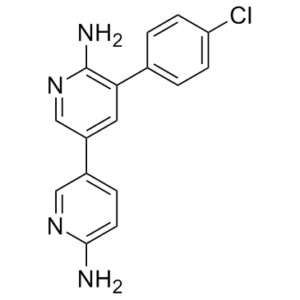
PF-06260933 is a highly selective small-molecule inhibitor of MAP4K4 (Mitogen-activated protein kinase kinase kinase 4) with IC50 values of 3.7 and 160 nM for cell-freel assay and cell assay, respectively. Additionally, with IC50 values of 8 and 13 nM, it inhibits MINK and TNIK. Fasting hyperglycemia in mice has been shown to be reduced by PF-06260933. Recent research on the serine/threonine protein kinase MAP4K4, which is found in adipose tissue, the pancreas, muscle, and macrophages, suggests that it may be a promising target for anti-diabetic medications. The evaluation of MAP4K4 as a potential new anti-diabetic target is being done with PF-6260933.
Physicochemical Properties
| Molecular Formula | C16H13CLN4 | |
| Molecular Weight | 296.08 | |
| Exact Mass | 296.08 | |
| Elemental Analysis | C, 64.76; H, 4.42; Cl, 11.95; N, 18.88 | |
| CAS # | 1811510-56-1 | |
| Related CAS # | 1883548-86-4 (2HCl);1811510-56-1;2118243-34-6 (HCl); | |
| PubChem CID | 118701008 | |
| Appearance | White to off-white solid powder | |
| LogP | 3 | |
| Hydrogen Bond Donor Count | 2 | |
| Hydrogen Bond Acceptor Count | 4 | |
| Rotatable Bond Count | 2 | |
| Heavy Atom Count | 21 | |
| Complexity | 332 | |
| Defined Atom Stereocenter Count | 0 | |
| InChi Key | KHPCIHZXOGHCLY-UHFFFAOYSA-N | |
| InChi Code | InChI=1S/C16H13ClN4/c17-13-4-1-10(2-5-13)14-7-12(9-21-16(14)19)11-3-6-15(18)20-8-11/h1-9H,(H2,18,20)(H2,19,21) | |
| Chemical Name | 5-(6-aminopyridin-3-yl)-3-(4-chlorophenyl)pyridin-2-amine | |
| Synonyms |
|
|
| HS Tariff Code | 2934.99.9001 | |
| Storage |
Powder-20°C 3 years 4°C 2 years In solvent -80°C 6 months -20°C 1 month |
|
| Shipping Condition | Room temperature (This product is stable at ambient temperature for a few days during ordinary shipping and time spent in Customs) |
Biological Activity
| Targets | MAP4K4 (IC50 = 3.7 nM) |
| ln Vitro | PF-6260933 demonstrates good physicochemical characteristics and a moderate HLM clearance[1]. |
| ln Vivo | PF-6260933 exhibits a plasma exposure after oral dosing (10 mg/kg) that provided free drug concentrations above the cell IC50 value for about 4-6 h after administration in a mouse model. For use as a tool in an in vivo diabetes model, PF-6260933's PK properties in mice are suitable[1]. |
| Enzyme Assay | Aortas were lysed in 1% NP-40, 50 mM Tris pH 7.4, 150 mM NaCl, 50 mM EDTA, and 1 × HALT protease and phosphatase inhibitors (Thermo Scientific). Immunoprecipitates were then made using Bethyl MAP4K4 antibodies (503 A; 1 μg) or regular rabbit IgG (Cell Signaling 2729; 1 μg). The immunoprecipitates were combined with 1 μg of myelin basic protein (MBP) and 10 μCi of [γ-32P]ATP, and then incubated for 30 min at 30 °C in kinase buffer (20 mM HEPES, 10 nM MgCl2, 1 mM dithiothreitol (DTT), and protease and phosphatase inhibitor cocktail. Samples were electrophoretically separated on a 12% SDS-polyacrylamide gel and then autoradiographically viewed. |
| Cell Assay | In EGM2 media, HUVECs are kept alive at 5% CO2 and 37°C. To ascertain whether pharmacological inhibition of MAP4K4 alters MAPK signaling in response to TNF-α, HUVECs or peritoneal macrophages are treated in vitro with vehicle or PF-06260933. |
| Animal Protocol | Compound PF-06260933 (10 mg/kg, dissolved in dH2O) is orally administered to 8 to 10-week-old male Apoe-/- mice twice daily for 6 weeks. Male Ldlr-/- mice are subjected to a high-fat diet (HFD) for ten weeks prior to medication administration. Male Ldlr-/- mice aged 8 to 10 weeks receive the same dosage of compound PF-06260933 for 10 weeks. In all studies, the vehicle control is the oral administration of water. CO2 inhalation and bilateral pneumothorax are used to put mice to sleep. |
| References |
[1]. Discovery of an in Vivo Tool to Establish Proof-of-Concept for MAP4K4-Based Antidiabetic Treatment. ACS Med Chem Lett. 2015 Oct 6;6(11):1128-33. [2]. Endothelial protein kinase MAP4K4 promotes vascular inflammation and atherosclerosis. Nat Commun. 2015 Dec 21;6:8995. |
Solubility Data
| Solubility (In Vitro) |
|
|||
| Solubility (In Vivo) |
Solubility in Formulation 1: ≥ 2.5 mg/mL (8.42 mM) (saturation unknown) in 10% DMSO + 40% PEG300 + 5% Tween80 + 45% Saline (add these co-solvents sequentially from left to right, and one by one), clear solution. For example, if 1 mL of working solution is to be prepared, you can add 100 μL of 25.0 mg/mL clear DMSO stock solution to 400 μL PEG300 and mix evenly; then add 50 μL Tween-80 to the above solution and mix evenly; then add 450 μL normal saline to adjust the volume to 1 mL. Preparation of saline: Dissolve 0.9 g of sodium chloride in 100 mL ddH₂ O to obtain a clear solution. Solubility in Formulation 2: ≥ 2.5 mg/mL (8.42 mM) (saturation unknown) in 10% DMSO + 90% Corn Oil (add these co-solvents sequentially from left to right, and one by one), clear solution. For example, if 1 mL of working solution is to be prepared, you can add 100 μL of 25.0 mg/mL clear DMSO stock solution to 900 μL of corn oil and mix evenly. (Please use freshly prepared in vivo formulations for optimal results.) |
| Preparing Stock Solutions | 1 mg | 5 mg | 10 mg | |
| 1 mM | 3.3775 mL | 16.8873 mL | 33.7747 mL | |
| 5 mM | 0.6755 mL | 3.3775 mL | 6.7549 mL | |
| 10 mM | 0.3377 mL | 1.6887 mL | 3.3775 mL |