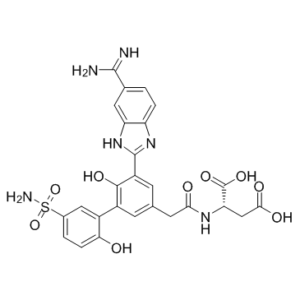
PCI-27483 is a novel, potent and reversible small-molecule inhibitor of activated factor VII (factor VIIa) with potential anticancer and antithrombotic activities. Factor VII is a serine protease which can be activated (FVIIa) upon binding with TF forming the FVIIa/TF complex, which induces intracellular signaling pathways by activating protease activated receptor 2 (PAR-2). Upon subcutaneous administration, factor VIIa inhibitor PCI-27483 selectively inhibits factor FVIIa in the VIIa/TF complex, which may prevent PAR-2 activation and PAR2-mediated signal transduction pathways, thereby inhibiting tumor cell proliferation, angiogenesis, and metastasis of TF-overexpressing tumor cells.
Physicochemical Properties
| Molecular Formula | C26H24N6O9S |
| Molecular Weight | 596.568564414978 |
| Exact Mass | 596.132 |
| CAS # | 871266-63-6 |
| PubChem CID | 135425273 |
| Appearance | Light yellow to yellow solid powder |
| Density | 1.7±0.1 g/cm3 |
| Index of Refraction | 1.775 |
| LogP | -0.74 |
| Hydrogen Bond Donor Count | 9 |
| Hydrogen Bond Acceptor Count | 12 |
| Rotatable Bond Count | 10 |
| Heavy Atom Count | 42 |
| Complexity | 1150 |
| Defined Atom Stereocenter Count | 1 |
| SMILES | OC1C(C2C(O)=CC=C(S(=O)(=O)N)C=2)=CC(CC(=O)N[C@H](C(=O)O)CC(=O)O)=CC=1C1=NC2C=CC(=CC=2N1)C(N)=N |
| InChi Key | WDJHHCAKBRKCLW-IBGZPJMESA-N |
| InChi Code | InChI=1S/C26H24N6O9S/c27-24(28)12-1-3-17-18(8-12)32-25(31-17)16-6-11(7-21(34)30-19(26(38)39)10-22(35)36)5-15(23(16)37)14-9-13(42(29,40)41)2-4-20(14)33/h1-6,8-9,19,33,37H,7,10H2,(H3,27,28)(H,30,34)(H,31,32)(H,35,36)(H,38,39)(H2,29,40,41)/t19-/m0/s1 |
| Chemical Name | (S)-2-(2-(5-(5-carbamimidoyl-1H-benzo[d]imidazol-2-yl)-2',6-dihydroxy-5'-sulfamoyl-[1,1'-biphenyl]-3-yl)acetamido)succinic acid. |
| Synonyms | PCI27483; PCI-27483; PCI 27483. |
| HS Tariff Code | 2934.99.9001 |
| Storage |
Powder-20°C 3 years 4°C 2 years In solvent -80°C 6 months -20°C 1 month |
| Shipping Condition | Room temperature (This product is stable at ambient temperature for a few days during ordinary shipping and time spent in Customs) |
Biological Activity
| Targets |
FVIIa/TF complex (factor VIIa/tissue factor complex) with high potency and selectivity. [2] |
| ln Vitro |
In BxPC3 cells, a human pancreatic adenocarcinoma cell line that expresses TF extensively, PCI-27483 suppresses TF:FVIIa complex-induced ERK1/2 phosphorylation and the consequent activation of c-fos. Furthermore, PCI-27483 has the ability to inhibit TF:FVIIa-induced IL8 secretion in MDA-MB-231 and BxPC3 breast cancer cells [2]. Preclinical studies showed antitumor effects of PCI-27483. [2] |
| ln Vivo |
PCI-27483 showed dose-dependent reduction of fibrin buildup, PT, and thrombosis. PCI-27483 (4 mg/kg) has an anticoagulant effect comparable to enoxaparin (2 mg/kg) [1]. When BxPC3 cells are implanted into CD1 nu/nu mice, PCI-27483 (0 and 90 mg/kg, subcutaneously) suppresses the formation of tumors [2]. In a baboon model of arterial thrombosis, PCI-27483 showed dose-dependent inhibition of thrombus formation, fibrin accumulation, and prolongation of prothrombin time (PT). PCI-27483 at 4 mg/kg showed comparable anticoagulation effects to enoxaparin 2 mg/kg. [2] |
| Animal Protocol |
A baboon model of arterial thrombosis was used to evaluate the antithrombotic effects of PCI-27483. The drug was administered intravenously, and thrombus formation, fibrin accumulation, and PT were measured. [2] |
| ADME/Pharmacokinetics |
In a phase I study in healthy volunteers following a single subcutaneous injection, the half-life of PCI-27483 was 10–12 hours. The International Normalized Ratio (INR) was strongly correlated with plasma drug concentration. [2] |
| Toxicity/Toxicokinetics |
PCI-27483 was well tolerated in healthy volunteers. [2] |
| References |
[1]. New parenteral anticoagulants in development. Ther Adv Cardiovasc Dis. 2011 Feb;5(1):33-59. [2]. New parenteral anticoagulants in development. Ther Adv Cardiovasc Dis. 2011 Feb;5(1):33-59. |
| Additional Infomation |
PCI-27483 has been used in trials studying the treatment of Pancreatic Cancer, Ductal Adrenocarcinoma, and Exocrine Pancreatic Cancer. Factor VIIa Inhibitor PCI-27483 is a reversible small-molecule inhibitor of activated factor VII (factor VIIa) with potential antineoplastic and antithrombotic activities. FVII, a serine protease, becomes activated (FVIIa) upon binding with TF forming the FVIIa/TF complex, which induces intracellular signaling pathways by activating protease activated receptor 2 (PAR-2). Upon subcutaneous administration, factor VIIa inhibitor PCI-27483 selectively inhibits factor FVIIa in the VIIa/TF complex, which may prevent PAR-2 activation and PAR2-mediated signal transduction pathways, thereby inhibiting tumor cell proliferation, angiogenesis, and metastasis of TF-overexpressing tumor cells. In addition, this agent inhibits both the extrinsic and intrinsic coagulation cascades, preventing blood clot formation. TF, a blood protein overexpressed on the cell surface of a variety of tumor cell types, may correlate with poor prognosis; PAR-2 (also known as thrombin receptor-like 1) is a G protein-coupled receptor (GPCR) and a protease-activated receptor. PCI-27483 is a small molecule with undisclosed structure, being developed as a factor VIIa/tissue factor inhibitor. It is being evaluated in a phase Ib/II trial in patients with pancreatic cancer receiving gemcitabine. [2] |
Solubility Data
| Solubility (In Vitro) | DMSO : ~62.5 mg/mL (~104.77 mM) |
| Solubility (In Vivo) |
Solubility in Formulation 1: ≥ 2.08 mg/mL (3.49 mM) (saturation unknown) in 10% DMSO + 40% PEG300 + 5% Tween80 + 45% Saline (add these co-solvents sequentially from left to right, and one by one), clear solution. For example, if 1 mL of working solution is to be prepared, you can add 100 μL of 20.8 mg/mL clear DMSO stock solution to 400 μL PEG300 and mix evenly; then add 50 μL Tween-80 to the above solution and mix evenly; then add 450 μL normal saline to adjust the volume to 1 mL. Preparation of saline: Dissolve 0.9 g of sodium chloride in 100 mL ddH₂ O to obtain a clear solution. Solubility in Formulation 2: ≥ 2.08 mg/mL (3.49 mM) (saturation unknown) in 10% DMSO + 90% (20% SBE-β-CD in Saline) (add these co-solvents sequentially from left to right, and one by one), clear solution. For example, if 1 mL of working solution is to be prepared, you can add 100 μL of 20.8 mg/mL clear DMSO stock solution to 900 μL of 20% SBE-β-CD physiological saline solution and mix evenly. Preparation of 20% SBE-β-CD in Saline (4°C,1 week): Dissolve 2 g SBE-β-CD in 10 mL saline to obtain a clear solution. Solubility in Formulation 3: ≥ 2.08 mg/mL (3.49 mM) (saturation unknown) in 10% DMSO + 90% Corn Oil (add these co-solvents sequentially from left to right, and one by one), clear solution. For example, if 1 mL of working solution is to be prepared, you can add 100 μL of 20.8 mg/mL clear DMSO stock solution to 900 μL of corn oil and mix evenly. (Please use freshly prepared in vivo formulations for optimal results.) |
| Preparing Stock Solutions | 1 mg | 5 mg | 10 mg | |
| 1 mM | 1.6762 mL | 8.3812 mL | 16.7625 mL | |
| 5 mM | 0.3352 mL | 1.6762 mL | 3.3525 mL | |
| 10 mM | 0.1676 mL | 0.8381 mL | 1.6762 mL |