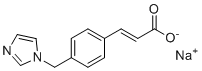
Ozagrel Sodium (formerly known as KCT-0809 and Cataclot) is the sodium salt of Ozagrel (also known as OKY-046) which is a potent and selective thromboxane A(2) (TXA(2)) synthetase inhibitor with IC50 of 11 nM for rabbit platelet, it is used for the improvement of postoperative cerebrovascular contraction and accompanying cerebral ischaemia. Ozagrel inhibits the production of thromboxane A(2) induced by oleic acid (OA), which in turn raises the total protein concentration, neutrophil and macrophage counts in bronchoalveolar lavage fluid, and increases the expression of interleukin-8 mRNA and monocyte chemoattractant protein-1 in the guinea pigs' entire lung.
Physicochemical Properties
| Molecular Formula | C13H11N2NAO2 |
| Molecular Weight | 250.2328 |
| Exact Mass | 250.071 |
| Elemental Analysis | C, 62.40; H, 4.43; N, 11.20; Na, 9.19; O, 12.79 |
| CAS # | 189224-26-8 |
| Related CAS # | Ozagrel; 82571-53-7; Ozagrel hydrochloride; 78712-43-3 |
| PubChem CID | 23663942 |
| Appearance | White to off-white solid powder |
| Boiling Point | 468ºC at 760 mmHg |
| Flash Point | 236.8ºC |
| LogP | 0.694 |
| Hydrogen Bond Donor Count | 0 |
| Hydrogen Bond Acceptor Count | 3 |
| Rotatable Bond Count | 4 |
| Heavy Atom Count | 18 |
| Complexity | 289 |
| Defined Atom Stereocenter Count | 0 |
| SMILES | O=C([O-])/C=C/C1=CC=C(CN2C=CN=C2)C=C1.[Na+] |
| InChi Key | NCNYJCOBUTXCBR-IPZCTEOASA-M |
| InChi Code | InChI=1S/C13H12N2O2.Na/c16-13(17)6-5-11-1-3-12(4-2-11)9-15-8-7-14-10-15;/h1-8,10H,9H2,(H,16,17);/q;+1/p-1/b6-5+; |
| Chemical Name | sodium;(E)-3-[4-(imidazol-1-ylmethyl)phenyl]prop-2-enoate |
| Synonyms | Ozagrel Sodium; KCT-0809; KCT 0809; KCT0809; Cataclot Xanbo |
| HS Tariff Code | 2934.99.9001 |
| Storage |
Powder-20°C 3 years 4°C 2 years In solvent -80°C 6 months -20°C 1 month Note: Please store this product in a sealed and protected environment, avoid exposure to moisture. |
| Shipping Condition | Room temperature (This product is stable at ambient temperature for a few days during ordinary shipping and time spent in Customs) |
Biological Activity
| Targets | TXA2 | ||
| ln Vitro |
|
||
| ln Vivo |
|
||
| Animal Protocol |
|
||
| References |
[1]. J Pharmacol Sci . 2009 Oct;111(2):211-5. [2]. Pharmacology . 1999 Nov;59(5):257-65. |
Solubility Data
| Solubility (In Vitro) |
H2O: ~50 mg/mL (~199.8 mM) DMSO: 1~6.3 mg/mL (4~25 mM) |
| Solubility (In Vivo) |
Solubility in Formulation 1: ≥ 0.62 mg/mL (2.48 mM) (saturation unknown) in 10% DMSO + 40% PEG300 + 5% Tween80 + 45% Saline (add these co-solvents sequentially from left to right, and one by one), clear solution. For example, if 1 mL of working solution is to be prepared, you can add 100 μL of 6.2 mg/mL clear DMSO stock solution to 400 μL PEG300 and mix evenly; then add 50 μL Tween-80 to the above solution and mix evenly; then add 450 μL normal saline to adjust the volume to 1 mL. Preparation of saline: Dissolve 0.9 g of sodium chloride in 100 mL ddH₂ O to obtain a clear solution. Solubility in Formulation 2: ≥ 0.62 mg/mL (2.48 mM) (saturation unknown) in 10% DMSO + 90% (20% SBE-β-CD in Saline) (add these co-solvents sequentially from left to right, and one by one), clear solution. For example, if 1 mL of working solution is to be prepared, you can add 100 μL of 6.2 mg/mL clear DMSO stock solution to 900 μL of 20% SBE-β-CD physiological saline solution and mix evenly. Preparation of 20% SBE-β-CD in Saline (4°C,1 week): Dissolve 2 g SBE-β-CD in 10 mL saline to obtain a clear solution. Solubility in Formulation 3: 70 mg/mL (279.74 mM) in PBS (add these co-solvents sequentially from left to right, and one by one), clear solution; with ultrasonication. (Please use freshly prepared in vivo formulations for optimal results.) |
| Preparing Stock Solutions | 1 mg | 5 mg | 10 mg | |
| 1 mM | 3.9963 mL | 19.9816 mL | 39.9632 mL | |
| 5 mM | 0.7993 mL | 3.9963 mL | 7.9926 mL | |
| 10 mM | 0.3996 mL | 1.9982 mL | 3.9963 mL |