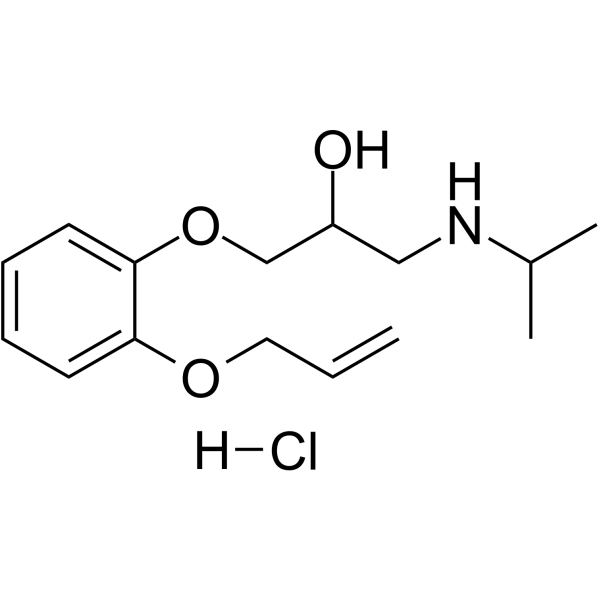
Oxprenolol HCl (Ba-39089 hydrochloride) is a novel and potent beta blocker with intrinsic sympathomimetic activity. It can be used for the treatment of angina pectoris, abnormal heart rhythms, and high blood pressure. It can be used to treat high blood pressure, irregular cardiac rhythms, and angina pectoris. It inhibits β-adrenergic receptor (β-AR) with a Ki of 7.10 nM in a radioligand binding assay using rat heart muscle.
Physicochemical Properties
| Molecular Formula | C15H24CLNO3 |
| Molecular Weight | 301.81 |
| Exact Mass | 301.144 |
| Elemental Analysis | C, 59.69; H, 8.02; Cl, 11.75; N, 4.64; O, 15.90 |
| CAS # | 6452-73-9 |
| Related CAS # | Oxprenolol-d7 hydrochloride; 1189649-47-5; Oxprenolol; 6452-71-7; Oxprenolol-d7; 1189805-10-4 |
| PubChem CID | 71172 |
| Appearance | White to off-white solid powder |
| Boiling Point | 403.3ºC at 760 mmHg |
| Melting Point | 178°C |
| Flash Point | 197.7ºC |
| LogP | 3.182 |
| Hydrogen Bond Donor Count | 3 |
| Hydrogen Bond Acceptor Count | 4 |
| Rotatable Bond Count | 9 |
| Heavy Atom Count | 20 |
| Complexity | 246 |
| Defined Atom Stereocenter Count | 0 |
| SMILES | OC(CNC(C)C)COC1=CC=CC=C1OCC=C.[H]Cl |
| InChi Key | COAJXCLTPGGDAJ-UHFFFAOYSA-N |
| InChi Code | InChI=1S/C15H23NO3.ClH/c1-4-9-18-14-7-5-6-8-15(14)19-11-13(17)10-16-12(2)3;/h4-8,12-13,16-17H,1,9-11H2,2-3H3;1H |
| Chemical Name | 1-(propan-2-ylamino)-3-(2-prop-2-enoxyphenoxy)propan-2-ol;hydrochloride |
| Synonyms | Dialicor; Coretal; Oxprenolol hydrochloride; 6452-73-9; Oxprenolol HCl; Evinrozit; Ranidrox; Rixiprol; Trasicor; Secondafil; Oxprenolol hydrochloride |
| HS Tariff Code | 2934.99.9001 |
| Storage |
Powder-20°C 3 years 4°C 2 years In solvent -80°C 6 months -20°C 1 month Note: Please store this product in a sealed and protected environment, avoid exposure to moisture. |
| Shipping Condition | Room temperature (This product is stable at ambient temperature for a few days during ordinary shipping and time spent in Customs) |
Biological Activity
| Targets | β-adrenoceptor ( Ki = 7.1 nM ) |
| ln Vitro | Oxprenolol is lipophilic [3]. Oxprenolol typically penetrates human abdominal skin at a rate of 1.54 ± 1.54×10⁻³ cm/h[3]. |
| ln Vivo | Oxprenolol (200 mg/kg/day; oral; once daily for 3 weeks) produces an effective beta-blocker[2]. |
| Enzyme Assay | Binding characteristics of the beta-blockers and beta-agonists with the beta-adrenoceptors were investigated in 3H-dihydroalprenolol (3H-DHA) binding to rat heart membranes treated with neuraminidase. When 60% of the total sialic acid content in the membranes was removed, reproducibility of the binding assay became much better than was attainable without neuraminidase treatment, and the maximum density of beta-adrenoceptors was increased. These data suggest that the binding of the test compounds with the beta-adrenergic receptors in cardiac muscle was under the influence of the sialic acid of the glycocalyx of the membrane. The 3H-DHA binding sites in membranes treated with neuraminidase showed a strict stereo-specificity when tested with propranolol. The ranking order of inhibition of beta-antagonists or agonists is: dl-propranolol > Oxprenolol > than alprenolol > pindolol > YM-09538 > labetalol > acebutolol > atenolol > metoprolol > sotalol > butoxamine > practolol as antagonists or l-isoproterenol > l-epinephrine > l-norepinephrine as agonists. A good correlation (r = 0.91, P less than 0.001) was observed between the Ki values observed by the present binding assay and the pA2 observed in the guinea-pig atria relative to the positive inotropic effect by Bieth et al. (Br. J. Pharmacol. 68, 563-569, 1980), indicating that the present method will be useful for screening new beta-adrenergic receptor antagonists or agonists. [1] |
| Animal Protocol |
Male rats (230 to 300 g body wt) of the Wistar strain 200 mg/kg Administered orally; daily for 3 weeks |
| ADME/Pharmacokinetics |
Absorption, Distribution and Excretion Oral bioavailability is 20-70%. Metabolism / Metabolites Hepatic. Oxoprenolol has known human metabolites that include Oxprenolol glucuronide. Biological Half-Life 1-2 hours |
| Toxicity/Toxicokinetics |
71172 women LDLo oral 90 mg/kg BEHAVIORAL: GENERAL ANESTHETIC; CARDIAC: ARRHYTHMIAS (INCLUDING CHANGES IN CONDUCTION); LUNGS, THORAX, OR RESPIRATION: CYANOSIS British Medical Journal., 1(552), 1977 71172 rat LD50 oral 214 mg/kg Arzneimittel-Forschung. Drug Research., 35(1236), 1985 [PMID:2866775] 71172 rat LD50 intraperitoneal 147 mg/kg BEHAVIORAL: SOMNOLENCE (GENERAL DEPRESSED ACTIVITY) Kiso to Rinsho. Clinical Report., 7(3131), 1973 71172 rat LD50 subcutaneous 940 mg/kg BEHAVIORAL: CONVULSIONS OR EFFECT ON SEIZURE THRESHOLD; BEHAVIORAL: ATAXIA; LUNGS, THORAX, OR RESPIRATION: DYSPNEA Arzneimittel-Forschung. Drug Research., 18(164), 1968 [PMID:5695373] 71172 rat LD50 intravenous 33 mg/kg BEHAVIORAL: CONVULSIONS OR EFFECT ON SEIZURE THRESHOLD; BEHAVIORAL: ATAXIA; LUNGS, THORAX, OR RESPIRATION: DYSPNEA Arzneimittel-Forschung. Drug Research., 18(164), 1968 [PMID:5695373] |
| References |
[1]. Binding Characteristics of 3H-dihydroalprenolol to Beta-Adrenoceptors of Rat Heart Treated With Neuraminidase. Jpn J Pharmacol. 1983 Aug;33(4):851-7. [2]. Abrupt Withdrawal of Chronic Beta-Blockade: Adaptive Changes in Cyclic AMP and Contractility. J Mol Cell Cardiol. 1981 Nov;13(11):999-1009. [3]. A comparative in vitro study of percutaneous penetration of β-blockers in human skin. International journal of pharmaceutics, 2000, 194(2): 249-259. |
| Additional Infomation |
Oxprenolol Hydrochloride is the hydrochloride salt form of oxprenolol, a lipophilic, nonselective beta-adrenergic receptor antagonist with anti-arrhythmic, anti-anginal and antihypertensive activities. Oxprenolol competitively binds to and blocks beta-1 adrenergic receptors in the heart, thereby decreasing cardiac contractility and rate. This leads to a reduction in cardiac output and lowers blood pressure. In addition, oxprenolol prevents the release of renin, a hormone secreted by the kidneys that causes constriction of blood vessels. A beta-adrenergic antagonist used in the treatment of hypertension, angina pectoris, arrhythmias, and anxiety. In the present study, as a continuation of a previous one in which two β-blockers celiprolol and bisoprolol were reported (Modamio et al., 1998), transdermal permeation properties across human skin in vitro of propranolol, Oxprenolol, metoprolol and atenolol were compared (including also both celiprolol and bisoprolol), and the potential of each individual drug studied assessed. In addition, correlations between physicochemical parameters of β-blockers chosen, were established, especially lipophilicity expressed as intrinsic partition coefficient, in order to determine whether optimal permeability, and so the predictive potential of these physicochemical parameters can be established. [3] |
Solubility Data
| Solubility (In Vitro) |
DMSO: ~250 mg/mL (~828.3 mM) H2O: ~100 mg/mL (~331.3 mM) |
| Solubility (In Vivo) |
Solubility in Formulation 1: ≥ 2.08 mg/mL (6.89 mM) (saturation unknown) in 10% DMSO + 40% PEG300 + 5% Tween80 + 45% Saline (add these co-solvents sequentially from left to right, and one by one), clear solution. For example, if 1 mL of working solution is to be prepared, you can add 100 μL of 20.8 mg/mL clear DMSO stock solution to 400 μL PEG300 and mix evenly; then add 50 μL Tween-80 to the above solution and mix evenly; then add 450 μL normal saline to adjust the volume to 1 mL. Preparation of saline: Dissolve 0.9 g of sodium chloride in 100 mL ddH₂ O to obtain a clear solution. Solubility in Formulation 2: ≥ 2.08 mg/mL (6.89 mM) (saturation unknown) in 10% DMSO + 90% (20% SBE-β-CD in Saline) (add these co-solvents sequentially from left to right, and one by one), clear solution. For example, if 1 mL of working solution is to be prepared, you can add 100 μL of 20.8 mg/mL clear DMSO stock solution to 900 μL of 20% SBE-β-CD physiological saline solution and mix evenly. Preparation of 20% SBE-β-CD in Saline (4°C,1 week): Dissolve 2 g SBE-β-CD in 10 mL saline to obtain a clear solution. Solubility in Formulation 3: ≥ 2.08 mg/mL (6.89 mM) (saturation unknown) in 10% DMSO + 90% Corn Oil (add these co-solvents sequentially from left to right, and one by one), clear solution. For example, if 1 mL of working solution is to be prepared, you can add 100 μL of 20.8 mg/mL clear DMSO stock solution to 900 μL of corn oil and mix evenly. (Please use freshly prepared in vivo formulations for optimal results.) |
| Preparing Stock Solutions | 1 mg | 5 mg | 10 mg | |
| 1 mM | 3.3133 mL | 16.5667 mL | 33.1334 mL | |
| 5 mM | 0.6627 mL | 3.3133 mL | 6.6267 mL | |
| 10 mM | 0.3313 mL | 1.6567 mL | 3.3133 mL |