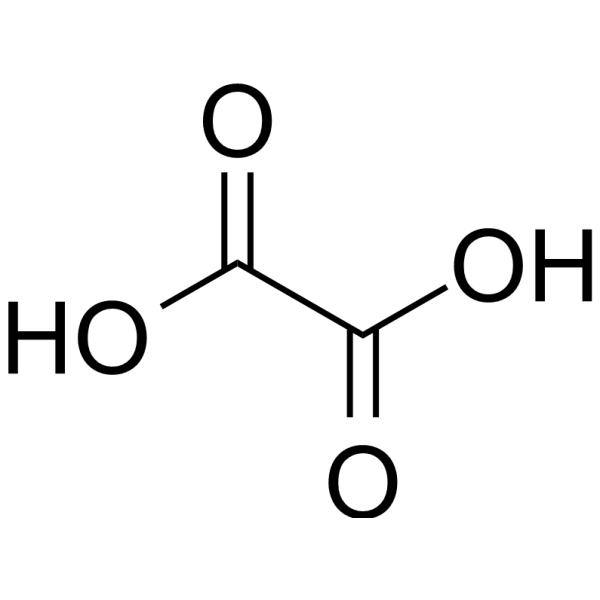
Physicochemical Properties
| Molecular Formula | C2H2O4 |
| Molecular Weight | 90.0349 |
| Exact Mass | 89.995 |
| CAS # | 144-62-7 |
| PubChem CID | 971 |
| Appearance | White to off-white solid powder |
| Density | 1.8±0.1 g/cm3 |
| Boiling Point | 365.1±25.0 °C at 760 mmHg |
| Melting Point | 189.5 °C (dec.)(lit.) |
| Flash Point | 188.8±19.7 °C |
| Vapour Pressure | 0.0±1.7 mmHg at 25°C |
| Index of Refraction | 1.480 |
| LogP | -1.19 |
| Hydrogen Bond Donor Count | 2 |
| Hydrogen Bond Acceptor Count | 4 |
| Rotatable Bond Count | 1 |
| Heavy Atom Count | 6 |
| Complexity | 71.5 |
| Defined Atom Stereocenter Count | 0 |
| InChi Key | MUBZPKHOEPUJKR-UHFFFAOYSA-N |
| InChi Code | InChI=1S/C2H2O4/c3-1(4)2(5)6/h(H,3,4)(H,5,6) |
| Chemical Name | oxalic acid |
| HS Tariff Code | 2934.99.9001 |
| Storage |
Powder-20°C 3 years 4°C 2 years In solvent -80°C 6 months -20°C 1 month |
| Shipping Condition | Room temperature (This product is stable at ambient temperature for a few days during ordinary shipping and time spent in Customs) |
Biological Activity
| Targets | Even in the absence of other fungal components, oxalic acid, a pathogenicity factor for sclerotinia sclerotiorum, suppresses the host plant's oxidative burst and directly limits the synthesis of H2O2 by soybean cells in response to OGA[1]. |
| ln Vitro |
Even in the absence of other fungal components, oxalic acid, a pathogenicity factor for sclerotinia sclerotiorum, suppresses the host plant's oxidative burst and directly limits the synthesis of H2O2 by soybean cells in response to OGA[1]. Oxalic Acid suppressed the oxidative burst (H₂O₂ production) in suspension-cultured tobacco and soybean cells induced by various elicitors, with a median inhibitory concentration (IC₅₀) of approximately 4 to 5 mM. Maximal inhibition was reached at about 6-7 mM. It inhibited bursts induced by oligogalacturonic acid (OGA), a Verticillium elicitor, hypoosmotic shock, cantharidin, and harpin, although the maximal inhibition of the harpin-induced burst was only about 30% of the control. [1] Filtrate from a wild-type, oxalate-secreting strain of S. sclerotiorum (containing ~12.4 mM oxalate) almost completely suppressed the OGA-induced H₂O₂ production in tobacco cells, whereas filtrate from an oxalate-deficient mutant (containing ~0.11 mM oxalate) did not. Adding 11 mM oxalate to the mutant filtrate restored its inhibitory potency. [1] The inhibitory effect was largely independent of medium acidification or Ca²⁺ chelation. Oxalate did not inhibit elicitor-stimulated cytosolic Ca²⁺ transients in aequorin-transformed tobacco cells. [1] Oxalate inhibited the oxidative burst only when added before or during the early phase of elicitor activation; it had no effect once H₂O₂ production had reached its maximal rate, indicating it acts prior to the catalysis by the assembled/activated oxidase complex. [1] |
| ln Vivo | Inoculation of tobacco leaves with an oxalate-deficient, nonpathogenic mutant of S. sclerotiorum induced a measurable oxidative burst (visualized by nitroblue tetrazolium staining), whereas inoculation with a wild-type, oxalate-secreting strain did not. The oxalate-secreting strain successfully colonized the leaf tissue. [1] |
| Cell Assay |
H₂O₂ Production Assay: Production of H₂O₂ in plant suspension cell cultures (tobacco or soybean) was monitored fluorometrically by measuring the oxidative quenching of the dye pyranine (excitation 405 nm, emission 512 nm). Cells (1.5 mL) were placed in a fluorometer cuvette with 1 µg/mL pyranine. After addition of an elicitor (e.g., 5 µg/mL OGA), the rate of H₂O₂ biosynthesis was approximated by measuring the maximum rate of fluorescence quenching. Test compounds like Oxalic Acid (pH-adjusted to 5.7) were added at the time of elicitor stimulation or at specified times afterwards. Data are presented as a percentage of the rate for control cells tested on the same day. [1] Cytosolic Ca²⁺ Measurement: Changes in cytosolic Ca²⁺ concentration were monitored in aequorin-transformed tobacco cells using luminescence measurements. Cells were treated with test compounds (e.g., 10 mM oxalate or 1.5 mM BAPTA-AM) 5 minutes prior to stimulation with an elicitor like OGA. Luminescence was recorded and transformed into corresponding Ca²⁺ concentrations. Residual functional aequorin was quantified after each run by lysing cells with CaCl₂ and detergent. [1] |
| ADME/Pharmacokinetics |
Absorption, Distribution and Excretion TARTARIC & OXALIC ACIDS ARE EXCRETED IN URINE UNCHANGED. The absorption of (14)C-labelled oxalic acid was studied in Wistar rats, CD-1 mice and NMRI mice. Oxalic acid in solution was given to the animals by gavage either with water alone or with 0.625 g/kg body wt of xylitol. Both xylitol adapted animals and animals not previously exposed to xylitol were used. Adaptation to xylitol diets enhanced the absorption and urinary excretion of the label (oxalic acid) in both strains of mice but not in rats. Earlier studies have indicated a high incidence of bladder calculi in mice but not in rats fed high amounts of xylitol. The results of the present study offer one likely explanation for the increased formation of bladder calculi as a result of over saturation of urine with oxalate. Metabolism / Metabolites IN RABBIT, MAJOR END-PRODUCT OF METAB OF (14)C-ETHYLENE GLYCOL IS RESP CARBON DIOXIDE (60% OF DOSE IN 3 DAYS), & METABOLITES EXCRETED IN URINE ARE UNCHANGED ETHYLENE GLYCOL (10%) & OXALIC ACID (0.1%). ... GLYCOLALDEHYDE, GLYCOLLIC ACID & GLYOXYLIC ACID ARE INTERMEDIATES IN CONVERSION TO CARBON DIOXIDE. IN OXIDATIVE METAB OF ETHYLENE GLYCOL IN MAMMALS, SPECIES VARIATIONS OCCUR WHICH EXPLAIN ... DIFFERENCES IN TOXICITY. GLYCOL IS OXIDIZED BY MAJOR PATHWAY INTO CARBON DIOXIDE, & BY MINOR PATHWAY TO ... OXALIC ACID. EXTENT OF FORMATION OF OXALIC ACID IS DEPENDENT ON DOSE LEVEL, BUT HAS ... BEEN SHOWN TO VARY WITH SPECIES ... INITIAL STEPS IN OXIDATION OF ETHYLENE GLYCOL TO DIALDEHYDE (GLYOXAL) & TO GLYOXYLIC ACID SEEM TO BE MEDIATED BY ALC DEHYDROGENASE; DECARBOXYLATION OF GLYOXYLIC ACID YIELDS CARBON DIOXIDE & FORMIC ACID. GLYOXYLIC ACID IS ALSO OXIDIZED TO OXALIC ACID. Piridoxilate is an association of glyoxylic acid and pyridoxine in which pyridoxine is supposed to facilitate in vivo transformation of glyoxylic acid to glycine rather than to oxalic acid. However, it has recently been shown that long term treatment with piridoxilate may result in over production of oxalic acid and in calcium oxalate nephrolithiasis. A patient in whom piridoxilate induced both oxalate nephrolithiasis and chronic oxalate nephropathy with renal insufficiency, an association that has not been previously described, was reported. Therefore, piridoxilate should be added to the list of chemicals responsible for chronic oxalate nephropathy. Cyclosporin A interferes with oxalate metabolism and, therefore, should be given with utmost caution in patients with primary hyperoxaluria. Oxalic acid is not metabolized but excreted in the urine. |
| Toxicity/Toxicokinetics |
Toxicity Summary The affinity of divalent metal ions is sometimes reflected in their tendency to form insoluble precipitates. Thus in the body, oxalic acid also combines with metals ions such as Ca2+, Fe2+, and Mg2+ to deposit crystals of the corresponding oxalates, which irritate the gut and kidneys. (2) Therefore the toxicity of oxalic acid is due to kidney failure caused by precipitation of solid calcium oxalate, the main component of kidney stones. Oxalic acid can also cause joint pain due to the formation of similar precipitates in the joints. Ingestion of ethylene glycol results in oxalic acid as a metabolite that can also cause acute kidney failure. Interactions A number of sulfhydryl compounds were shown to inhibit CO2 and oxalate formation from glyoxylate by rat liver homogenates and hepatocytes. The most significant inhibition occurred with cysteine and this inhibition was concentration dependent. In rats made hyperoxaluric by administering ethylene glycol in their drinking water, daily intraperitoneal injections of cysteine caused a rapid and marked decrease in urinary oxalate excretion which was maintained over the duration of the treatment (28 days). Over this time period, the level of urinary oxalate excretion inthese ethylene glycol treated rats was reduced to that of the controls.It is postulated that the decrease is due to the formation of acysteine-glyoxylate adduct, 2-carboxy-4-thiazolidine carboxylate, which prevents glyoxylate being further oxidized to oxalate. Cysteine or similar sulphydryl compounds may therefore have potential as therapeutic agents in the prevention of renal stones. The study was conducted to investigate the effect of vitamin A, B1 and B6 deficiency on oxalate metabolism in rats. A significant hyperoxaluria was the common observation in all the three vitamin deficiencies (vitamin B6 greater than vitamin A greater than vitamin B1). The activities of hepatic glycolate oxidase and glycolate dehydrogenase were markedly enhanced in vitamin A and vitamin B6 deficient rats. However, lactate dehydrogenase levels remained unaltered in these deficiencies as compared to their respective pair fed controls. Vitamin B1 deficiency of 4 weeks duration could augment the activity of glycolate oxidase only, with no alterations in the glycolate dehydrogenase and lactate dehydrogenase levels. Intestinal oxalate uptake studies revealed increased bioavailability of oxalate from the gut in vitamin A and vitamin B6 deficient rats. Thus, the results suggest the relative contribution of both exogenous as well as endogenous oxalate in the process of calculogenesis under various nutritional stress conditions in rat. Hyperoxalemia can be aggravated by vitamin C supplementation in regular hemodialysis patients. The present study was undertaken to examine the validity of this observation in an experimental setting. Fifty five-sixths nephrectomized rats were divided into two groups: 30 rats were allowed free access to water containing 8 mg/ml of vitamin C (100-160 mg/100 g/24 hr) and the remainder given tap water without vitamin C. The serum creatinine increased and the hematocrit decreased gradually; however, there was no difference between the two groups. Plasma vitamin C, oxalate and urinary oxalate levels were higher in the vitamin treated group than the nontreated rats. Histological examination revealed glomerular and interstitial fibrosis and round cell infiltration as well as tubular cyst formation. Oxalate deposits in renal tubules were found only in vitamin C-treated rats with advanced renal failure. Nontreated animals with equally advanced renal impairment showed no oxalate deposits. These results confirm previous clinical findings that vitamin C supplementation aggravates the secondary oxalosis of chronic renal failure. Male Wistar strain rats which had been fed a glycolic acid diet developed severe nephrocalcinosis with urinary calculi within 4 weeks. Rats fed the same diet with citrate salts added had, however, either slight or no nephrocalcinosis without any stones in the urinary system. Nephrocalcinosis intermediate between those in the citrate groups and the glycolic acid group, with some urinary calculi, was observed in the citric acid group. During the experiment, the urinary oxalate concentration increased markedly and was higher in the citrate and citric acid than in the glycolic acid group. The urinary citrate concentration was significantly higher in the citrate groups and lower in the citric acid and glycolic acid groups. Therefore, citrate salts can be concluded to inhibit nephrocalcinosis and calculi formation as a result of decreased urinary saturation by means of increase in urinary citrate, in spite of a slight increase in the urinary oxalate. For more Interactions (Complete) data for OXALIC ACID (6 total), please visit the HSDB record page. Non-Human Toxicity Values LDLo Dog oral 1000 mg/kg |
| References |
[1]. Oxalic acid, a pathogenicity factor for Sclerotinia sclerotiorum, suppresses the oxidative burst of the host plant. Plant Cell. 2000 Nov;12(11):2191-200. |
| Additional Infomation |
Oxalic acid is an odorless white solid. Sinks and mixes with water. (USCG, 1999) Oxalic acid is an alpha,omega-dicarboxylic acid that is ethane substituted by carboxyl groups at positions 1 and 2. It has a role as a human metabolite, a plant metabolite and an algal metabolite. It is a conjugate acid of an oxalate(1-) and an oxalate. Oxalic acid is a metabolite found in or produced by Escherichia coli (strain K12, MG1655). Oxalic Acid has been reported in Camellia sinensis, Microchloropsis, and other organisms with data available. Oxalic acid is a dicarboxylic acid. It is a colorless crystalline solid that dissolves in water to give colorless, acidic solutions. In terms of acid strength, it is much stronger than acetic acid. Oxalic acid, because of its di-acid structure can also act as a chelating agent for metal cations. About 25% of produced oxalic acid is used as a mordant in dyeing processes. It is also used in bleaches, especially for pulpwood. Oxalic acid's main applications include cleaning (it is also found in baking powder) or bleaching, especially for the removal of rust. Oxalic acid is found in a number of common foods with members of the spinach family being particularly high in oxalates. Beat leaves, parsley, chives and cassava are quite rich in oxalate. Rhubarb leaves contain about 0.5% oxalic acid and jack-in-the-pulpit (Arisaema triphyllum) contains calcium oxalate crystals. Bacteria naturally produce oxalates from the oxidation of carbohydrates. At least two pathways exist for the enzyme-mediated formation of oxalate in humans. In one pathway, oxaloacetate (part of the citric acid cycle) can be hydrolyzed to oxalate and acetic acid by the enzyme oxaloacetase. Oxalic acid can also be generated from the dehydrogenation of glycolic acid, which is produced by the metabolism of ethylene glycol. Oxalate is a competitive inhibitor of lactate dehydrogenase (LDH). LDH catalyses the conversion of pyruvate to lactic acid oxidizing the coenzyme NADH to NAD+ and H+ concurrently. As cancer cells preferentially use aerobic glycolysis, inhibition of LDH has been shown to inhibit tumor formation and growth. However, oxalic acid is not particularly safe and is considered a mild toxin. In particular, it is a well-known uremic toxin. In humans, ingested oxalic acid has an oral lowest-published-lethal-dose of 600 mg/kg. It has been reported that the lethal oral dose is 15 to 30 grams. The toxicity of oxalic acid is due to kidney failure caused by precipitation of solid calcium oxalate, the main component of kidney stones. Oxalic acid can also cause joint pain due to the formation of similar precipitates in the joints. A strong dicarboxylic acid occurring in many plants and vegetables. It is produced in the body by metabolism of glyoxylic acid or ascorbic acid. It is not metabolized but excreted in the urine. It is used as an analytical reagent and general reducing agent. See also: Oxalic acid dihydrate (active moiety of); Sodium Oxalate (is active moiety of) ... View More ... Mechanism of Action Metabolically its toxicity is believed due to the capacity of oxalic acid to immobilize calcium and thus upset the calcium-potassium ratio in critical tissues. Drug Warnings Ascorbic acid ingestion in high doses is associated with oxalate deposition in tissue in dialysis patients. /Oxalates/ Oxalic Acid is a key pathogenicity factor secreted by the fungus Sclerotinia sclerotiorum. Its secretion is required for successful infection. [1] The proposed mechanism by which Oxalic Acid enhances fungal virulence includes suppression of the host plant's oxidative burst, an early defense response. This action is largely independent of simply lowering apoplastic pH or chelating Ca²⁺. [1] Some plants, like wheat and barley, express the enzyme oxalate oxidase, which degrades oxalate and produces H₂O₂, potentially contributing to resistance against oxalate-secreting pathogens. [1] |
Solubility Data
| Solubility (In Vitro) | DMSO : ~130 mg/mL (~1443.96 mM) |
| Solubility (In Vivo) |
Solubility in Formulation 1: 3.25 mg/mL (36.10 mM) in 10% DMSO + 40% PEG300 + 5% Tween80 + 45% Saline (add these co-solvents sequentially from left to right, and one by one), suspension solution; with sonication. For example, if 1 mL of working solution is to be prepared, you can add 100 μL of 32.5 mg/mL clear DMSO stock solution to 400 μL of PEG300 and mix evenly; then add 50 μL of Tween-80 to the above solution and mix evenly; then add 450 μL of normal saline to adjust the volume to 1 mL. Preparation of saline: Dissolve 0.9 g of sodium chloride in 100 mL ddH₂ O to obtain a clear solution. Solubility in Formulation 2: ≥ 3.25 mg/mL (36.10 mM) (saturation unknown) in 10% DMSO + 90% (20% SBE-β-CD in Saline) (add these co-solvents sequentially from left to right, and one by one), clear solution. For example, if 1 mL of working solution is to be prepared, you can add 100 μL of 32.5 mg/mL clear DMSO stock solution to 900 μL of 20% SBE-β-CD physiological saline solution and mix evenly. Preparation of 20% SBE-β-CD in Saline (4°C,1 week): Dissolve 2 g SBE-β-CD in 10 mL saline to obtain a clear solution. Solubility in Formulation 3: ≥ 3.25 mg/mL (36.10 mM) (saturation unknown) in 10% DMSO + 90% Corn Oil (add these co-solvents sequentially from left to right, and one by one), clear solution. For example, if 1 mL of working solution is to be prepared, you can add 100 μL of 32.5 mg/mL clear DMSO stock solution to 900 μL of corn oil and mix evenly. (Please use freshly prepared in vivo formulations for optimal results.) |
| Preparing Stock Solutions | 1 mg | 5 mg | 10 mg | |
| 1 mM | 11.1074 mL | 55.5370 mL | 111.0741 mL | |
| 5 mM | 2.2215 mL | 11.1074 mL | 22.2148 mL | |
| 10 mM | 1.1107 mL | 5.5537 mL | 11.1074 mL |