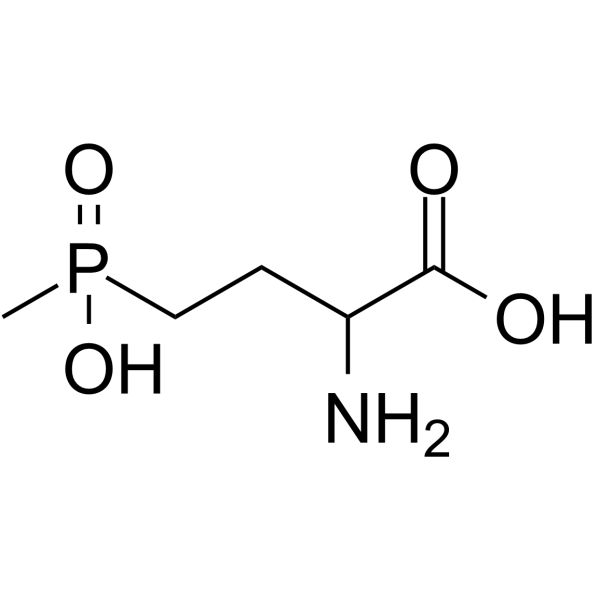
Physicochemical Properties
| Molecular Formula | C5H12NO4P |
| Molecular Weight | 181.12688 |
| Exact Mass | 181.05 |
| CAS # | 51276-47-2 |
| Related CAS # | Glufosinate-d3 hydrochloride;1323254-05-2;Glufosinate ammonium;77182-82-2 |
| PubChem CID | 4794 |
| Appearance | White to light yellow crystalline powder |
| Density | 1.378 g/cm3 |
| Boiling Point | 519.1ºC at 760 mmHg |
| Melting Point | 230ºC |
| Flash Point | 267.7ºC |
| Index of Refraction | 1.5 |
| LogP | 0.388 |
| Hydrogen Bond Donor Count | 3 |
| Hydrogen Bond Acceptor Count | 5 |
| Rotatable Bond Count | 4 |
| Heavy Atom Count | 11 |
| Complexity | 193 |
| Defined Atom Stereocenter Count | 0 |
| SMILES | OC(C(CCP(=O)(C)O)N)=O |
| InChi Key | IAJOBQBIJHVGMQ-UHFFFAOYSA-N |
| InChi Code | InChI=1S/C5H12NO4P/c1-11(9,10)3-2-4(6)5(7)8/h4H,2-3,6H2,1H3,(H,7,8)(H,9,10) |
| Chemical Name | 2-amino-4-[hydroxy(methyl)phosphoryl]butanoic acid |
| HS Tariff Code | 2934.99.9001 |
| Storage |
Powder-20°C 3 years 4°C 2 years In solvent -80°C 6 months -20°C 1 month |
| Shipping Condition | Room temperature (This product is stable at ambient temperature for a few days during ordinary shipping and time spent in Customs) |
Biological Activity
| ln Vitro | Glufosinate (1-100 μM; 12DIV) breaks down cell-cell adhesion in neural stem cells (NSC) of differentiated V-SVZ [2]. At 100 μM, glufosinate (1-100 μM; 12DIV) dramatically lowers Celsr2 gene expression [2]. The synthesis of cilia by ependymal cells is hindered by glutamate-ammonium [2]. |
| ln Vivo | In Wistar rats given dosages of 50 or 250 mg/kg, glufosinate-ammonium (10-250 mg/kg; gavage; daily; gestation days 6–15) showed maternal toxicity [3]. Less than four hours pass between the administration of glufosinate (oral intubation) and the blood of male and female rats [3]. |
| ADME/Pharmacokinetics |
Metabolism / Metabolites The principal metabolite in urine & feces is 3-[hydroxy(methyl)phosphinoyl]propionic acid. In plants, degradation of glufosinate-ammonium involves deamination, decarboxylation, & finally beta-oxidation to carbon dioxide. Biological Half-Life ...A 65-yr-old male ingested BASTA, which contains 20% w/v of glufosinate ammonium... The changes in serum glufosinate concn exhibited T-1/2 alpha of 1.84 and T-1/2 beta of 9.59 hr. /BASTA/ |
| Toxicity/Toxicokinetics |
Toxicity Summary Glufosinate irreversibly inhibits the enzyme glutamine synthetase, which decreases ammonia detoxification. Increased ammonia levels lead to impairment of photorespiration and photosynthesis in plants. (T10) Toxicity Data LC50 (rat) = 1,260 mg/m3 Non-Human Toxicity Values LD50 Rat (male) oral 2000 mg/kg LD50 Rat (female) oral 1620 mg/kg LD50 Mouse (male) oral 431 mg/kg LD50 Mouse (female) oral 416 mg/kg For more Non-Human Toxicity Values (Complete) data for GLUFOSINATE-AMMONIUM (11 total), please visit the HSDB record page. |
| References |
[1]. The effect of high concentrations of glufosinate ammonium on the yield components of transgenic spring wheat (Triticum aestivum L.) constitutively expressing the bar gene. ScientificWorldJournal. 2012;2012:657945. [2]. Multiple effects of the herbicide glufosinate-ammonium and its main metabolite on neural stem cells from the subventricular zone of newborn mice. Neurotoxicology. 2018 Dec;69:152-163. [3]. Summary of safety evaluation toxicity studies of glufosinate ammonium. Food Chem Toxicol. 1990 May;28(5):339-49. |
| Additional Infomation |
2-amino-4-[hydroxy(methyl)phosphoryl]butanoic acid is a non-proteinogenic alpha-amino acid that is 2-aminobutanoic acid which is substituted at position 4 by a hydroxy(methyl)phosphoryl group. It is a member of phosphinic acids and a non-proteinogenic alpha-amino acid. Glufosinate is a metabolite found in or produced by Escherichia coli (strain K12, MG1655). Glufosinate has been reported in Streptomyces hygroscopicus and Streptomyces viridochromogenes with data available. Glufosinate or its ammonium salt DL-phosphinothricin is an active ingredient in several nonselective systemic herbicides such as Basta, Rely, Finale, Ignite, Challenge, and Liberty. It interferes with the glutamine biosynthetic pathway that binds to the glutamate site of the enzyme. Glufosinate-treated plants die due to a buildup of ammonia and a cessation of photosynthesis due to lack of glutamine. Mechanism of Action ...Glufosinate ammonium is a structural analogue of glutamate & acts in plants by inhibition of glutamine synthetase leading to a complete breakdown of ammonia metab. Owing to the structural analogy of glufosinate ammonium to glutamate, its effect on various glutamate-utilizing systems needed to be investigated in mammals. Although in laboratory animals glufosinate ammonium causes an inhibition of glutamine synthetase activity in different tissues, this inhibition led to slight increases of glutamate and ammonia levels at high sublethal and lethal doses only. After oral admin for 28 days, glufosinate ammonium had no effect on glutathione & carbohydrate metab & no effect on biosynthesis of non-essential amino acids in rats & dogs. Glufosinate ammonium does not interfere with various neurotransmitter receptors in vitro & does not influence the catecholamine neurotransmitter tissue concn after iv application. The results of these studies show that ... in mammals the inhibition of glutamine synthetase activity in various tissues does not lead to a breakdown of ammonia metab. The mammalian metab ... compensates for this inhibition of glutamine synthetase activity by various other metabolic pathways ... |
Solubility Data
| Solubility (In Vitro) | May dissolve in DMSO (in most cases), if not, try other solvents such as H2O, Ethanol, or DMF with a minute amount of products to avoid loss of samples |
| Solubility (In Vivo) |
Note: Listed below are some common formulations that may be used to formulate products with low water solubility (e.g. < 1 mg/mL), you may test these formulations using a minute amount of products to avoid loss of samples. Injection Formulations (e.g. IP/IV/IM/SC) Injection Formulation 1: DMSO : Tween 80: Saline = 10 : 5 : 85 (i.e. 100 μL DMSO stock solution → 50 μL Tween 80 → 850 μL Saline) *Preparation of saline: Dissolve 0.9 g of sodium chloride in 100 mL ddH ₂ O to obtain a clear solution. Injection Formulation 2: DMSO : PEG300 :Tween 80 : Saline = 10 : 40 : 5 : 45 (i.e. 100 μL DMSO → 400 μLPEG300 → 50 μL Tween 80 → 450 μL Saline) Injection Formulation 3: DMSO : Corn oil = 10 : 90 (i.e. 100 μL DMSO → 900 μL Corn oil) Example: Take the Injection Formulation 3 (DMSO : Corn oil = 10 : 90) as an example, if 1 mL of 2.5 mg/mL working solution is to be prepared, you can take 100 μL 25 mg/mL DMSO stock solution and add to 900 μL corn oil, mix well to obtain a clear or suspension solution (2.5 mg/mL, ready for use in animals). Injection Formulation 4: DMSO : 20% SBE-β-CD in saline = 10 : 90 [i.e. 100 μL DMSO → 900 μL (20% SBE-β-CD in saline)] *Preparation of 20% SBE-β-CD in Saline (4°C,1 week): Dissolve 2 g SBE-β-CD in 10 mL saline to obtain a clear solution. Injection Formulation 5: 2-Hydroxypropyl-β-cyclodextrin : Saline = 50 : 50 (i.e. 500 μL 2-Hydroxypropyl-β-cyclodextrin → 500 μL Saline) Injection Formulation 6: DMSO : PEG300 : castor oil : Saline = 5 : 10 : 20 : 65 (i.e. 50 μL DMSO → 100 μLPEG300 → 200 μL castor oil → 650 μL Saline) Injection Formulation 7: Ethanol : Cremophor : Saline = 10: 10 : 80 (i.e. 100 μL Ethanol → 100 μL Cremophor → 800 μL Saline) Injection Formulation 8: Dissolve in Cremophor/Ethanol (50 : 50), then diluted by Saline Injection Formulation 9: EtOH : Corn oil = 10 : 90 (i.e. 100 μL EtOH → 900 μL Corn oil) Injection Formulation 10: EtOH : PEG300:Tween 80 : Saline = 10 : 40 : 5 : 45 (i.e. 100 μL EtOH → 400 μLPEG300 → 50 μL Tween 80 → 450 μL Saline) Oral Formulations Oral Formulation 1: Suspend in 0.5% CMC Na (carboxymethylcellulose sodium) Oral Formulation 2: Suspend in 0.5% Carboxymethyl cellulose Example: Take the Oral Formulation 1 (Suspend in 0.5% CMC Na) as an example, if 100 mL of 2.5 mg/mL working solution is to be prepared, you can first prepare 0.5% CMC Na solution by measuring 0.5 g CMC Na and dissolve it in 100 mL ddH2O to obtain a clear solution; then add 250 mg of the product to 100 mL 0.5% CMC Na solution, to make the suspension solution (2.5 mg/mL, ready for use in animals). Oral Formulation 3: Dissolved in PEG400 Oral Formulation 4: Suspend in 0.2% Carboxymethyl cellulose Oral Formulation 5: Dissolve in 0.25% Tween 80 and 0.5% Carboxymethyl cellulose Oral Formulation 6: Mixing with food powders Note: Please be aware that the above formulations are for reference only. InvivoChem strongly recommends customers to read literature methods/protocols carefully before determining which formulation you should use for in vivo studies, as different compounds have different solubility properties and have to be formulated differently. (Please use freshly prepared in vivo formulations for optimal results.) |
| Preparing Stock Solutions | 1 mg | 5 mg | 10 mg | |
| 1 mM | 5.5209 mL | 27.6045 mL | 55.2090 mL | |
| 5 mM | 1.1042 mL | 5.5209 mL | 11.0418 mL | |
| 10 mM | 0.5521 mL | 2.7604 mL | 5.5209 mL |