Physicochemical Properties
| Molecular Formula | C₁₆H₁₂O₅ |
| Molecular Weight | 284.26 |
| Exact Mass | 284.068 |
| CAS # | 480-11-5 |
| PubChem CID | 5320315 |
| Appearance | Light yellow to yellow solid powder |
| Density | 1.4±0.1 g/cm3 |
| Boiling Point | 540.9±50.0 °C at 760 mmHg |
| Melting Point | 195-197ºC |
| Flash Point | 207.4±23.6 °C |
| Vapour Pressure | 0.0±1.5 mmHg at 25°C |
| Index of Refraction | 1.669 |
| LogP | 2.37 |
| Hydrogen Bond Donor Count | 2 |
| Hydrogen Bond Acceptor Count | 5 |
| Rotatable Bond Count | 2 |
| Heavy Atom Count | 21 |
| Complexity | 426 |
| Defined Atom Stereocenter Count | 0 |
| InChi Key | LKOJGSWUMISDOF-UHFFFAOYSA-N |
| InChi Code | InChI=1S/C16H12O5/c1-20-16-11(18)8-13-14(15(16)19)10(17)7-12(21-13)9-5-3-2-4-6-9/h2-8,18-19H,1H3 |
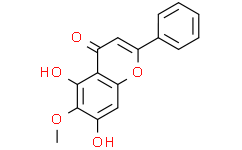
| Chemical Name | 5,7-dihydroxy-6-methoxy-2-phenylchromen-4-one |
| Synonyms | Baicalein 6-methyl etherOroxylin A |
| HS Tariff Code | 2934.99.9001 |
| Storage |
Powder-20°C 3 years 4°C 2 years In solvent -80°C 6 months -20°C 1 month |
| Shipping Condition | Room temperature (This product is stable at ambient temperature for a few days during ordinary shipping and time spent in Customs) |
Biological Activity
| ln Vitro | Oroxylin A (20 μM; 24 hours) prevents MDA-MB-231 cells from proliferating, growing, and migrating. Moreover, oroxylin A can prevent MDA-MB-231 from invading and from going through the epithelial-mesenchymal transition (EMT) pathway [4]. Moreover, oroxylin A (20 μM; 24 h) suppresses the NF-κB signaling pathway and pro-inflammatory cytokine expression [4]. TNF-α neutralizes the anti-inflammatory properties of oroxylin A [4]. |
| ADME/Pharmacokinetics |
Metabolism / Metabolites Oroxylin A has known human metabolites that include (2S,3S,4S,5R)-3,4,5-Trihydroxy-6-(5-hydroxy-6-methoxy-4-oxo-2-phenylchromen-7-yl)oxyoxane-2-carboxylic acid. |
| References |
[1]. Oroxylin A promotes PTEN-mediated negative regulation of MDM2 transcription via SIRT3-mediated deacetylation to stabilize p53 and inhibit glycolysis in wt-p53 cancer cells. J Hematol Oncol. 2015 Apr 23;8:41. http://www.ncbi.nlm.nih.gov/pubmed/25902914. [2]. Oroxylin A regulates glucose metabolism in response to hypoxic stress with the involvement of Hypoxia-inducible factor-1 in human hepatoma HepG2 cells. Mol Carcinog. 2015 Aug 10. [3]. Oroxylin A inhibits glycolysis-dependent proliferation of human breast cancer via promoting SIRT3-mediated SOD2 transcription and HIF1α destabilization. Cell Death Dis. 2015 Apr 9. [4]. Oroxylin A Suppresses the Cell Proliferation, Migration, and EMT via NF-κB Signaling Pathway in Human Breast Cancer Cells. Biomed Res Int. 2019 Jun 23;2019:9241769. [5]. Oroxylin A inhibits colitis-associated carcinogenesis through modulating the IL-6/STAT3 signaling pathway. Inflamm Bowel Dis. 2013 Aug;19(9):1990-2000. |
| Additional Infomation |
Oroxylin A is a dihydroxy- and monomethoxy-flavone in which the hydroxy groups are positioned at C-5 and C-7 and the methoxy group is at C-6. It has a role as an antineoplastic agent and an EC 1.14.13.39 (nitric oxide synthase) inhibitor. It is a monomethoxyflavone and a dihydroxyflavone. It is a conjugate acid of an oroxylin A(1-). Oroxylin A has been reported in Rhinacanthus nasutus, Scutellaria racemosa, and other organisms with data available. |
Solubility Data
| Solubility (In Vitro) | DMSO : ≥ 32 mg/mL (~112.57 mM) |
| Solubility (In Vivo) |
Note: Listed below are some common formulations that may be used to formulate products with low water solubility (e.g. < 1 mg/mL), you may test these formulations using a minute amount of products to avoid loss of samples. Injection Formulations (e.g. IP/IV/IM/SC) Injection Formulation 1: DMSO : Tween 80: Saline = 10 : 5 : 85 (i.e. 100 μL DMSO stock solution → 50 μL Tween 80 → 850 μL Saline) *Preparation of saline: Dissolve 0.9 g of sodium chloride in 100 mL ddH ₂ O to obtain a clear solution. Injection Formulation 2: DMSO : PEG300 :Tween 80 : Saline = 10 : 40 : 5 : 45 (i.e. 100 μL DMSO → 400 μLPEG300 → 50 μL Tween 80 → 450 μL Saline) Injection Formulation 3: DMSO : Corn oil = 10 : 90 (i.e. 100 μL DMSO → 900 μL Corn oil) Example: Take the Injection Formulation 3 (DMSO : Corn oil = 10 : 90) as an example, if 1 mL of 2.5 mg/mL working solution is to be prepared, you can take 100 μL 25 mg/mL DMSO stock solution and add to 900 μL corn oil, mix well to obtain a clear or suspension solution (2.5 mg/mL, ready for use in animals). Injection Formulation 4: DMSO : 20% SBE-β-CD in saline = 10 : 90 [i.e. 100 μL DMSO → 900 μL (20% SBE-β-CD in saline)] *Preparation of 20% SBE-β-CD in Saline (4°C,1 week): Dissolve 2 g SBE-β-CD in 10 mL saline to obtain a clear solution. Injection Formulation 5: 2-Hydroxypropyl-β-cyclodextrin : Saline = 50 : 50 (i.e. 500 μL 2-Hydroxypropyl-β-cyclodextrin → 500 μL Saline) Injection Formulation 6: DMSO : PEG300 : castor oil : Saline = 5 : 10 : 20 : 65 (i.e. 50 μL DMSO → 100 μLPEG300 → 200 μL castor oil → 650 μL Saline) Injection Formulation 7: Ethanol : Cremophor : Saline = 10: 10 : 80 (i.e. 100 μL Ethanol → 100 μL Cremophor → 800 μL Saline) Injection Formulation 8: Dissolve in Cremophor/Ethanol (50 : 50), then diluted by Saline Injection Formulation 9: EtOH : Corn oil = 10 : 90 (i.e. 100 μL EtOH → 900 μL Corn oil) Injection Formulation 10: EtOH : PEG300:Tween 80 : Saline = 10 : 40 : 5 : 45 (i.e. 100 μL EtOH → 400 μLPEG300 → 50 μL Tween 80 → 450 μL Saline) Oral Formulations Oral Formulation 1: Suspend in 0.5% CMC Na (carboxymethylcellulose sodium) Oral Formulation 2: Suspend in 0.5% Carboxymethyl cellulose Example: Take the Oral Formulation 1 (Suspend in 0.5% CMC Na) as an example, if 100 mL of 2.5 mg/mL working solution is to be prepared, you can first prepare 0.5% CMC Na solution by measuring 0.5 g CMC Na and dissolve it in 100 mL ddH2O to obtain a clear solution; then add 250 mg of the product to 100 mL 0.5% CMC Na solution, to make the suspension solution (2.5 mg/mL, ready for use in animals). Oral Formulation 3: Dissolved in PEG400 Oral Formulation 4: Suspend in 0.2% Carboxymethyl cellulose Oral Formulation 5: Dissolve in 0.25% Tween 80 and 0.5% Carboxymethyl cellulose Oral Formulation 6: Mixing with food powders Note: Please be aware that the above formulations are for reference only. InvivoChem strongly recommends customers to read literature methods/protocols carefully before determining which formulation you should use for in vivo studies, as different compounds have different solubility properties and have to be formulated differently. (Please use freshly prepared in vivo formulations for optimal results.) |
| Preparing Stock Solutions | 1 mg | 5 mg | 10 mg | |
| 1 mM | 3.5179 mL | 17.5895 mL | 35.1791 mL | |
| 5 mM | 0.7036 mL | 3.5179 mL | 7.0358 mL | |
| 10 mM | 0.3518 mL | 1.7590 mL | 3.5179 mL |