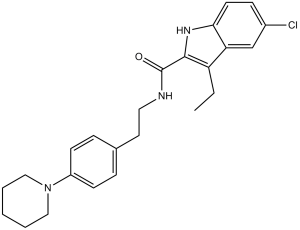
Org 27569 (Org27569; Org-27569), similar to the anorectic antiobesity drug rimonabant, is a novel, potent and selective allosteric modulator of cannabinoid CB1 receptor with anti-obesity effects.
Physicochemical Properties
| Molecular Formula | C24H28CLN3O | |
| Molecular Weight | 409.95 | |
| Exact Mass | 409.192 | |
| Elemental Analysis | C, 70.31; H, 6.88; Cl, 8.65; N, 10.25; O, 3.90 | |
| CAS # | 868273-06-7 | |
| Related CAS # |
|
|
| PubChem CID | 44828492 | |
| Appearance | White to off-white solid powder | |
| Density | 1.2±0.1 g/cm3 | |
| Boiling Point | 660.3±55.0 °C at 760 mmHg | |
| Flash Point | 353.2±31.5 °C | |
| Vapour Pressure | 0.0±2.0 mmHg at 25°C | |
| Index of Refraction | 1.635 | |
| LogP | 6.36 | |
| Hydrogen Bond Donor Count | 2 | |
| Hydrogen Bond Acceptor Count | 2 | |
| Rotatable Bond Count | 6 | |
| Heavy Atom Count | 29 | |
| Complexity | 530 | |
| Defined Atom Stereocenter Count | 0 | |
| SMILES | O=C(C1=C(CC)C2C(=CC=C(C=2)Cl)N1)NCCC1C=CC(N2CCCCC2)=CC=1 |
|
| InChi Key | AHFZDNYNXFMRFQ-UHFFFAOYSA-N | |
| InChi Code | InChI=1S/C24H28ClN3O/c1-2-20-21-16-18(25)8-11-22(21)27-23(20)24(29)26-13-12-17-6-9-19(10-7-17)28-14-4-3-5-15-28/h6-11,16,27H,2-5,12-15H2,1H3,(H,26,29) | |
| Chemical Name | 5-chloro-3-ethyl-N-[2-(4-piperidin-1-ylphenyl)ethyl]-1H-indole-2-carboxamide | |
| Synonyms |
|
|
| HS Tariff Code | 2934.99.9001 | |
| Storage |
Powder-20°C 3 years 4°C 2 years In solvent -80°C 6 months -20°C 1 month |
|
| Shipping Condition | Room temperature (This product is stable at ambient temperature for a few days during ordinary shipping and time spent in Customs) |
Biological Activity
| Targets | CB1 | ||
| ln Vitro |
|
||
| ln Vivo |
|
||
| Enzyme Assay | The CB1 receptor antagonist [3H]SR 141716A (1.2 nM) and the CB1 receptor agonist [3H]CP 55,940 (0.7 nM) are used in binding assays, along with 500 μL of total assay volume, 1 mg/mL BSA, and 50 mM Tris buffer containing 0.5 mM MgCl2 and 0.1 mM EDTA, pH 7.4. The addition of 30 μg of mouse brain membranes starts the binding process. Whatman GF/B glass-fiber filters that have been soaked in wash buffer at 4°C for 24 hours are used in conjunction with a 24-well sampling manifold to perform assays at 37°C for 60 minutes. The assays are then terminated by adding ice-cold wash buffer (50 mM Tris buffer and 1 mg/mL BSA) and vacuum filtration. Using a 4-mL aliquot of buffer, each reaction tube is cleaned five times. Radioactivity is measured using liquid scintillation spectrometry after the filters are oven-dried for 60 minutes and submerged in 5 mL of scintillation fluid. The difference between the binding that happens with and without 1 μM concentrations of the corresponding unlabeled ligand is known as specific binding, which accounts for 70–80% of net binding. | ||
| Cell Assay | ORG27569 (10 μM) is applied to CB1 receptor-expressing cells for a duration of 5 to 15 minutes. To treat the toxin and prevent Gi coupling effects, 5 ng/ml of PTX is added to the medium. After the cells are incubated with the toxin for eighteen hours, they are twice washed with PBS and treated with various compounds. After washing the cells in ice-cold PBS, the cells are harvested and treated with ice-cold lysis buffer (150 mM NaCl, 1.0% IGEPAL CA-630, 0.5% sodium deoxycholate, 0.1% SDS, and 50 mM Tris, pH 7.5) that contains protease inhibitors such as pepstatin A, E-64, bestatin, leupeptin, and aprotinin. | ||
| Animal Protocol |
|
||
| References |
[1]. Effects of the cannabinoid CB? receptor allosteric modulator ORG 27569 on reinstatement of cocaine- and methamphetamine-seeking behavior in rats. Drug Alcohol Depend. 2014 Oct 1;143:251-6. [2]. A key agonist-induced conformational change in the cannabinoid receptor CB1 is blocked by the allosteric ligand Org 27569. J Biol Chem. 2012 Jul 30. [3]. In-vivo pharmacological evaluation of the CB1-receptor allosteric modulator Org-27569. Behav Pharmacol. 2014 Apr;25(2):182-5. [4]. Allosteric modulation of the cannabinoid CB1 receptor. Mol Pharmacol. 2005 Nov;68(5):1484-95. [5]. CB(1) receptor allosteric modulators display both agonist and signaling pathway specificity. Mol Pharmacol. 2013 Feb;83(2):322-38. |
Solubility Data
| Solubility (In Vitro) |
|
|||
| Solubility (In Vivo) |
Solubility in Formulation 1: 2.5 mg/mL (6.10 mM) in 10% DMSO + 40% PEG300 + 5% Tween80 + 45% Saline (add these co-solvents sequentially from left to right, and one by one), suspension solution; with sonication. For example, if 1 mL of working solution is to be prepared, you can add 100 μL of 25.0 mg/mL clear DMSO stock solution to 400 μL PEG300 and mix evenly; then add 50 μL Tween-80 to the above solution and mix evenly; then add 450 μL normal saline to adjust the volume to 1 mL. Preparation of saline: Dissolve 0.9 g of sodium chloride in 100 mL ddH₂ O to obtain a clear solution. Solubility in Formulation 2: 2.5 mg/mL (6.10 mM) in 10% DMSO + 90% (20% SBE-β-CD in Saline) (add these co-solvents sequentially from left to right, and one by one), suspension solution; with ultrasonication. For example, if 1 mL of working solution is to be prepared, you can add 100 μL of 25.0 mg/mL clear DMSO stock solution to 900 μL of 20% SBE-β-CD physiological saline solution and mix evenly. Preparation of 20% SBE-β-CD in Saline (4°C,1 week): Dissolve 2 g SBE-β-CD in 10 mL saline to obtain a clear solution. Solubility in Formulation 3: ≥ 2.5 mg/mL (6.10 mM) (saturation unknown) in 10% DMSO + 90% Corn Oil (add these co-solvents sequentially from left to right, and one by one), clear solution. For example, if 1 mL of working solution is to be prepared, you can add 100 μL of 25.0 mg/mL clear DMSO stock solution to 900 μL of corn oil and mix evenly. (Please use freshly prepared in vivo formulations for optimal results.) |
| Preparing Stock Solutions | 1 mg | 5 mg | 10 mg | |
| 1 mM | 2.4393 mL | 12.1966 mL | 24.3932 mL | |
| 5 mM | 0.4879 mL | 2.4393 mL | 4.8786 mL | |
| 10 mM | 0.2439 mL | 1.2197 mL | 2.4393 mL |