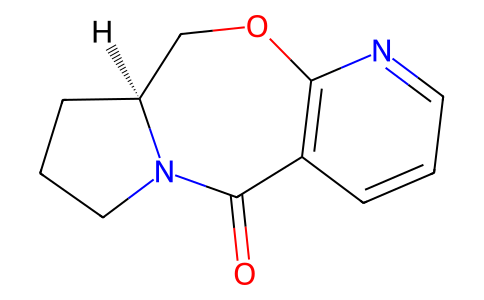
Physicochemical Properties
| Molecular Formula | C11H12N2O2 |
| Molecular Weight | 204.23 |
| Exact Mass | 204.09 |
| CAS # | 100044-96-0 |
| PubChem CID | 13584912 |
| Appearance | White to off-white solid powder |
| LogP | 1.016 |
| Hydrogen Bond Donor Count | 0 |
| Hydrogen Bond Acceptor Count | 3 |
| Rotatable Bond Count | 0 |
| Heavy Atom Count | 15 |
| Complexity | 269 |
| Defined Atom Stereocenter Count | 1 |
| SMILES | C1C[C@H]2COC3=C(C=CC=N3)C(=O)N2C1 |
| InChi Key | FIKUEZUFASUKAH-QMMMGPOBSA-N |
| InChi Code | InChI=1S/C11H12N2O2/c14-11-9-4-1-5-12-10(9)15-7-8-3-2-6-13(8)11/h1,4-5,8H,2-3,6-7H2/t8-/m0/s1 |
| Chemical Name | (7S)-9-oxa-3,11-diazatricyclo[8.4.0.03,7]tetradeca-1(10),11,13-trien-2-one |
| HS Tariff Code | 2934.99.9001 |
| Storage |
Powder-20°C 3 years 4°C 2 years In solvent -80°C 6 months -20°C 1 month |
| Shipping Condition | Room temperature (This product is stable at ambient temperature for a few days during ordinary shipping and time spent in Customs) |
Biological Activity
| ln Vitro | With an EC50 of 8–16 μM in rat hippocampal primary cultured neurons, Org-26576 (Org 26576) exhibits 10–30 fold greater potency when compared to CX516 in potentiating AMPA-mediated electrophysiological responses. Structurally, Org 26576 is a distinct chemical series derived from the first generation ampakine CX516. When evaluated at 10 μM against over 60 molecular targets, such as kinases, ion channels, and G-Protein Coupled Receptors, Org-26576 exhibits selectivity for AMPA receptors[1]. |
| ln Vivo | In mice, anteroventral and laterodorsal thalamus, cingulate cortex, dentate gyrus, and the CA3 subfield of the hippocampus all significantly increase in response to Org-26576 (Org 26576; 1 mg/kg)[1]. With the 10-mg/kg dosage, progenitor cell proliferation in the prelimbic cortex (about 35%) and dentate gyrus (nearly 40%). The majority of the cells that survive when exposed to persistent Org-26576 in the dentate gyrus have a neuronal phenotype, and their survival rates are enhanced to about 30%[2]. The potentiation of AMPA receptors by Org-26576 (Org 26576) has a favorable modulatory effect on the production of brain-derived neurotrophic factor (BDNF) while neurons are actively firing. When Org-26576 and stress are combined, animals' hippocampi have markedly elevated levels of total BDNF mRNA[3]. |
| References |
[1]. Regionally selective and dose-dependent effects of the ampakines Org 26576 and Org 24448 on local cerebral glucose utilisation in the mouse as assessed by 14C-2-deoxyglucose autoradiography. Neuropharmacology. 2005 Aug;49(2):254-64. [2]. Chronic treatment with AMPA receptor potentiator Org 26576 increases neuronal cell proliferation and survival in adult rodent hippocampus. Psychopharmacology (Berl). 2009 Oct;206(2):215-22. [3]. The AMPA receptor potentiator Org 26576 modulates stress-induced transcription of BDNF isoforms in rat hippocampus. Pharmacol Res. 2012 Feb;65(2):176-81. |
Solubility Data
| Solubility (In Vitro) | DMSO: 25 mg/mL (122.41 mM) |
| Solubility (In Vivo) |
Note: Listed below are some common formulations that may be used to formulate products with low water solubility (e.g. < 1 mg/mL), you may test these formulations using a minute amount of products to avoid loss of samples. Injection Formulations (e.g. IP/IV/IM/SC) Injection Formulation 1: DMSO : Tween 80: Saline = 10 : 5 : 85 (i.e. 100 μL DMSO stock solution → 50 μL Tween 80 → 850 μL Saline) *Preparation of saline: Dissolve 0.9 g of sodium chloride in 100 mL ddH ₂ O to obtain a clear solution. Injection Formulation 2: DMSO : PEG300 :Tween 80 : Saline = 10 : 40 : 5 : 45 (i.e. 100 μL DMSO → 400 μLPEG300 → 50 μL Tween 80 → 450 μL Saline) Injection Formulation 3: DMSO : Corn oil = 10 : 90 (i.e. 100 μL DMSO → 900 μL Corn oil) Example: Take the Injection Formulation 3 (DMSO : Corn oil = 10 : 90) as an example, if 1 mL of 2.5 mg/mL working solution is to be prepared, you can take 100 μL 25 mg/mL DMSO stock solution and add to 900 μL corn oil, mix well to obtain a clear or suspension solution (2.5 mg/mL, ready for use in animals). Injection Formulation 4: DMSO : 20% SBE-β-CD in saline = 10 : 90 [i.e. 100 μL DMSO → 900 μL (20% SBE-β-CD in saline)] *Preparation of 20% SBE-β-CD in Saline (4°C,1 week): Dissolve 2 g SBE-β-CD in 10 mL saline to obtain a clear solution. Injection Formulation 5: 2-Hydroxypropyl-β-cyclodextrin : Saline = 50 : 50 (i.e. 500 μL 2-Hydroxypropyl-β-cyclodextrin → 500 μL Saline) Injection Formulation 6: DMSO : PEG300 : castor oil : Saline = 5 : 10 : 20 : 65 (i.e. 50 μL DMSO → 100 μLPEG300 → 200 μL castor oil → 650 μL Saline) Injection Formulation 7: Ethanol : Cremophor : Saline = 10: 10 : 80 (i.e. 100 μL Ethanol → 100 μL Cremophor → 800 μL Saline) Injection Formulation 8: Dissolve in Cremophor/Ethanol (50 : 50), then diluted by Saline Injection Formulation 9: EtOH : Corn oil = 10 : 90 (i.e. 100 μL EtOH → 900 μL Corn oil) Injection Formulation 10: EtOH : PEG300:Tween 80 : Saline = 10 : 40 : 5 : 45 (i.e. 100 μL EtOH → 400 μLPEG300 → 50 μL Tween 80 → 450 μL Saline) Oral Formulations Oral Formulation 1: Suspend in 0.5% CMC Na (carboxymethylcellulose sodium) Oral Formulation 2: Suspend in 0.5% Carboxymethyl cellulose Example: Take the Oral Formulation 1 (Suspend in 0.5% CMC Na) as an example, if 100 mL of 2.5 mg/mL working solution is to be prepared, you can first prepare 0.5% CMC Na solution by measuring 0.5 g CMC Na and dissolve it in 100 mL ddH2O to obtain a clear solution; then add 250 mg of the product to 100 mL 0.5% CMC Na solution, to make the suspension solution (2.5 mg/mL, ready for use in animals). Oral Formulation 3: Dissolved in PEG400 Oral Formulation 4: Suspend in 0.2% Carboxymethyl cellulose Oral Formulation 5: Dissolve in 0.25% Tween 80 and 0.5% Carboxymethyl cellulose Oral Formulation 6: Mixing with food powders Note: Please be aware that the above formulations are for reference only. InvivoChem strongly recommends customers to read literature methods/protocols carefully before determining which formulation you should use for in vivo studies, as different compounds have different solubility properties and have to be formulated differently. (Please use freshly prepared in vivo formulations for optimal results.) |
| Preparing Stock Solutions | 1 mg | 5 mg | 10 mg | |
| 1 mM | 4.8964 mL | 24.4822 mL | 48.9644 mL | |
| 5 mM | 0.9793 mL | 4.8964 mL | 9.7929 mL | |
| 10 mM | 0.4896 mL | 2.4482 mL | 4.8964 mL |