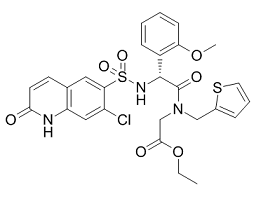
OSMI-4 is a novel and potent inhibitor of O-GlcNAc transferase (OGT) with an EC50 of ~3 μM in cells. It reduces O-GlcNAc levels almost completely by 5 μM (O-GlcNAc (RL-2) blot of HEK293T cell lysates after treatment); OSMI-4 is the best OGT inhibitor reported to date, and it is especially attractive for probing OGT’s complex biology.
Physicochemical Properties
| Molecular Formula | C27H26CLN3O7S2 |
| Molecular Weight | 604.0942 |
| Exact Mass | 603.09 |
| CAS # | 2260791-14-6 |
| PubChem CID | 137319721 |
| Appearance | Light yellow to yellow solid powder |
| LogP | 3.6 |
| Hydrogen Bond Donor Count | 2 |
| Hydrogen Bond Acceptor Count | 9 |
| Rotatable Bond Count | 12 |
| Heavy Atom Count | 40 |
| Complexity | 1050 |
| Defined Atom Stereocenter Count | 1 |
| SMILES | ClC1C([H])=C2C(C([H])=C([H])C(N2[H])=O)=C([H])C=1S(N([H])[C@]([H])(C(N(C([H])([H])C(=O)OC([H])([H])C([H])([H])[H])C([H])([H])C1=C([H])C([H])=C([H])S1)=O)C1=C([H])C([H])=C([H])C([H])=C1OC([H])([H])[H])(=O)=O |
| InChi Key | STPSLAZMEWZDAJ-AREMUKBSSA-N |
| InChi Code | InChI=1S/C27H26ClN3O7S2/c1-3-38-25(33)16-31(15-18-7-6-12-39-18)27(34)26(19-8-4-5-9-22(19)37-2)30-40(35,36)23-13-17-10-11-24(32)29-21(17)14-20(23)28/h4-14,26,30H,3,15-16H2,1-2H3,(H,29,32)/t26-/m1/s1 |
| Chemical Name | ethyl 2-[[(2R)-2-[(7-chloro-2-oxo-1H-quinolin-6-yl)sulfonylamino]-2-(2-methoxyphenyl)acetyl]-(thiophen-2-ylmethyl)amino]acetate |
| Synonyms | OSMI-4 OSMI 4 OSMI4 |
| HS Tariff Code | 2934.99.9001 |
| Storage |
Powder-20°C 3 years 4°C 2 years In solvent -80°C 6 months -20°C 1 month |
| Shipping Condition | Room temperature (This product is stable at ambient temperature for a few days during ordinary shipping and time spent in Customs) |
Biological Activity
| Targets | OSMI-4 targets O-GlcNAc transferase (OGT) (IC50 = 1.7 nM for human OGT enzymatic activity; Ki = 0.7 nM, competitive inhibition mode against UDP-GlcNAc) [1] |
| ln Vitro |
OSMI-4 (4b) is the best OGT reagent discovered to date; it can investigate the intricate biological genesis of OGT with an EC50 of about 3 μM in cells [1]. - OGT enzyme inhibitory activity: OSMI-4 potently and selectively inhibited recombinant human OGT-mediated O-GlcNAcylation in a dose-dependent manner, with IC50 = 1.7 nM and Ki = 0.7 nM. Kinetic analysis confirmed it competes with the sugar donor UDP-GlcNAc for binding to OGT’s active site [1] - Inhibition of intracellular O-GlcNAcylation: OSMI-4 (5 nM-10 μM) dose-dependently reduced global protein O-GlcNAcylation levels in HeLa and MCF-7 cells. At 10 μM, O-GlcNAcylated protein levels were reduced by 75% (HeLa) and 70% (MCF-7) as detected by western blot with O-GlcNAc-specific antibody [1] - High selectivity: The compound showed no significant inhibition against other glycosyltransferases (e.g., glycogen synthase kinase 3β, β-1,4-galactosyltransferase) at 100 μM, and did not affect cellular phosphorylation levels of key signaling proteins (Akt, ERK1/2) [1] - Minimal cytotoxicity: OSMI-4 at concentrations up to 20 μM exhibited no obvious cytotoxicity to HeLa, MCF-7, or normal human foreskin fibroblasts (NHF), with cell viability > 90% after 72 hours of treatment [1] - Target specificity validation: In OGT-overexpressing HeLa cells, the inhibitory effect of OSMI-4 (1 μM) on O-GlcNAcylation was reversed by 60%, confirming direct targeting of OGT [1] |
| Enzyme Assay |
- OGT enzymatic activity assay: Recombinant human OGT catalytic domain was mixed with UDP-GlcNAc (sugar donor), fluorescently labeled peptide substrate (derived from p53), and OSMI-4 at gradient concentrations (0.1 nM-100 nM) in reaction buffer (pH 7.5). The mixture was incubated at 37°C for 1 hour, and O-GlcNAcylated peptide was detected by fluorescence polarization. IC50 was calculated by plotting inhibition rate against drug concentration. Kinetic analysis with varying UDP-GlcNAc concentrations confirmed competitive inhibition [1] - Isothermal titration calorimetry (ITC) binding assay: OSMI-4 was titrated into a solution containing recombinant human OGT in buffer at 25°C. Heat changes during binding were recorded to determine the binding affinity (KD = 0.5 nM) and stoichiometry (1:1 binding ratio) [1] - Glycosyltransferase selectivity assay: Recombinant glycogen synthase kinase 3β, β-1,4-galactosyltransferase, and other glycosyltransferases were separately mixed with their corresponding substrates, cofactors, and OSMI-4 (100 μM) in optimal reaction buffers. After 37°C incubation for 2 hours, enzyme activity was detected by substrate-specific assays to evaluate selectivity [1] |
| Cell Assay |
- Intracellular O-GlcNAcylation detection assay: HeLa or MCF-7 cells were seeded into 6-well plates (5×10⁵ cells/well) and incubated overnight. Cells were treated with OSMI-4 (5 nM-10 μM) for 24 hours, lysed, and proteins were separated by SDS-PAGE. Western blot was performed with O-GlcNAc-specific antibody and GAPDH (loading control), and band intensities were quantified by densitometry [1] - Cell viability assay: HeLa, MCF-7, and NHF cells were seeded into 96-well plates (5×10³ cells/well) and treated with OSMI-4 (0.1 nM-20 μM) for 72 hours. Cell viability was measured by tetrazolium salt-based assay, and no significant cytotoxicity was observed [1] - Target specificity validation assay: HeLa cells were transfected with OGT overexpression plasmid or empty vector for 48 hours. Transfected cells were treated with OSMI-4 (1 μM) for 24 hours, and O-GlcNAcylation levels were detected by western blot to confirm direct OGT targeting [1] |
| References |
[1]. Structure-Based Evolution of Low Nanomolar O-GlcNAc Transferase Inhibitors. J Am Chem Soc. 2018 Oct 24;140(42):13542-13545. |
| Additional Infomation |
- Chemical classification: OSMI-4 is a small-molecule OGT inhibitor, developed through structure-based drug design targeting the UDP-GlcNAc binding pocket of OGT [1] - Mechanism of action: The compound binds to the active site of OGT, competitively blocking the binding of UDP-GlcNAc (the sugar donor for O-GlcNAcylation). This inhibits OGT-mediated post-translational modification of intracellular proteins, reducing global O-GlcNAcylation levels without affecting other glycosylation or phosphorylation pathways [1] - Target background: OGT is a unique glycosyltransferase that catalyzes the addition of O-linked N-acetylglucosamine (O-GlcNAc) to serine/threonine residues of proteins. Aberrant OGT activity and dysregulated O-GlcNAcylation are associated with cancer, neurodegenerative diseases, and metabolic disorders [1] - Therapeutic potential: OSMI-4 is a potent, selective, and cell-permeable OGT inhibitor, serving as a valuable chemical tool for studying O-GlcNAcylation biology. It has potential therapeutic applications in diseases driven by dysregulated OGT activity, including certain cancers and Alzheimer’s disease [1] |
Solubility Data
| Solubility (In Vitro) | DMSO : ~62.5 mg/mL (~103.46 mM) |
| Solubility (In Vivo) |
Solubility in Formulation 1: ≥ 2.08 mg/mL (3.44 mM) (saturation unknown) in 10% DMSO + 40% PEG300 + 5% Tween80 + 45% Saline (add these co-solvents sequentially from left to right, and one by one), clear solution. For example, if 1 mL of working solution is to be prepared, you can add 100 μL of 20.8 mg/mL clear DMSO stock solution to 400 μL PEG300 and mix evenly; then add 50 μL Tween-80 to the above solution and mix evenly; then add 450 μL normal saline to adjust the volume to 1 mL. Preparation of saline: Dissolve 0.9 g of sodium chloride in 100 mL ddH₂ O to obtain a clear solution. Solubility in Formulation 2: ≥ 2.08 mg/mL (3.44 mM) (saturation unknown) in 10% DMSO + 90% Corn Oil (add these co-solvents sequentially from left to right, and one by one), clear solution. For example, if 1 mL of working solution is to be prepared, you can add 100 μL of 20.8 mg/mL clear DMSO stock solution to 900 μL of corn oil and mix evenly. (Please use freshly prepared in vivo formulations for optimal results.) |
| Preparing Stock Solutions | 1 mg | 5 mg | 10 mg | |
| 1 mM | 1.6554 mL | 8.2769 mL | 16.5538 mL | |
| 5 mM | 0.3311 mL | 1.6554 mL | 3.3108 mL | |
| 10 mM | 0.1655 mL | 0.8277 mL | 1.6554 mL |