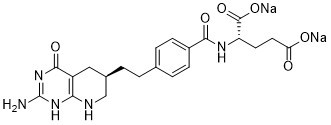
Lometrexol is a novel and potent antimetabolite that belongs to the folate class with antineoplastic activity. As the 6R diastereomer of 5,10-dideazatetrahydrofolate, lometrexol inhibits glycinamide ribonucleotide formyltransferase (GARFT), the enzyme that catalyzes the first step in the de novo purine biosynthetic pathway, thereby inhibiting DNA synthesis, arresting cells in the S phase of the cell cycle, and inhibiting tumor cell proliferation. The agent has been shown to be active against tumors that are resistant to the folate antagonist methotrexate.
Physicochemical Properties
| Molecular Formula | C21H25N5O6.NA+ |
| Molecular Weight | 466.4429 |
| Exact Mass | 487.144 |
| CAS # | 120408-07-3 |
| Related CAS # | Lometrexol;106400-81-1;Lometrexol hydrate;1435784-14-7;LY243246;106400-18-4 |
| PubChem CID | 135508134 |
| Appearance | White to light yellow solid powder |
| LogP | 1.727 |
| Hydrogen Bond Donor Count | 4 |
| Hydrogen Bond Acceptor Count | 8 |
| Rotatable Bond Count | 7 |
| Heavy Atom Count | 34 |
| Complexity | 820 |
| Defined Atom Stereocenter Count | 2 |
| SMILES | C1[C@H](CNC2=C1C(=O)NC(=N2)N)CCC3=CC=C(C=C3)C(=O)N[C@@H](CCC(=O)[O-])C(=O)[O-].[Na+].[Na+] |
| InChi Key | SVJSWELRJWVPQD-KJWOGLQMSA-L |
| InChi Code | InChI=1S/C21H25N5O6.2Na/c22-21-25-17-14(19(30)26-21)9-12(10-23-17)2-1-11-3-5-13(6-4-11)18(29)24-15(20(31)32)7-8-16(27)28;;/h3-6,12,15H,1-2,7-10H2,(H,24,29)(H,27,28)(H,31,32)(H4,22,23,25,26,30);;/q;2*+1/p-2/t12-,15+;;/m1../s1 |
| Chemical Name | disodium;(2S)-2-[[4-[2-[(6R)-2-amino-4-oxo-5,6,7,8-tetrahydro-3H-pyrido[2,3-d]pyrimidin-6-yl]ethyl]benzoyl]amino]pentanedioate |
| HS Tariff Code | 2934.99.9001 |
| Storage |
Powder-20°C 3 years 4°C 2 years In solvent -80°C 6 months -20°C 1 month |
| Shipping Condition | Room temperature (This product is stable at ambient temperature for a few days during ordinary shipping and time spent in Customs) |
Biological Activity
| ln Vitro | In order to rapidly and persistently deplete intracellular purine ribonucleotides, lometrexol (DDATHF) disodium binds firmly to GART [3]. Rapid and total growth inhibition of L1210 cells is induced by disodium lometrexol (1-30 μM; 2-10 hours) [3]. Cell cycle arrest is induced in mouse leukemia L1210 cells by 1 μM of lometrexol disodium, which can be applied for 2-24 hours [3]. |
| ln Vivo | By interfering with purine metabolism, lometrexole (DDATHF; i.p. ; 15–60 mg/kg; gestation day 7.5) disodium causes neural tube defects (NTDs). It also dose-dependently accelerates embryonic resorption and retards growth. [1]. Glycylamide ribonucleotide formyltransferase (GARFT) activity is decreased by lometrexol (ip; 40 mg/kg; gestation day 7.5) disodium, which also modifies the levels of ATP, GTP, dATP, and dGTP [1]. Neural tube defects (NTD) are characterized by aberrant proliferation and apoptosis, which are induced by lomitrexol (ip; 40 mg/kg; gestation day 7.5) disodium [1]. |
| Cell Assay |
Cell Viability Assay [3] Cell Types: Mouse Leukemia L1210 Cell Tested Concentrations: 1, 30 μM Incubation Duration: 2, 4, 6, 8, 10 hrs (hours) Experimental Results: Induced rapid and complete growth inhibition. Cell cycle analysis [3] Cell Types: L1210 Cell Tested Concentrations: 1 μM Incubation Duration: 2, 4, 8, 12, 24 hrs (hours) Experimental Results: Caused rapid loss of G2/M phase cell population and accumulation of cells in early S phase for 8 hrs (hours). By 24 h, the S phase population appears to be slowly shifting to higher DNA content, thus transitioning from mid to late S phase to higher DNA content. |
| Animal Protocol |
Animal/Disease Models: C57BL/6 mice (7-8 weeks, 18-20 g) [1] Doses: 15, 30, 35, 40, 45 and 60 mg/kg Route of Administration: intraperitoneal (ip) injection; gestation day 7.5 Experimental Results: The embryo resorption rate is increased and growth is retarded in a dose-dependent manner. Animal/Disease Models: C57BL/6 mice (7-8 weeks, 18-20g) [1] Doses: 40mg/kg Route of Administration: intraperitoneal (ip) injection; gestation day 7.5, lasting 0, 6, 24, 48 and 96 hrs (hrs (hours)) Experimental Results: Inhibits glycylamide ribonucleotide formyltransferase (GARFT) activity, and GARFT activity is maximally inhibited after 6 hrs (hrs (hours)). The levels of ATP, GTP, dATP and dGTP in NTDs embryonic brain tissue were Dramatically diminished at 6 hrs (hrs (hours)). Animal/Disease Models: C57BL/6 mice (7-8 weeks, 18-20g) [1] Doses: 40mg/kg Route of Administration: intraperitoneal (ip) injection; pregnancy day 7.5, lasting for 4 days Experimental Results: NTD group proliferation-related genes (Pcna , Foxg1 and Ptch1) diminished, and the expression of apoptosis-related genes (Bax, Casp8 and Casp9) increased. |
| References |
[1]. The effect of inhibiting glycinamide ribonucleotide formyl transferase on the development of neural tube in mice. Nutr Metab (Lond). 2016 Aug 23;13(1):56. [2]. Structural basis of inhibition of the human serine hydroxymethyltransferase SHMT2 by antifolate drugs. FEBS Lett. 2019 Jul;593(14):1863-1873. [3]. Antifolates targeting purine synthesis allow entry of tumor cells into S phase regardless of p53 function. Cancer Res. 2002 Sep 15;62(18):5236-41. |
| Additional Infomation | Lometrexol Sodium is the sodium salt form of lometrexol, a folate analogue antimetabolite with antineoplastic activity. As the stereoisomer of 5,10-dideazatetrahydrofolate, lometrexol selectively inhibits glycinamide ribonucleotide formyltransferase (GARFT), the enzyme that catalyzes the first step in the de novo purine biosynthetic pathway, thereby inhibiting DNA synthesis and leading to an inhibition of tumor cell proliferation. The agent has been shown to be active against tumors that are resistant to the folate antagonist methotrexate, but causes severe, dose-limiting toxicities. |
Solubility Data
| Solubility (In Vitro) | May dissolve in DMSO (in most cases), if not, try other solvents such as H2O, Ethanol, or DMF with a minute amount of products to avoid loss of samples |
| Solubility (In Vivo) |
Note: Listed below are some common formulations that may be used to formulate products with low water solubility (e.g. < 1 mg/mL), you may test these formulations using a minute amount of products to avoid loss of samples. Injection Formulations (e.g. IP/IV/IM/SC) Injection Formulation 1: DMSO : Tween 80: Saline = 10 : 5 : 85 (i.e. 100 μL DMSO stock solution → 50 μL Tween 80 → 850 μL Saline) *Preparation of saline: Dissolve 0.9 g of sodium chloride in 100 mL ddH ₂ O to obtain a clear solution. Injection Formulation 2: DMSO : PEG300 :Tween 80 : Saline = 10 : 40 : 5 : 45 (i.e. 100 μL DMSO → 400 μLPEG300 → 50 μL Tween 80 → 450 μL Saline) Injection Formulation 3: DMSO : Corn oil = 10 : 90 (i.e. 100 μL DMSO → 900 μL Corn oil) Example: Take the Injection Formulation 3 (DMSO : Corn oil = 10 : 90) as an example, if 1 mL of 2.5 mg/mL working solution is to be prepared, you can take 100 μL 25 mg/mL DMSO stock solution and add to 900 μL corn oil, mix well to obtain a clear or suspension solution (2.5 mg/mL, ready for use in animals). Injection Formulation 4: DMSO : 20% SBE-β-CD in saline = 10 : 90 [i.e. 100 μL DMSO → 900 μL (20% SBE-β-CD in saline)] *Preparation of 20% SBE-β-CD in Saline (4°C,1 week): Dissolve 2 g SBE-β-CD in 10 mL saline to obtain a clear solution. Injection Formulation 5: 2-Hydroxypropyl-β-cyclodextrin : Saline = 50 : 50 (i.e. 500 μL 2-Hydroxypropyl-β-cyclodextrin → 500 μL Saline) Injection Formulation 6: DMSO : PEG300 : castor oil : Saline = 5 : 10 : 20 : 65 (i.e. 50 μL DMSO → 100 μLPEG300 → 200 μL castor oil → 650 μL Saline) Injection Formulation 7: Ethanol : Cremophor : Saline = 10: 10 : 80 (i.e. 100 μL Ethanol → 100 μL Cremophor → 800 μL Saline) Injection Formulation 8: Dissolve in Cremophor/Ethanol (50 : 50), then diluted by Saline Injection Formulation 9: EtOH : Corn oil = 10 : 90 (i.e. 100 μL EtOH → 900 μL Corn oil) Injection Formulation 10: EtOH : PEG300:Tween 80 : Saline = 10 : 40 : 5 : 45 (i.e. 100 μL EtOH → 400 μLPEG300 → 50 μL Tween 80 → 450 μL Saline) Oral Formulations Oral Formulation 1: Suspend in 0.5% CMC Na (carboxymethylcellulose sodium) Oral Formulation 2: Suspend in 0.5% Carboxymethyl cellulose Example: Take the Oral Formulation 1 (Suspend in 0.5% CMC Na) as an example, if 100 mL of 2.5 mg/mL working solution is to be prepared, you can first prepare 0.5% CMC Na solution by measuring 0.5 g CMC Na and dissolve it in 100 mL ddH2O to obtain a clear solution; then add 250 mg of the product to 100 mL 0.5% CMC Na solution, to make the suspension solution (2.5 mg/mL, ready for use in animals). Oral Formulation 3: Dissolved in PEG400 Oral Formulation 4: Suspend in 0.2% Carboxymethyl cellulose Oral Formulation 5: Dissolve in 0.25% Tween 80 and 0.5% Carboxymethyl cellulose Oral Formulation 6: Mixing with food powders Note: Please be aware that the above formulations are for reference only. InvivoChem strongly recommends customers to read literature methods/protocols carefully before determining which formulation you should use for in vivo studies, as different compounds have different solubility properties and have to be formulated differently. (Please use freshly prepared in vivo formulations for optimal results.) |
| Preparing Stock Solutions | 1 mg | 5 mg | 10 mg | |
| 1 mM | 2.1439 mL | 10.7195 mL | 21.4390 mL | |
| 5 mM | 0.4288 mL | 2.1439 mL | 4.2878 mL | |
| 10 mM | 0.2144 mL | 1.0719 mL | 2.1439 mL |