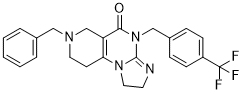
ONC212 (ONC-212; ONC 212), a fluorinated-ONC201 analog, is a novel, potent and selective agonist of GPR132 with anticancer activity. It exhibits strong in vivo efficacy against hepatocellular cancer and melanoma models.
Physicochemical Properties
| Molecular Formula | C24H23F3N4O |
| Molecular Weight | 440.460835695267 |
| Exact Mass | 440.18 |
| Elemental Analysis | C, 65.44; H, 5.26; F, 12.94; N, 12.72; O, 3.63 |
| CAS # | 1807861-48-8 |
| Related CAS # | 1807861-48-8 |
| PubChem CID | 124085867 |
| Appearance | White to off-white solid powder |
| LogP | 2.8 |
| Hydrogen Bond Donor Count | 0 |
| Hydrogen Bond Acceptor Count | 6 |
| Rotatable Bond Count | 4 |
| Heavy Atom Count | 32 |
| Complexity | 779 |
| Defined Atom Stereocenter Count | 0 |
| InChi Key | DFULPGUTXZTYKA-UHFFFAOYSA-N |
| InChi Code | InChI=1S/C24H23F3N4O/c25-24(26,27)19-8-6-18(7-9-19)15-31-22(32)20-16-29(14-17-4-2-1-3-5-17)12-10-21(20)30-13-11-28-23(30)31/h1-9H,10-16H2 |
| Chemical Name | 11-benzyl-7-[[4-(trifluoromethyl)phenyl]methyl]-2,5,7,11-tetrazatricyclo[7.4.0.02,6]trideca-1(9),5-dien-8-one |
| Synonyms | ONC 212; ONC-212; ONC212 |
| HS Tariff Code | 2934.99.9001 |
| Storage |
Powder-20°C 3 years 4°C 2 years In solvent -80°C 6 months -20°C 1 month |
| Shipping Condition | Room temperature (This product is stable at ambient temperature for a few days during ordinary shipping and time spent in Customs) |
Biological Activity
| Targets | GPR132 |
| ln Vitro | ONC212 has at least ten times the potency of ONC201 compared to ONC212, and it exhibits an anti-proliferative effect in a wide panel of pancreatic cancer cell lines. In susceptible pancreatic cancer cell lines, ONC212 induces apoptosis earlier and at lower concentrations than ONC201[1]. On mantle cell lymphoma (MCL) and acute myeloid leukemia (AML) cell lines, ONC212 has strong and noticeable apoptogenic effects (e.g., ED50s of 141.0 nM in p53 wild-type OCI-AML3 cells, 105.7 nM in MOLM13 cells, and 265.2 nM in p53-null JeKo-1 cell lines). ONC212 takes longer than 36 hours to begin inducing apoptosis in OCI-AML3 cells, according to time course analysis of apoptosis[2]. Significantly, ONC212 causes cell cycle arrest and/or Sub-G1 apoptotic cells[4]. |
| ln Vivo | ONC212 exhibits increased efficacy in melanoma and hepatocellular carcinoma xenograft models[1]. In mice, ONC212 exhibits a broad therapeutic window, a satisfactory PK profile, and oral well-tolerance at effective doses for both triple negative breast cancer and colon cancer[3]. ONC212 shows fast activity kinetics. ONC212 has a slightly shorter half-life than ONC201, with a Cmax of 1.4 mg/mL, a T1/2 of 4.3 hours, and a clearance from the blood at 12 hours. Despite systemic clearance, it has a sustained pharmacodynamic effect. In a human melanoma xenograft and hepatocellular model, oral ONC212 exhibits strong anti-tumor efficacy. While ONC212 only inhibits invasion of tumor cells, ONC206 and ONC201 both inhibit invasion and migration[4]. |
| Cell Assay | In assays for colony formation, 0.2 × 10⁶ cells are seeded per well in a 6-well plate and treated with the appropriate doses of ONC201 or ONC212. After 72 hours of treatment, 500 cells from each treatment group are taken out and plated in triplicate in drug-free media to initiate the colony-forming process. On Day 10, colonies are stained with 0.25% crystal violet, counted, photographed, and reported as the number of colonies ± SEM. |
| Animal Protocol | In this study, female athymic nu/nu mice aged six to seven weeks are employed. TSubcutaneous injection of 50 μL of PBS mixed with 50 μL of Matrigel, containing 3 to 5×10⁶ luciferase-expressing cells, is performed into the mice's back flanks. The indicated control or treatment groups are randomly assigned to mice once the tumor volume reaches an average of 100 to 150 cm3. By oral gavage, ONC201 and ONC212 are administered in a solution containing 10% DMSO, 20% Kolliphor®EL, and 70% PBS. Employing a digital caliper, the tumors' length (L) and width (W) are measured one or two times per week, and the tumor's volume is computed. To keep an eye out for indications of drug toxicity, mice are also weighed once a week [2]. |
| References |
[1]. Oncotarget. 2017 Oct 10; 8(47): 81776–81793. [2]. Blood (2016) 128 (22): 4059. [3]. Cancer Res (2017) 77 (13_Supplement): 3245. [3]. Cell Cycle . 2017 Oct 2;16(19):1790-1799. |
Solubility Data
| Solubility (In Vitro) |
DMSO: 50~88 mg/mL (113.5~199.8 mM) Ethanol: ~88 mg/mL |
| Solubility (In Vivo) |
Solubility in Formulation 1: ≥ 2.5 mg/mL (5.68 mM) (saturation unknown) in 10% DMSO + 40% PEG300 + 5% Tween80 + 45% Saline (add these co-solvents sequentially from left to right, and one by one), clear solution. For example, if 1 mL of working solution is to be prepared, you can add 100 μL of 25.0 mg/mL clear DMSO stock solution to 400 μL PEG300 and mix evenly; then add 50 μL Tween-80 to the above solution and mix evenly; then add 450 μL normal saline to adjust the volume to 1 mL. Preparation of saline: Dissolve 0.9 g of sodium chloride in 100 mL ddH₂ O to obtain a clear solution. Solubility in Formulation 2: ≥ 2.5 mg/mL (5.68 mM) (saturation unknown) in 10% DMSO + 90% (20% SBE-β-CD in Saline) (add these co-solvents sequentially from left to right, and one by one), clear solution. For example, if 1 mL of working solution is to be prepared, you can add 100 μL of 25.0 mg/mL clear DMSO stock solution to 900 μL of 20% SBE-β-CD physiological saline solution and mix evenly. Preparation of 20% SBE-β-CD in Saline (4°C,1 week): Dissolve 2 g SBE-β-CD in 10 mL saline to obtain a clear solution. Solubility in Formulation 3: ≥ 2.5 mg/mL (5.68 mM) (saturation unknown) in 10% DMSO + 90% Corn Oil (add these co-solvents sequentially from left to right, and one by one), clear solution. For example, if 1 mL of working solution is to be prepared, you can add 100 μL of 25.0 mg/mL clear DMSO stock solution to 900 μL of corn oil and mix evenly. (Please use freshly prepared in vivo formulations for optimal results.) |
| Preparing Stock Solutions | 1 mg | 5 mg | 10 mg | |
| 1 mM | 2.2704 mL | 11.3518 mL | 22.7035 mL | |
| 5 mM | 0.4541 mL | 2.2704 mL | 4.5407 mL | |
| 10 mM | 0.2270 mL | 1.1352 mL | 2.2704 mL |