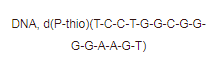
Physicochemical Properties
| CAS # | 1146541-45-8 |
| Related CAS # | Biotin-labeled ODN 2088 sodium;FITC-labeled ODN 2088 sodium |
| Appearance | White to off-white solid powder |
| HS Tariff Code | 2934.99.9001 |
| Storage |
Powder-20°C 3 years 4°C 2 years In solvent -80°C 6 months -20°C 1 month Note: Please store this product in a sealed and protected environment, avoid exposure to moisture. |
| Shipping Condition | Room temperature (This product is stable at ambient temperature for a few days during ordinary shipping and time spent in Customs) |
Biological Activity
| Targets | TLR3/7/9 |
| ln Vitro | In human PBMC, ODN 2088 (0.01, 0.1, 1, 10 μM; 48 hours) does not cause cytotoxicity [1]. ODN 2088 (0.01, 0.1, 1, 10 μM; 24 h) blocks human PBMCs activated by TLR7-ligand RNA-ORN 22075 (5 μM) and CpG-ODN 2216 (3 μM) from releasing IFN-α[1]. Iripimod (5 μg/ml)-stimulated IL-6 release in human PBMC is inhibited by ODN 2088 (0.01, 0.1, 1, 10 μM; 48 h), although CpG-ODN 2006 (100 nM)-stimulated IL-6 release is weakly inhibited[1]. When B cells are activated with CpG-DNA 2006 (100 nM), ODN 2088 (0.1, 1, 10 μM; 24 h) hardly decreases IL-6 release; however, when humans are stimulated with imiquimod (5 μg/ml), IL-6 release from B cells is inhibited[1]. When CpG-ODN 2006 or imiquimod are not present, ODN 2088 (1, 10 μM; 48 hours) boosts the expression of CD86 and HLA-DR in CD20+ B cells [1]. ODN 2088 binds to the C-terminal region of TLR9 competitively, which may hinder CpG-ODN-induced TLR9-induced signaling [1]. When BMDM were treated with CpG-ODN 1826 (100 nM), ODN 2088 (0.001, 0.01, 0.1, 1, 10 μM; 24 h) demonstrated a dose-dependent suppression of TNF-α secretion, with a weekly inhibition. imiquimod, the agonist [3]. B cell proliferation is stimulated by ODN 2088 (10 μM) [3]. |
| Cell Assay |
Cytotoxicity assay [1] Cell Types: human PBMC Tested Concentrations: 0.01, 0.1, 1, 10 μM Incubation Duration: 48 h Experimental Results: No cytotoxicity to human PBMC. |
| References |
[1]. Guanine-modified inhibitory oligonucleotides efficiently impair TLR7- and TLR9-mediated immune responses of human immune cells. PLoS One. 2015 Feb 19;10(2):e0116703. [2]. Inhibitors of TLR-9 act on multiple cell subsets in mouse and man in vitro and prevent death in vivo from systemic inflammation. J Immunol. 2005 May 1;174(9):5193-200. [3]. Guanine modification of inhibitory oligonucleotides potentiates their suppressive function. J Immunol. 2013 Sep 15;191(6):3240-53. |
Solubility Data
| Solubility (In Vitro) | May dissolve in DMSO (in most cases), if not, try other solvents such as H2O, Ethanol, or DMF with a minute amount of products to avoid loss of samples |
| Solubility (In Vivo) |
Note: Listed below are some common formulations that may be used to formulate products with low water solubility (e.g. < 1 mg/mL), you may test these formulations using a minute amount of products to avoid loss of samples. Injection Formulations (e.g. IP/IV/IM/SC) Injection Formulation 1: DMSO : Tween 80: Saline = 10 : 5 : 85 (i.e. 100 μL DMSO stock solution → 50 μL Tween 80 → 850 μL Saline) *Preparation of saline: Dissolve 0.9 g of sodium chloride in 100 mL ddH ₂ O to obtain a clear solution. Injection Formulation 2: DMSO : PEG300 :Tween 80 : Saline = 10 : 40 : 5 : 45 (i.e. 100 μL DMSO → 400 μLPEG300 → 50 μL Tween 80 → 450 μL Saline) Injection Formulation 3: DMSO : Corn oil = 10 : 90 (i.e. 100 μL DMSO → 900 μL Corn oil) Example: Take the Injection Formulation 3 (DMSO : Corn oil = 10 : 90) as an example, if 1 mL of 2.5 mg/mL working solution is to be prepared, you can take 100 μL 25 mg/mL DMSO stock solution and add to 900 μL corn oil, mix well to obtain a clear or suspension solution (2.5 mg/mL, ready for use in animals). Injection Formulation 4: DMSO : 20% SBE-β-CD in saline = 10 : 90 [i.e. 100 μL DMSO → 900 μL (20% SBE-β-CD in saline)] *Preparation of 20% SBE-β-CD in Saline (4°C,1 week): Dissolve 2 g SBE-β-CD in 10 mL saline to obtain a clear solution. Injection Formulation 5: 2-Hydroxypropyl-β-cyclodextrin : Saline = 50 : 50 (i.e. 500 μL 2-Hydroxypropyl-β-cyclodextrin → 500 μL Saline) Injection Formulation 6: DMSO : PEG300 : castor oil : Saline = 5 : 10 : 20 : 65 (i.e. 50 μL DMSO → 100 μLPEG300 → 200 μL castor oil → 650 μL Saline) Injection Formulation 7: Ethanol : Cremophor : Saline = 10: 10 : 80 (i.e. 100 μL Ethanol → 100 μL Cremophor → 800 μL Saline) Injection Formulation 8: Dissolve in Cremophor/Ethanol (50 : 50), then diluted by Saline Injection Formulation 9: EtOH : Corn oil = 10 : 90 (i.e. 100 μL EtOH → 900 μL Corn oil) Injection Formulation 10: EtOH : PEG300:Tween 80 : Saline = 10 : 40 : 5 : 45 (i.e. 100 μL EtOH → 400 μLPEG300 → 50 μL Tween 80 → 450 μL Saline) Oral Formulations Oral Formulation 1: Suspend in 0.5% CMC Na (carboxymethylcellulose sodium) Oral Formulation 2: Suspend in 0.5% Carboxymethyl cellulose Example: Take the Oral Formulation 1 (Suspend in 0.5% CMC Na) as an example, if 100 mL of 2.5 mg/mL working solution is to be prepared, you can first prepare 0.5% CMC Na solution by measuring 0.5 g CMC Na and dissolve it in 100 mL ddH2O to obtain a clear solution; then add 250 mg of the product to 100 mL 0.5% CMC Na solution, to make the suspension solution (2.5 mg/mL, ready for use in animals). Oral Formulation 3: Dissolved in PEG400 Oral Formulation 4: Suspend in 0.2% Carboxymethyl cellulose Oral Formulation 5: Dissolve in 0.25% Tween 80 and 0.5% Carboxymethyl cellulose Oral Formulation 6: Mixing with food powders Note: Please be aware that the above formulations are for reference only. InvivoChem strongly recommends customers to read literature methods/protocols carefully before determining which formulation you should use for in vivo studies, as different compounds have different solubility properties and have to be formulated differently. (Please use freshly prepared in vivo formulations for optimal results.) |