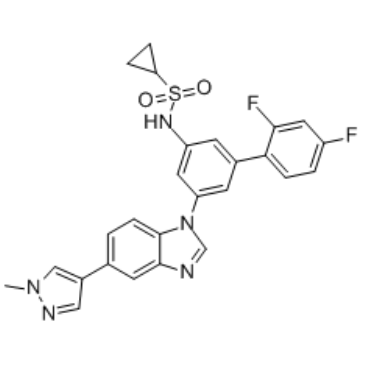
ODM-203 is a potent and orally bioavailable inhibitor of FGFR and VEGFR families inhibitor with IC50s of 11, 16, 6, 35 nM towards recombinant FGFR1, FGFR2, FGFR3 and FGFR4 as well as 26, 9, 5 nM towards VEGFR1, VEGFR2 and VEGFR3, respectively. ODM-203 has potent antiangiogenic and antitumorous properties. Both VEGFRs and FGFRs are inhibited by the VEGFR/FGFR inhibitor ODM-203, which may lead to the inhibition of VEGFR- and FGFR-mediated signaling. When tumor cells overexpress VEGFR and/or FGFR, this results in the inhibition of angiogenesis and cell proliferation. Both FGFRs and VEGFRs are members of the receptor tyrosine kinase superfamily and are expressed at elevated levels in different types of tumor cells.
Physicochemical Properties
| Molecular Formula | C26H21F2N5O2S |
| Molecular Weight | 505.53905081749 |
| Exact Mass | 505.138 |
| Elemental Analysis | C, 61.77; H, 4.19; F, 7.52; N, 13.85; O, 6.33; S, 6.34 |
| CAS # | 1430723-35-5 |
| Related CAS # | 1430723-35-5 |
| PubChem CID | 71554322 |
| Appearance | White to yellow solid powder |
| LogP | 4.4 |
| Hydrogen Bond Donor Count | 1 |
| Hydrogen Bond Acceptor Count | 7 |
| Rotatable Bond Count | 6 |
| Heavy Atom Count | 36 |
| Complexity | 886 |
| Defined Atom Stereocenter Count | 0 |
| InChi Key | ZJFCBQXPTQSTCZ-UHFFFAOYSA-N |
| InChi Code | InChI=1S/C26H21F2N5O2S/c1-32-14-18(13-30-32)16-2-7-26-25(10-16)29-15-33(26)21-9-17(23-6-3-19(27)11-24(23)28)8-20(12-21)31-36(34,35)22-4-5-22/h2-3,6-15,22,31H,4-5H2,1H3 |
| Chemical Name | N-[3-(2,4-difluorophenyl)-5-[5-(1-methylpyrazol-4-yl)benzimidazol-1-yl]phenyl]cyclopropanesulfonamide |
| Synonyms | ODM-203; ODM203; ODM 203 |
| HS Tariff Code | 2934.99.9001 |
| Storage |
Powder-20°C 3 years 4°C 2 years In solvent -80°C 6 months -20°C 1 month |
| Shipping Condition | Room temperature (This product is stable at ambient temperature for a few days during ordinary shipping and time spent in Customs) |
Biological Activity
| Targets | FGFR1 (IC50 = 11 nM); FGFR2 (IC50 = 16 nM); FGFR3 (IC50 = 6 nM); FGFR4 (IC50 = 35 nM); VEGFR1 (IC50 = 26 nM); VEGFR2 (IC50 = 9 nM); VEGFR3 (IC50 = 5 nM); DDR1 (IC50 = 6 nM); RET (IC50 = 8 nM); SIK3 (IC50 = 23 nM); PDGFRa (IC50 = 35 nM); MINK1 (IC50 = 41 nM); MAP4K4 (IC50 = 49 nM) |
| ln Vitro | ODM-203 exhibits a comparable level of potency in suppressing VEGFR-induced tube formation (IC50 33 nmol/L) as it does in inhibiting the proliferation of FGFR-dependent cell lines, including H1581, SNU16, and RT4 cells (IC50 50-150 nmol/L) in assays involving cells |
| ln Vivo | ODM-203 exhibits potent antitumor activity at comparable well-tolerated doses in both angiogenic and FGFR-dependent xenograft models in vivo. |
| Cell Assay | Following an eight-dose concentration series up to 3 μmol/L for 96 hours, the test compounds were applied to the cells after allowing them to attach for the entire night. |
| Animal Protocol |
Subcutaneous Renca syngenic model 20 and 40 mg/kg Oral gavage |
| References |
[1]. ODM-203, a Selective Inhibitor of FGFR and VEGFR, Shows Strong Antitumor Activity, and Induces Antitumor Immunity. Mol Cancer Ther. 2019 Jan;18(1):28-38. |
| Additional Infomation | VEGFR/FGFR Inhibitor ODM-203 is an orally available inhibitor of the human vascular endothelial growth factor receptors (VEGFRs) and fibroblast growth factor receptors (FGFRs), with potential antiangiogenic and antineoplastic activities. VEGFR/FGFR inhibitor ODM-203 inhibits both VEGFRs and FGFRs, which may result in the inhibition of VEGFR- and FGFR-mediated signaling. This leads to an inhibition of angiogenesis and cell proliferation in tumor cells overexpressing VEGFR and/or FGFR. Both VEGFRs and FGFRs belong to the superfamily of receptor tyrosine kinases and are upregulated in various tumor cell types. |
Solubility Data
| Solubility (In Vitro) | DMSO: 66.7~100 mg/mL (131.9~197.8 mM) |
| Solubility (In Vivo) |
Solubility in Formulation 1: ≥ 2.08 mg/mL (4.11 mM) (saturation unknown) in 10% DMSO + 40% PEG300 + 5% Tween80 + 45% Saline (add these co-solvents sequentially from left to right, and one by one), clear solution. For example, if 1 mL of working solution is to be prepared, you can add 100 μL of 20.8 mg/mL clear DMSO stock solution to 400 μL PEG300 and mix evenly; then add 50 μL Tween-80 to the above solution and mix evenly; then add 450 μL normal saline to adjust the volume to 1 mL. Preparation of saline: Dissolve 0.9 g of sodium chloride in 100 mL ddH₂ O to obtain a clear solution. Solubility in Formulation 2: ≥ 2.08 mg/mL (4.11 mM) (saturation unknown) in 10% DMSO + 90% (20% SBE-β-CD in Saline) (add these co-solvents sequentially from left to right, and one by one), clear solution. For example, if 1 mL of working solution is to be prepared, you can add 100 μL of 20.8 mg/mL clear DMSO stock solution to 900 μL of 20% SBE-β-CD physiological saline solution and mix evenly. Preparation of 20% SBE-β-CD in Saline (4°C,1 week): Dissolve 2 g SBE-β-CD in 10 mL saline to obtain a clear solution. Solubility in Formulation 3: ≥ 2.08 mg/mL (4.11 mM) (saturation unknown) in 10% DMSO + 90% Corn Oil (add these co-solvents sequentially from left to right, and one by one), clear solution. For example, if 1 mL of working solution is to be prepared, you can add 100 μL of 20.8 mg/mL clear DMSO stock solution to 900 μL of corn oil and mix evenly. (Please use freshly prepared in vivo formulations for optimal results.) |
| Preparing Stock Solutions | 1 mg | 5 mg | 10 mg | |
| 1 mM | 1.9781 mL | 9.8904 mL | 19.7808 mL | |
| 5 mM | 0.3956 mL | 1.9781 mL | 3.9562 mL | |
| 10 mM | 0.1978 mL | 0.9890 mL | 1.9781 mL |