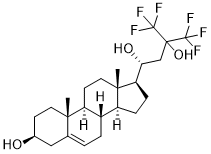
NSC-12 (also known as NSC12; NSC 172285) is an orally available pan-FGF trap able to inhibit FGF2/FGFR interaction and endowed with promising antitumor activity. NSC-12 is an extracellular FGF trap with significant implications in cancer therapy. The extracellular FGF trap NSC-12 has important ramifications for cancer treatment. While NSC12 did not have any inhibitory effect on FGF-independent tumor cells expressing constitutively active FGFR1, it did inhibit the proliferation of several FGF-dependent tumor cell lines. NSC12 has been demonstrated to suppress FGFR phosphorylation, angiogenesis, and the growth of primary and metastatic tumors in FGF-dependent human and mouse cancer cells in vivo. Crucially, there was no toxic effect across the board.
Physicochemical Properties
| Molecular Formula | C24H34F6O3 | |
| Molecular Weight | 484.52 | |
| Exact Mass | 484.241 | |
| Elemental Analysis | C, 59.49; H, 7.07; F, 23.53; O, 9.91 | |
| CAS # | 102586-30-1 | |
| Related CAS # |
|
|
| PubChem CID | 97290924 | |
| Appearance | White to light yellow solid powder | |
| LogP | 5.533 | |
| Hydrogen Bond Donor Count | 3 | |
| Hydrogen Bond Acceptor Count | 9 | |
| Rotatable Bond Count | 3 | |
| Heavy Atom Count | 33 | |
| Complexity | 778 | |
| Defined Atom Stereocenter Count | 8 | |
| SMILES | OC1CC[C@@]2([C@H]3CC[C@@]4([C@@H](C(CC(C(F)(F)F)(O)C(F)(F)F)O)CC[C@H]4[C@@H]3CC=C2C1)C)C |
|
| InChi Key | OHKBOEWLASAFLW-DRPHTYIMSA-N | |
| InChi Code | InChI=1S/C24H34F6O3/c1-20-9-7-14(31)11-13(20)3-4-15-16-5-6-18(21(16,2)10-8-17(15)20)19(32)12-22(33,23(25,26)27)24(28,29)30/h3,14-19,31-33H,4-12H2,1-2H3/t14?,15-,16-,17-,18+,19?,20-,21-/m0/s1 | |
| Chemical Name | 4,4,4-trifluoro-1-[(8S,9S,10R,13S,14S,17S)-3-hydroxy-10,13-dimethyl-2,3,4,7,8,9,11,12,14,15,16,17-dodecahydro-1H-cyclopenta[a]phenanthren-17-yl]-3-(trifluoromethyl)butane-1,3-diol | |
| Synonyms |
|
|
| HS Tariff Code | 2934.99.9001 | |
| Storage |
Powder-20°C 3 years 4°C 2 years In solvent -80°C 6 months -20°C 1 month |
|
| Shipping Condition | Room temperature (This product is stable at ambient temperature for a few days during ordinary shipping and time spent in Customs) |
Biological Activity
| Targets | FGF3 (Kd = 15.9 μM); FGF8b (Kd = 18.9 μM); FGF22 (Kd = 26.8 μM); FGF20 (Kd = 29.4 μM); FGF2/FGFR (IC50 = 30 μM) |
| ln Vitro | NSC12 suppresses angiogenesis, metastases, and tumor growth that is FGF-dependent. While FGF2 does not interact with heparin when bound to the immobilized receptor (ID50 ~30 μM), NSC12 prevents this from happening. NSC12 disrupts the FGF2/FGFR1 interaction while leaving the growth factor unaffected in its interactions with heparin or HSPGs. Moreover, immobilized FGF3, FGF4, FGF6, FGF8, FGF16, FGF18, FGF20, and FGF22 are bound by NSC12, with Kd values varying from approximately ~16 and ~120 μM. Through interactions with every member of the canonical FGF subfamilies, NSC12 may function as a multi-FGF trap. NSC12 inhibits Chinese hamster ovary (CHO) cells that express Klotho from activating FGFR1 through FGF23. All tumor cell lines treated with NSC12 exhibit a reduction in the S phase of the cell cycle; however, LLC cells exhibit an accumulation in the S phase. In CHO cell transfectants, NSC12 inhibits the phosphorylation of FGFR1, FGFR2, FGFR3, and FGFR4. With no inhibitory effect on FGF-independent cancer cell lines or HCC827 cancer cells that carry a tumor-driving mutation of the EGFR TK domain, NSC12 suppresses the growth of a variety of FGF-dependent murine and human cancer cell lines[1]. |
| ln Vivo | In FGF-dependent murine and human tumor models, parenteral and oral administration of NSC12 inhibits FGFR activation, tumor growth, angiogenesis, and metastasis. At all doses examined in the animal models, NSC12 significantly reduces tumor weight, tumor cell FGFR1 phosphorylation and proliferation, and tumor CD31+ neovascularization[1]. |
| Cell Assay | In 96 well plates, KATO Ⅲ cells are plated at 104 cells/well in RPMI medium supplemented with 1% FBS. Following a 24-hour period, cells are exposed to varying concentrations of FGFs (30 ng/ml) with or without an ideal dosage of NSC12 (1.0 or 3.0 μM) or NSC21. The MTT assay is carried out in accordance with the manufacturer's instructions after 72 hours. With a plate reader set to a reference wavelength of 630 nm and a test wavelength of 595 nm, the optical density (OD) is calculated. |
| Animal Protocol |
C57BL/6 mice from 2.5 to 10 mg/kg i.p. |
| References |
[1]. Long-Pentraxin 3 Derivative as a Small-Molecule FGF Trap for Cancer Therapy. Cancer Cell. 2015 Aug 10;28(2):225-39. |
| Additional Infomation | NCS172285 is a 3beta-hydroxy steroid that is androst-5-en-3beta-ol in which the 17beta-hydrogen has been replaced by a 1,3-dihydroxy-3,3-bis(trifluoromethyl)propyl group. NCS172285 (also known as acts as NSC12) has been used as an extracellular fibroblast growth factor (FGF) trap with implications in cancer therapy. The stereochemistry shown is that of the most active stereoisomer, as determined by Mattia Anselmi (PhD thesis, University of Parma, 2015). It is a 20-hydroxy steroid, a fluorinated steroid and a 3beta-hydroxy-Delta(5)-steroid. |
Solubility Data
| Solubility (In Vitro) |
|
|||
| Solubility (In Vivo) |
|
| Preparing Stock Solutions | 1 mg | 5 mg | 10 mg | |
| 1 mM | 2.0639 mL | 10.3195 mL | 20.6390 mL | |
| 5 mM | 0.4128 mL | 2.0639 mL | 4.1278 mL | |
| 10 mM | 0.2064 mL | 1.0319 mL | 2.0639 mL |