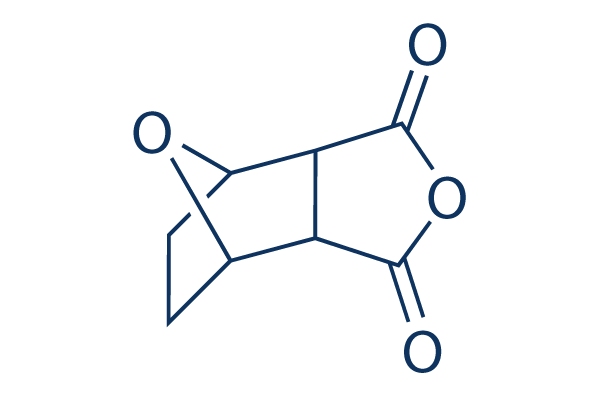
Norcantharidin (also known as NCTD; Endothall anhydride, Norcantharadine) is a dual inhibitor of c-Met and EGFR with anticancer activity. It can induce cell cycle arrest at G2/M phase in HCT116 and HT29 cells. NCTD inhibits not only the expression of the total EGFR and the p-EGFR (phosphorylated EGFR) but also the expression of the total c-Met and the pc-Met (phosphorylated c-Met) in colon cancer cells. Norcantharidin is also an inhibitor of protein phosphatase types 1, 2A and 2B, and can arrest the cell cycle at G2/M phase in K562 human myeloid leukemia cells, and inhibit DNA synthesis in HL-60 cells. Norcantharidin is a demethylated derivative of cantharidin, which is an anticancer active ingredient of traditional Chinese medicine.
Physicochemical Properties
| Molecular Formula | C8H8O4 | |
| Molecular Weight | 168.15 | |
| Exact Mass | 168.042 | |
| CAS # | 5442-12-6 | |
| Related CAS # |
|
|
| PubChem CID | 93004 | |
| Appearance | White to off-white solid | |
| Density | 1.5±0.1 g/cm3 | |
| Boiling Point | 362.5±35.0 °C at 760 mmHg | |
| Flash Point | 167.0±26.0 °C | |
| Vapour Pressure | 0.0±0.8 mmHg at 25°C | |
| Index of Refraction | 1.550 | |
| LogP | -0.85 | |
| Hydrogen Bond Donor Count | 0 | |
| Hydrogen Bond Acceptor Count | 4 | |
| Rotatable Bond Count | 0 | |
| Heavy Atom Count | 12 | |
| Complexity | 246 | |
| Defined Atom Stereocenter Count | 0 | |
| SMILES | O=C1OC(=O)C2C3CCC(O3)C12 |
|
| InChi Key | JAABVEXCGCXWRR-UHFFFAOYSA-N | |
| InChi Code | InChI=1S/C8H8O4/c9-7-5-3-1-2-4(11-3)6(5)8(10)12-7/h3-6H,1-2H2 | |
| Chemical Name |
|
|
| Synonyms |
|
|
| HS Tariff Code | 2934.99.9001 | |
| Storage |
Powder-20°C 3 years 4°C 2 years In solvent -80°C 6 months -20°C 1 month Note: Please store this product in a sealed and protected environment, avoid exposure to moisture. |
|
| Shipping Condition | Room temperature (This product is stable at ambient temperature for a few days during ordinary shipping and time spent in Customs) |
Biological Activity
| Targets |
Endogenous Metabolite; apoptosis and autophagy[1]
The targets of Norcantharidin (NCTD) include EGFR (epidermal growth factor receptor) and c-Met (mesenchymal-epithelial transition factor) [1] Norcantharidin (NCTD) also targets Protein Phosphatase 2A (PP2A), Wnt/β-catenin signaling pathway, Caspase family proteins, AMPK pathway, and platelet α2 integrin [3] Additional targets of Norcantharidin (NCTD) involve PI3K, NF-κB, MAPK, JNK, PP1, PP2B, Cdc6, cyclin D1, CDKs, CDKIs, YAP, ERK, Ets1, Sp1, STAT1, MMPs, VEGF/VEGFR, EphA2, FAK, TSP, Ang-2, Ln-5γ2, TIMP [4] |
| ln Vitro |
In vitro activity: Norcantharidin (also known as NCTD) is a dual inhibitor of c-Met and EGFR. It has anticancer activity and can induce cell cycle arrest at G2/M phase in HCT116 and HT29 cells. NCTD inhibits not only the expression of the total EGFR and the p-EGFR (phosphorylated EGFR) but also the expression of the total c-Met and the pc-Met (phosphorylated c-Met) in colon cancer cells. Cell Assay: Norcantharidin is also an inhibitor of protein phosphatase types 1, 2A and 2B, and can arrest the cell cycle at G2/M phase in K562 human myeloid leukemia cells, and inhibit DNA synthesis in HL-60 cells. HT29 and HCT116 cells suspended in complete media are seeded in 96-well plates (2000 cells/well). After growing for 24 h in incubator, media are aspirated and 0.2 mL complete media containing serial concentrations of NCTD are added to each well. After incubating the plate for 24, 48, or 72 h, 20 μL of resazurin (2 mg/mL dissolved in water) is added to each well. The fluorescent signal is monitored using 544 nm excitation and 595 nm emission wavelengths by Spectramax M5 plate reader after incubation at 37 °C for 16 h in the incubator. The number of living cells in each well is proportional to the relative fluorescence unit (RFU) measured by the assay. 1. Anti-proliferative activity in colon cancer cells: Norcantharidin (NCTD) was tested on HCT116 and HT29 human colon cancer cell lines at concentrations of 6.25, 12.5, 25, 50, 100, 150, and 200 μM for 24 h, 48 h, and 72 h. The results showed that NCTD inhibited cell viability in a dose- and time-dependent manner. [1] 2. Cell cycle arrest in colon cancer cells: Flow cytometry analysis revealed that Norcantharidin (NCTD) induced G2/M phase cell cycle arrest in both HCT116 and HT29 cell lines after treatment with serial concentrations (6.25–100 μM) for 24 h. Statistical analysis confirmed a significant difference (p < 0.001) in the number of cells in G0/G1, S, and G2/M phases between the control and NCTD-treated groups [1] 3. Apoptosis induction in colon cancer cells: Norcantharidin (NCTD) induced both early and late apoptosis in HCT116 and HT29 cells after 48 h of treatment with concentrations ranging from 6.25 to 100 μM (p < 0.001 vs control). Western blot analysis showed that NCTD upregulated the expression of cleaved Caspase-3 (HCT116: 1.0–10.5-fold; HT29: 1.0–5.9-fold), cleaved PARP (HCT116: 1.0–5.5-fold; HT29: 1.0–33.0-fold), and Bax (HCT116: 1.0–1.6-fold; HT29: 1.0–1.8-fold), while downregulating Cyclin D1 (HCT116: 1.0–0.2-fold; HT29: 1.0–0.3-fold), CDK-4 (HCT116: 1.0–0.4-fold; HT29: 1.0–0.3-fold), and Rb (HCT116: 1.0–0.1-fold; HT29: 1.0–0.1-fold) in a dose-dependent manner (band intensities normalized to β-Actin, SD ±15%) [1] 4. Inhibition of EGFR and c-Met expression/phosphorylation: Norcantharidin (NCTD) (6.25–100 μM, 72 h treatment) suppressed the expression of total EGFR, phosphorylated EGFR (p-EGFR), total c-Met, and phosphorylated c-Met (p-c-Met) in HCT116 and HT29 cells. Co-treatment with MG132 (0.2 μM), a proteasome inhibitor, mostly restored EGFR expression in HCT116 cells treated with 50 μM NCTD for 48 h. The inhibitory effect of NCTD on EGFR/c-Met was comparable to that of gefitinib (a tyrosine kinase inhibitor for EGFR) [1] 5. Broad anti-cancer mechanisms in vitro: Norcantharidin (NCTD) inhibits cell proliferation, induces apoptosis/autophagy, suppresses migration/metastasis, modulates immunity, and inhibits lymphangiogenesis in vitro. It inhibits PP2A, modulates Wnt/β-catenin signaling, and affects the c-Met/EGFR pathway [3] 6. Anti-platelet activity in vitro: Norcantharidin (NCTD) inhibits platelet signaling and downregulates α2 integrin in vitro [3] 7. Immunomodulatory effects in vitro: Norcantharidin (NCTD) regulates macrophage polarization and LPS-mediated immune response in vitro, [3] |
| ln Vivo |
Norcantharidin (NCTD) inhibits xenografted tumor growth in a dose- and time-dependent manner. Tumor volume decreases with an increased tumor inhibitory rate in the NTCD group compared with the control group. The apoptosis rate increases along with a decreased percentage of cells in S phase in the NTCD group compared with the control group. The morphological changes of apoptosis such as nuclear shrinkage, chromatin aggregation, chromosome condensation, and typical apoptosis bodies in the xenografted tumor cells induced by NCTD are observed. The expression of cyclin-D1, Bcl-2 and survivin proteins/mRNAs decrease significantly, with increased expression of p27 and Bax proteins/mRNAs in the NCTD group compared with the control group. NCTD is reported clinically as an anti-tumor drug against hepatoma, esophageal and gastric carcinoma, and leucopenia. 1. Anti-tumor activity in gallbladder carcinoma xenografts: Norcantharidin (NCTD) inhibited the growth of human gallbladder carcinoma GBC-SD xenografted tumors in nude mice in a dose- and time-dependent manner. The tumor volume in the NCTD group was 5.61±0.39 cm³ (vs 9.78±0.61 cm³ in the control group, P=0.000), with a tumor inhibitory rate of 42.63% (vs 0% in control, P=0.012) [2] 2. Cell cycle and apoptosis modulation in xenografts: Norcantharidin (NCTD) increased the apoptosis rate of xenografted tumor cells to 15.08±1.49% (vs 5.49±0.59% in control, P=0.0001) and decreased the percentage of cells in S phase to 43.47±2.83% (vs 69.85±1.96% in control, P=0.0001). Light/electron microscopy observed apoptotic morphological changes (nuclear shrinkage, chromatin aggregation, chromosome condensation, apoptosis bodies) in NCTD-treated tumor cells [2] 3. Regulation of protein/mRNA expression in xenografts: Norcantharidin (NCTD) significantly downregulated the expression of cyclin-D1, Bcl-2, and survivin at both protein and mRNA levels, while upregulating p27 and Bax protein/mRNA expression in xenografted tumors (detected by SABC method and RT-PCR) [2] 4. Multi-target anti-cancer effects in vivo: Norcantharidin (NCTD) exerts multi-target anticancer activities in vivo, including inhibiting proliferation, inducing apoptosis, suppressing invasion/metastasis, and inhibiting tumor vascularization (angiogenesis, VM, lymphangiogenesis) [4] |
| Enzyme Assay | Cantharidin (CTD) is the main bioactive component of Cantharides, which is called Banmao in Traditional Chinese Medicine (TCM). Norcantharidin (NCTD) is a structural modifier of CTD. To compare with CTD, NCTD has lighter side effects and stronger bioactivity in anti-cancer through inhibiting cell proliferation, causing apoptosis and autophagy, overwhelming migration and metastasis, affecting immunity as well as lymphangiogenesis. Examples of these effects include suppressing Protein Phosphatase 2A and modulating Wnt/beta catenin signal, with Caspase family proteins, AMPK pathway and c-Met/EGFR pathway involving respectively. Moreover, NCTD has the effects of immune enhancement, anti-platelet aggregation and inhibition of renal interstitial fibrosis with distinct signaling pathways. The immunological effects induced by NCTD are related to the regulation of macrophage polarization and LPS-mediated immune response. The antiplatelet activity that NCTD induced is relevant to the inhibition of platelet signaling and the downregulation of α2 integrin. Furthermore, some of novel derivatives designed and synthesized artificially show stronger biological activities (e.g., anticancer effect, enzyme inhibition effect, antioxidant effect) and lower toxicity than NCTD itself. Plenty of literatures have reported various pharmacological effects of NCTD, particularly the anticancer effect, which has been widely concerned in clinical application and laboratory research. In this review, the pharmaceutical activities and derivatives of NCTD are discussed, which can be reference for further study[3]. |
| Cell Assay |
Cantharidin (CTD) is the main bioactive component of Cantharides, which is called Banmao in Traditional Chinese Medicine (TCM). Norcantharidin (NCTD) is a structural modifier of CTD. To compare with CTD, NCTD has lighter side effects and stronger bioactivity in anti-cancer through inhibiting cell proliferation, causing apoptosis and autophagy, overwhelming migration and metastasis, affecting immunity as well as lymphangiogenesis. Examples of these effects include suppressing Protein Phosphatase 2A and modulating Wnt/beta catenin signal, with Caspase family proteins, AMPK pathway and c-Met/EGFR pathway involving respectively. Moreover, NCTD has the effects of immune enhancement, anti-platelet aggregation and inhibition of renal interstitial fibrosis with distinct signaling pathways. The immunological effects induced by NCTD are related to the regulation of macrophage polarization and LPS-mediated immune response. The antiplatelet activity that NCTD induced is relevant to the inhibition of platelet signaling and the downregulation of α2 integrin. Furthermore, some of novel derivatives designed and synthesized artificially show stronger biological activities (e.g., anticancer effect, enzyme inhibition effect, antioxidant effect) and lower toxicity than NCTD itself. Plenty of literatures have reported various pharmacological effects of NCTD, particularly the anticancer effect, which has been widely concerned in clinical application and laboratory research. [3] 1. Colon cancer cell viability assay: - Step 1: HCT116 and HT29 cells were seeded in 96-well plates at a density of 2000 cells/well and cultured for 24 h under standard conditions. - Step 2: The culture medium was replaced with 200 μL complete medium containing serial concentrations of Norcantharidin (NCTD) (6.25, 12.5, 25, 50, 100, 150, 200 μM), and the cells were incubated for 24 h, 48 h, or 72 h. - Step 3: Viable cells were quantified by measuring the fluorescent signal (detection method not specified), and the experiments were repeated three times [1] 2. Cell cycle analysis by flow cytometry: - Step 1: HCT116 and HT29 cells were seeded in 6-well plates and cultured for 24 h. - Step 2: Cells were treated with serial concentrations of Norcantharidin (NCTD) (6.25–100 μM) in complete medium for 24 h. - Step 3: Cells were harvested, stained (staining method not specified), and analyzed by flow cytometry to determine cell cycle distribution (G0/G1, S, G2/M phases). Statistical analysis was performed using Student’s t-test (p < 0.001), and experiments were repeated three times [1] 3. Apoptosis analysis by flow cytometry: - Step 1: HCT116 and HT29 cells were seeded in 6-well plates and cultured for 24 h. - Step 2: Cells were treated with serial concentrations of Norcantharidin (NCTD) (6.25–100 μM) for 48 h. - Step 3: Cells were harvested, stained (staining method not specified), and analyzed by flow cytometry to detect early/late apoptosis. Statistical analysis was performed using Student’s t-test (p < 0.001), and experiments were repeated three times [1] 4. Western blot analysis for protein expression: - Step 1: HCT116 and HT29 cells were seeded in 10-cm dishes and cultured for 24 h. - Step 2: Cells were treated with Norcantharidin (NCTD) (6.25–100 μM) or gefitinib (6.25–100 μM) for 72 h; for time-course experiments, cells were treated with 100 μM NCTD for indicated periods. - Step 3: Cells were harvested, lysed (lysis buffer not specified), and protein concentration was determined (method not specified). - Step 4: Equal amounts of protein were separated by SDS-PAGE, transferred to a membrane (type not specified), and probed with primary antibodies against EGFR, p-EGFR, c-Met, p-c-Met, cleaved Caspase-3, cleaved PARP, Bax, Cyclin D1, CDK-4, Rb, and β-Actin (loading control). - Step 5: Protein bands were detected (detection method not specified), and band intensities were quantified by Image J software (normalized to β-Actin, mean of three independent experiments, SD ±15%) [1] 5. MG132 rescue assay for EGFR expression: - Step 1: HCT116 cells were seeded in 10-cm dishes and cultured for 24 h. - Step 2: Cells were treated with 50 μM Norcantharidin (NCTD) alone or in combination with 0.2 μM MG132 for 48 h. - Step 3: Cells were harvested for western blot analysis to detect EGFR and β-Actin expression (experimental procedures as described above) [1] |
| Animal Protocol |
Formulated in normal saline; 24 mg/kg and 28 mg/kg; i.p. Tumor xenograft model of human gallbladder carcinoma in nude mice The tumor xenograft model of human gallbladder carcinoma in nude mice in vivo was established with subcutaneous GBC-SD cells. The experimental mice were randomly divided into control, 5-FU, NCTD, and NCTD+5-FU groups which were given different treatments. Tumor growth in terms of size, growth curve, and inhibitory rate was evaluated. Cell cycle, apoptosis, and morphological changes of the xenografted tumors were assessed by flow cytometry and light/electron microscopy. The expression of the cell cycle-related proteins cyclin-D1 and p27 as well as the apoptosis-related proteins Bcl-2, Bax, and survivin were determined by the streptavidin-biotin complex (SABC) method and RT-PCR. Results: NCTD inhibited the growth of the xenografted tumors in a dose- and time-dependent manner. Tumor volume decreased (5.61+/-0.39 vs. 9.78+/-0.61 cm3, P=0.000) with an increased tumor inhibitory rate (42.63% vs. 0%, P=0.012) in the NTCD group compared with the control group. The apoptosis rate increased (15.08+/-1.49% vs. 5.49+/-0.59%, P=0.0001) along with a decreased percentage of cells in S phase (43.47+/-2.83% vs. 69.85+/-1.96%, P=0.0001) in the NTCD group compared with the control group. The morphological changes of apoptosis such as nuclear shrinkage, chromatin aggregation, chromosome condensation, and typical apoptosis bodies in the xenografted tumor cells induced by NCTD were observed by light and electron microscopy. The expression of cyclin-D1, Bcl-2 and survivin proteins/mRNAs decreased significantly, with increased expression of p27 and Bax proteins/mRNAs in the NCTD group compared with the control group.[3] 1. Gallbladder carcinoma xenograft model in nude mice: - Step 1: Human gallbladder carcinoma GBC-SD cells were subcutaneously implanted into nude mice (gender/age not specified) to establish the xenograft model. - Step 2: Experimental mice were randomly divided into control, 5-FU, NCTD, and NCTD+5-FU groups (group size not specified). - Step 3: Norcantharidin (NCTD) was administered to the NCTD group (administration route/dose/frequency not specified); 5-FU was given to the 5-FU group, and the combination group received both drugs; the control group received a vehicle (dissolution formula not specified). - Step 4: Tumor size was measured regularly (measurement interval not specified) to generate growth curves and calculate the tumor inhibitory rate. - Step 5: Tumor tissues were harvested to assess cell cycle distribution (flow cytometry), apoptosis (flow cytometry/light/electron microscopy), and protein/mRNA expression (SABC method/RT-PCR) [2] |
| Toxicity/Toxicokinetics |
1. Comparison with cantharidin (CTD): Norcantharidin (NCTD) is a demethylated derivative of CTD with lighter side effects and lower cytotoxicity than CTD; [3][4] |
| References |
[1]. Norcantharidin Inhibits cell growth by suppressing the expression and phosphorylation of both EGFR and c-Met in human colon cancer cells. BMC Cancer.2017 Jan 13;17(1):55. [2]. Norcantharidin inhibits growth of human gallbladder carcinoma xenografted tumors in nude mice by inducing apoptosis and blocking the cell cycle in vivo. Hepatobiliary Pancreat Dis Int.2010 Aug;9(4):414-22. [3]. Norcantharidin: research advances in pharmaceutical activities and derivatives in recent years. Biomed Pharmacother. 2020 Nov;131:110755. [4]. Insight into norcantharidin, a small-molecule synthetic compound with potential multi-target anticancer activities. Chin Med. 2020 May 29;15:55. |
| Additional Infomation |
NORCANTHARIDIN is a furofuran. 1. Background and chemical properties: Norcantharidin (NCTD) is a chemically synthesized drug approved by the Chinese FDA for cancer treatment. It is a demethylated analog of cantharidin (CTD), a bioactive component of Traditional Chinese Medicine Mylabris (Spanish fly), with a molecular formula of C₈H₈O₄ and molecular weight of 168.15 g/mol. NCTD can be synthesized by furan and maleic anhydride through the Diels–Alder reaction [1][4] 2. Clinical application: Norcantharidin (NCTD) is clinically used as a routine anti-cancer drug in China, and it may be a cost-effective alternative to gefitinib for cancer treatment [1][4] 3. Broad pharmacological activities: Besides anti-cancer effects, Norcantharidin (NCTD) has immune-enhancing effects, anti-platelet aggregation effects, and inhibitory effects on renal interstitial fibrosis, with distinct signaling pathways involved in each activity [3] 4. Derivatives: Novel synthetic derivatives of Norcantharidin (NCTD) exhibit stronger biological activities (anticancer, enzyme inhibition, antioxidant) and lower toxicity than NCTD itself; no specific derivative structures or activity data were provided [3] 5. Multi-target anti-cancer mechanisms: Norcantharidin (NCTD) exerts anti-cancer effects through "multi-points priming" mechanisms, including inhibiting PI3K/NF-κB/MAPK/JNK signaling, modulating PP1/PP2A/PP2B activity, regulating Cdc6/cyclin D1/CDKs/CDKIs for cell cycle control, and targeting Bcl-2/Bax for apoptosis induction. It also inhibits tumor invasion/metastasis by regulating YAP/ERK/Ets1/Sp1/STAT1/MMPs/EMT and suppresses tumor vascularization by targeting VEGF/VEGFR/EphA2/FAK/TSP/Ang-2/Ln-5γ2/TIMP [4] |
Solubility Data
| Solubility (In Vitro) |
|
|||
| Solubility (In Vivo) |
Solubility in Formulation 1: ≥ 2.08 mg/mL (12.37 mM) (saturation unknown) in 10% DMSO + 40% PEG300 + 5% Tween80 + 45% Saline (add these co-solvents sequentially from left to right, and one by one), clear solution. For example, if 1 mL of working solution is to be prepared, you can add 100 μL of 20.8 mg/mL clear DMSO stock solution to 400 μL PEG300 and mix evenly; then add 50 μL Tween-80 to the above solution and mix evenly; then add 450 μL normal saline to adjust the volume to 1 mL. Preparation of saline: Dissolve 0.9 g of sodium chloride in 100 mL ddH₂ O to obtain a clear solution. Solubility in Formulation 2: ≥ 2.08 mg/mL (12.37 mM) (saturation unknown) in 10% DMSO + 90% (20% SBE-β-CD in Saline) (add these co-solvents sequentially from left to right, and one by one), clear solution. For example, if 1 mL of working solution is to be prepared, you can add 100 μL of 20.8 mg/mL clear DMSO stock solution to 900 μL of 20% SBE-β-CD physiological saline solution and mix evenly. Preparation of 20% SBE-β-CD in Saline (4°C,1 week): Dissolve 2 g SBE-β-CD in 10 mL saline to obtain a clear solution. Solubility in Formulation 3: ≥ 2.08 mg/mL (12.37 mM) (saturation unknown) in 10% DMSO + 90% Corn Oil (add these co-solvents sequentially from left to right, and one by one), clear solution. For example, if 1 mL of working solution is to be prepared, you can add 100 μL of 20.8 mg/mL clear DMSO stock solution to 900 μL of corn oil and mix evenly. (Please use freshly prepared in vivo formulations for optimal results.) |
| Preparing Stock Solutions | 1 mg | 5 mg | 10 mg | |
| 1 mM | 5.9471 mL | 29.7354 mL | 59.4707 mL | |
| 5 mM | 1.1894 mL | 5.9471 mL | 11.8941 mL | |
| 10 mM | 0.5947 mL | 2.9735 mL | 5.9471 mL |