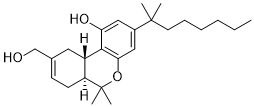
HU-
Physicochemical Properties
| Molecular Formula | C25H38O3 |
| Molecular Weight | 386.57 |
| Exact Mass | 386.282 |
| Elemental Analysis | C, 77.68; H, 9.91; O, 12.42 |
| CAS # | 112924-45-5 |
| PubChem CID | 107778 |
| Appearance | Typically exists as solid at room temperature |
| Density | 1.0±0.1 g/cm3 |
| Boiling Point | 470.1±45.0 °C at 760 mmHg |
| Flash Point | 238.1±28.7 °C |
| Vapour Pressure | 0.0±1.2 mmHg at 25°C |
| Index of Refraction | 1.526 |
| LogP | 8.19 |
| Hydrogen Bond Donor Count | 2 |
| Hydrogen Bond Acceptor Count | 3 |
| Rotatable Bond Count | 7 |
| Heavy Atom Count | 28 |
| Complexity | 550 |
| Defined Atom Stereocenter Count | 2 |
| SMILES | CCCCCCC(C)(C)C1=CC(=C2[C@H]3CC(=CC[C@@H]3C(C)(C)OC2=C1)CO)O |
| InChi Key | SSQJFGMEZBFMNV-PMACEKPBSA-N |
| InChi Code | InChI=1S/C25H38O3/c1-6-7-8-9-12-24(2,3)18-14-21(27)23-19-13-17(16-26)10-11-20(19)25(4,5)28-22(23)15-18/h10,14-15,19-20,26-27H,6-9,11-13,16H2,1-5H3/t19-,20-/m0/s1 |
| Chemical Name | (6aS,10aS)-9-(hydroxymethyl)-6,6-dimethyl-3-(2-methyloctan-2-yl)-6a,7,10,10a-tetrahydrobenzo[c]chromen-1-ol |
| Synonyms | Dexanabinol; 112924-45-5; HU-211; Sinnabidiol; HU 211; Sinnabidol; 1,1-Dimethylheptyl-11-hydroxytetrahydrocannabinol; PRS 211007-000; |
| HS Tariff Code | 2934.99.9001 |
| Storage |
Powder-20°C 3 years 4°C 2 years In solvent -80°C 6 months -20°C 1 month |
| Shipping Condition | Room temperature (This product is stable at ambient temperature for a few days during ordinary shipping and time spent in Customs) |
Biological Activity
| Targets | Cannabinoid receptor |
| ln Vitro |
Researchers report the synthesis of terminally fluorinated HU-210 and HU-211 analogues (HU-210F and HU-211F, respectively) and their biological evaluation as ligands of cannabinoid receptors (CB1 and CB2) and N-methyl d-aspartate receptor (NMDAR). [18F]-labelled HU-210F was radiosynthesised from the bromo-substituted precursor. In vitro assays showed that both HU-210F and HU-211F retain the potent pharmacological profile of HU-210 and HU-211, suggesting that [18F]-radiolabelled HU-210F and HU-211F could have potential as PET tracers for in vivo imaging.[1] CB receptor agonist HU-210 exhibits an infarction-limiting effect during in vitro reperfusion of the heart after focal ischemia. This effect is paralleled by a decrease in left-ventricular developed pressure and double product. In addition, HU-210 reduces end-diastolic pressure during the reperfusion period, which indirectly attests to reduced Ca2+ overload of cardiomyocytes[3]. |
| ln Vivo | Upon DSS challenge, mice suffered from bloody stool, colon shortening, intestinal mucosa edema, pro-inflammatory cytokine increase and intestinal barrier destruction with goblet cell depletion, increased intestinal microflora accompanied with elevated plasma lipopolysaccharide, reduced mRNA expression of the intestinal tight junction proteins, and abnormal ratio of CD4+/CD8+ T cells in the intestinal Peyer's patches. Pro-inflammatory cytokines in the plasma and the lung, as well as pulmonary myeloperoxidase activity, indicators of extraintestinal inflammation were increased. Protein expression of p38α and pp38 was up-regulated in the colon of WT mice. Tlr4 -/- mice showed milder colitis. HU210 reversed the intestinal barrier changes in both strains of mice, but alleviated inflammation only in WT mice. Conclusions: Our study indicates that in experimental colitis, HU210 displays a protective effect on the intestinal barrier function independently of the TLR4 signaling pathway; however, in the extraintestinal tissues, the anti-inflammatory action seems through affecting TLR4-mediated p38 mitogen-activated protein kinase pathway [2]. |
| Animal Protocol |
Background: Ulcerative colitis (UC) is strongly associated with inflammation and intestinal barrier disorder. The nonselective cannabinoid receptor agonist HU210 has been shown to ameliorate inflamed colon in colitis, but its effects on intestinal barrier function and extraintestinal inflammation are unclear. [2] Aims: To investigate the effects and the underlying mechanism of HU210 action on the UC in relation to a role of TLR4 and MAP kinase signaling. [2] Methods: Wild-type (WT) and TLR4 knockout (Tlr4 -/-) mice were exposed to 4% dextran sulfate sodium (DSS) for 7 days. The effects of HU210 on inflammation and intestinal barrier were explored. [2] |
| References |
[1]. Synthesis, radio-synthesis and in vitro evaluation of terminally fluorinated derivatives of HU-210 and HU-211 as novel candidate PET tracers. Org Biomol Chem. 2017 Mar 1;15(9):2086-2096. [2]. The Anti-Inflammatory Effect and Intestinal Barrier Protection of HU210 Differentially Depend on TLR4 Signaling in Dextran Sulfate Sodium-Induced Murine Colitis. Dig Dis Sci. 2017 Feb;62(2):372-386. [3]. CB-Receptor Agonist HU-210 Mimics the Postconditioning Phenomenon of Isolated Heart. Bull Exp Biol Med. 2016 Nov;162(1):27-29. |
| Additional Infomation |
Dexanabinol is a 1-benzopyran. Dexanabinol is a synthetic, terpene-based cannabinoid derivative devoid of cannabinoid receptors 1 and 2 agonist activity and with potential neuroprotective, antiinflammatory and antineoplastic activities. Functioning as an N-Methyl-D-aspartate (NMDA) receptor antagonist, dexanabinol protects neuronal cells against NMDA and glutamate neurotoxicity. This agent also scavenges peroxy radicals and protects neurons from the damages of reactive oxygen species. Furthermore, dexanabinol inhibits the activity of nuclear factor kappa B (NF-kB), thereby preventing the expression of NF-kB target genes, such as tumor necrosis factor alpha, cytokines and inducible nitric oxide synthase. As a result, this agent may restore apoptotic processes in cancerous cells. NF-kB is activated in a variety of cancer cells and plays a key role in the regulation of apoptosis and cellular proliferation. Drug Indication Investigated for use/treatment in traumatic brain injuries and neurologic disorders. |
Solubility Data
| Solubility (In Vitro) | May dissolve in DMSO (in most cases), if not, try other solvents such as H2O, Ethanol, or DMF with a minute amount of products to avoid loss of samples |
| Solubility (In Vivo) |
Note: Listed below are some common formulations that may be used to formulate products with low water solubility (e.g. < 1 mg/mL), you may test these formulations using a minute amount of products to avoid loss of samples. Injection Formulations (e.g. IP/IV/IM/SC) Injection Formulation 1: DMSO : Tween 80: Saline = 10 : 5 : 85 (i.e. 100 μL DMSO stock solution → 50 μL Tween 80 → 850 μL Saline) *Preparation of saline: Dissolve 0.9 g of sodium chloride in 100 mL ddH ₂ O to obtain a clear solution. Injection Formulation 2: DMSO : PEG300 :Tween 80 : Saline = 10 : 40 : 5 : 45 (i.e. 100 μL DMSO → 400 μLPEG300 → 50 μL Tween 80 → 450 μL Saline) Injection Formulation 3: DMSO : Corn oil = 10 : 90 (i.e. 100 μL DMSO → 900 μL Corn oil) Example: Take the Injection Formulation 3 (DMSO : Corn oil = 10 : 90) as an example, if 1 mL of 2.5 mg/mL working solution is to be prepared, you can take 100 μL 25 mg/mL DMSO stock solution and add to 900 μL corn oil, mix well to obtain a clear or suspension solution (2.5 mg/mL, ready for use in animals). Injection Formulation 4: DMSO : 20% SBE-β-CD in saline = 10 : 90 [i.e. 100 μL DMSO → 900 μL (20% SBE-β-CD in saline)] *Preparation of 20% SBE-β-CD in Saline (4°C,1 week): Dissolve 2 g SBE-β-CD in 10 mL saline to obtain a clear solution. Injection Formulation 5: 2-Hydroxypropyl-β-cyclodextrin : Saline = 50 : 50 (i.e. 500 μL 2-Hydroxypropyl-β-cyclodextrin → 500 μL Saline) Injection Formulation 6: DMSO : PEG300 : castor oil : Saline = 5 : 10 : 20 : 65 (i.e. 50 μL DMSO → 100 μLPEG300 → 200 μL castor oil → 650 μL Saline) Injection Formulation 7: Ethanol : Cremophor : Saline = 10: 10 : 80 (i.e. 100 μL Ethanol → 100 μL Cremophor → 800 μL Saline) Injection Formulation 8: Dissolve in Cremophor/Ethanol (50 : 50), then diluted by Saline Injection Formulation 9: EtOH : Corn oil = 10 : 90 (i.e. 100 μL EtOH → 900 μL Corn oil) Injection Formulation 10: EtOH : PEG300:Tween 80 : Saline = 10 : 40 : 5 : 45 (i.e. 100 μL EtOH → 400 μLPEG300 → 50 μL Tween 80 → 450 μL Saline) Oral Formulations Oral Formulation 1: Suspend in 0.5% CMC Na (carboxymethylcellulose sodium) Oral Formulation 2: Suspend in 0.5% Carboxymethyl cellulose Example: Take the Oral Formulation 1 (Suspend in 0.5% CMC Na) as an example, if 100 mL of 2.5 mg/mL working solution is to be prepared, you can first prepare 0.5% CMC Na solution by measuring 0.5 g CMC Na and dissolve it in 100 mL ddH2O to obtain a clear solution; then add 250 mg of the product to 100 mL 0.5% CMC Na solution, to make the suspension solution (2.5 mg/mL, ready for use in animals). Oral Formulation 3: Dissolved in PEG400 Oral Formulation 4: Suspend in 0.2% Carboxymethyl cellulose Oral Formulation 5: Dissolve in 0.25% Tween 80 and 0.5% Carboxymethyl cellulose Oral Formulation 6: Mixing with food powders Note: Please be aware that the above formulations are for reference only. InvivoChem strongly recommends customers to read literature methods/protocols carefully before determining which formulation you should use for in vivo studies, as different compounds have different solubility properties and have to be formulated differently. (Please use freshly prepared in vivo formulations for optimal results.) |
| Preparing Stock Solutions | 1 mg | 5 mg | 10 mg | |
| 1 mM | 2.5869 mL | 12.9343 mL | 25.8685 mL | |
| 5 mM | 0.5174 mL | 2.5869 mL | 5.1737 mL | |
| 10 mM | 0.2587 mL | 1.2934 mL | 2.5869 mL |