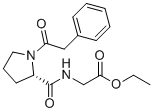
Physicochemical Properties
| Molecular Formula | C17H22N2O4 |
| Molecular Weight | 318.373 |
| Exact Mass | 318.157 |
| CAS # | 157115-85-0 |
| Related CAS # | 157115-85-0; |
| PubChem CID | 180496 |
| Appearance | White to off-white solid powder |
| Density | 1.2±0.1 g/cm3 |
| Boiling Point | 547.3±50.0 °C at 760 mmHg |
| Melting Point | 94.0 to 98.0 °C |
| Flash Point | 284.8±30.1 °C |
| Vapour Pressure | 0.0±1.5 mmHg at 25°C |
| Index of Refraction | 1.549 |
| LogP | 1.28 |
| Hydrogen Bond Donor Count | 1 |
| Hydrogen Bond Acceptor Count | 4 |
| Rotatable Bond Count | 7 |
| Heavy Atom Count | 23 |
| Complexity | 432 |
| Defined Atom Stereocenter Count | 1 |
| SMILES | CCOC(=O)CNC(=O)[C@@H]1CCCN1C(=O)CC2=CC=CC=C2 |
| InChi Key | PJNSMUBMSNAEEN-AWEZNQCLSA-N |
| InChi Code | InChI=1S/C17H22N2O4/c1-2-23-16(21)12-18-17(22)14-9-6-10-19(14)15(20)11-13-7-4-3-5-8-13/h3-5,7-8,14H,2,6,9-12H2,1H3,(H,18,22)/t14-/m0/s1 |
| Chemical Name | ethyl (2-phenylacetyl)-L-prolylglycinate |
| Synonyms | DVD-111 GVS-111 SGS-111 DVD111 GVS111 SGS111 DVD 111 GVS 111 SGS 111 Omberacetam |
| HS Tariff Code | 2934.99.9001 |
| Storage |
Powder-20°C 3 years 4°C 2 years In solvent -80°C 6 months -20°C 1 month |
| Shipping Condition | Room temperature (This product is stable at ambient temperature for a few days during ordinary shipping and time spent in Customs) |
Biological Activity
| ln Vitro | The AMPA receptor ([G-3H]Ro 48-8587) is selectively agonistic for nooglutil, which shows pharmacologically significant competition for the receptor binding site (IC50 = 6.4 +/- 0.2 microM). In contrast, noopept competes for these receptor binding sites, but at a much lower level (IC50 = 80 +/- 5.6 microM) [1]. Following H(2)O(2) treatment, GVS-111 dramatically improves neuronal survival. It has dose-dependent neuroprotective efficacy from 10 nM to 100 microM, with an IC(50) value of 1.21+/-0.07 microM. GVS-111's antioxidant action is demonstrated by its ability to prevent intracellular free radical buildup and lipid peroxidation damage in neurons treated with H(2)O(2) or FeSO(4) [2]. |
| ln Vivo | Intravenous administration of N-phenylacetyl-L-prolylglycine ethyl ester (GVS-111) at a dose of 0.5 mg/kg/day was performed initially 1 hour after the ischemic lesion and then 9 days postoperatively. The final dose was given 15 minutes prior to testing, and it attenuated the defect [3]. One hour after a 5-mg/kg intraperitoneal injection, GVS-111 itself was no longer detected in the rat brain, having reached the limit of detection (LOD) under high-performance liquid chromatography (HPLC) conditions [4]. The dipeptide showed the strongest anti-inflammatory effects in a rat model of adjuvant arthritis when it was given at a dose of 0.5 mg/kg (im) or 5 mg/kg (po) every day for 25 days. medication, which on day 12 dramatically decreased the chronic immunological inflammation by 94.0 and 74.1%, respectively [5]. |
| References |
[1]. Studying specific effects of nootropic drugs on glutamate receptors in the rat brain. Eksp Klin Farmakol. 2011;74(1):6-10. [2]. GVS-111 prevents oxidative damage and apoptosis in normal and Down's syndrome human cortical neurons. Int J Dev Neurosci. 2003 May;21(3):117-24. [3]. Memory restoring and neuroprotective effects of the proline-containing dipeptide, GVS-111, in a photochemical stroke model. Behav Pharmacol. 1999 Sep;10(5):549-53. [4]. The major metabolite of dipeptide piracetam analogue GVS-111 in rat brain and its similarity to endogenous neuropeptide cyclo-L-prolylglycine. Eur J Drug Metab Pharmacokinet. 1997 Jul-Sep;22(3):245-52. [5]. Anti-inflammatory properties of noopept (dipeptide nootropic agent GVS-111). Eksp Klin Farmakol. 2002 Mar-Apr;65(2):53-5. [6]. Preclinical study of noopept toxicity. Eksp Klin Farmakol. 2002 Jan-Feb;65(1):62-4. |
Solubility Data
| Solubility (In Vitro) | DMSO : ≥ 100 mg/mL (~314.10 mM) |
| Solubility (In Vivo) |
Solubility in Formulation 1: ≥ 2.5 mg/mL (7.85 mM) (saturation unknown) in 10% DMSO + 40% PEG300 + 5% Tween80 + 45% Saline (add these co-solvents sequentially from left to right, and one by one), clear solution. For example, if 1 mL of working solution is to be prepared, you can add 100 μL of 25.0 mg/mL clear DMSO stock solution to 400 μL PEG300 and mix evenly; then add 50 μL Tween-80 to the above solution and mix evenly; then add 450 μL normal saline to adjust the volume to 1 mL. Preparation of saline: Dissolve 0.9 g of sodium chloride in 100 mL ddH₂ O to obtain a clear solution. Solubility in Formulation 2: ≥ 2.5 mg/mL (7.85 mM) (saturation unknown) in 10% DMSO + 90% (20% SBE-β-CD in Saline) (add these co-solvents sequentially from left to right, and one by one), clear solution. For example, if 1 mL of working solution is to be prepared, you can add 100 μL of 25.0 mg/mL clear DMSO stock solution to 900 μL of 20% SBE-β-CD physiological saline solution and mix evenly. Preparation of 20% SBE-β-CD in Saline (4°C,1 week): Dissolve 2 g SBE-β-CD in 10 mL saline to obtain a clear solution. Solubility in Formulation 3: ≥ 2.5 mg/mL (7.85 mM) (saturation unknown) in 10% DMSO + 90% Corn Oil (add these co-solvents sequentially from left to right, and one by one), clear solution. For example, if 1 mL of working solution is to be prepared, you can add 100 μL of 25.0 mg/mL clear DMSO stock solution to 900 μL of corn oil and mix evenly. (Please use freshly prepared in vivo formulations for optimal results.) |
| Preparing Stock Solutions | 1 mg | 5 mg | 10 mg | |
| 1 mM | 3.1410 mL | 15.7050 mL | 31.4100 mL | |
| 5 mM | 0.6282 mL | 3.1410 mL | 6.2820 mL | |
| 10 mM | 0.3141 mL | 1.5705 mL | 3.1410 mL |