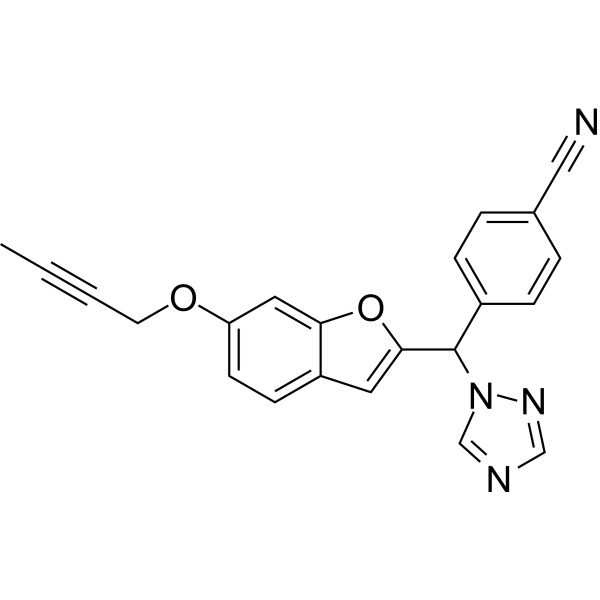
Physicochemical Properties
| Molecular Formula | C22H16N4O2 |
| Molecular Weight | 368.39 |
| CAS # | 3033282-93-5 |
| PubChem CID | 164887539 |
| Appearance | White to off-white solid powder |
| Hydrogen Bond Acceptor Count | 5 |
| Rotatable Bond Count | 5 |
| Heavy Atom Count | 28 |
| Complexity | 639 |
| Defined Atom Stereocenter Count | 0 |
| HS Tariff Code | 2934.99.9001 |
| Storage |
Powder-20°C 3 years 4°C 2 years In solvent -80°C 6 months -20°C 1 month |
| Shipping Condition | Room temperature (This product is stable at ambient temperature for a few days during ordinary shipping and time spent in Customs) |
Biological Activity
| ln Vitro | Excellent aromatase inhibition activity is demonstrated by nonsteroidal aromatase inhibitor 1 (0.001 pM-100 pM; 1 h) treatment[1]. Treatment with nonsteroidal aromatase inhibitor 1 (1 μM; 48 h) does not affect the growth of MCF-10A or MDA-MB-231 [1]. |
| Cell Assay |
Cell Viability Assay[1] Cell Types: JEG-3 cells Tested Concentrations: 0.001 pM-100 pM Incubation Duration: 1 hour Experimental Results: demonstrated excellent aromatase inhibition with the IC50 value of 0.09 nM. Cell Cytotoxicity Assay[1] Cell Types: MCF-10A and MDA-MB-231 cells Tested Concentrations: 1 μM Incubation Duration: 48 hour Experimental Results: Suggested possible limited toxicity in normal breast tissue and little off-target effects. |
| References |
[1]. 4th generation nonsteroidal aromatase inhibitors: An iterative SAR-guided design, synthesis, and biological evaluation towards picomolar dual binding inhibitors. Eur J Med Chem. 2022 Jul 6;240:114569. |
Solubility Data
| Solubility (In Vitro) | May dissolve in DMSO (in most cases), if not, try other solvents such as H2O, Ethanol, or DMF with a minute amount of products to avoid loss of samples |
| Solubility (In Vivo) |
Solubility in Formulation 1: ≥ 2.5 mg/mL (6.79 mM) (saturation unknown) in 10% DMSO + 40% PEG300 + 5% Tween80 + 45% Saline (add these co-solvents sequentially from left to right, and one by one), clear solution. For example, if 1 mL of working solution is to be prepared, you can add 100 μL of 25.0 mg/mL clear DMSO stock solution to 400 μL PEG300 and mix evenly; then add 50 μL Tween-80 to the above solution and mix evenly; then add 450 μL normal saline to adjust the volume to 1 mL. Preparation of saline: Dissolve 0.9 g of sodium chloride in 100 mL ddH₂ O to obtain a clear solution. Solubility in Formulation 2: ≥ 2.5 mg/mL (6.79 mM) (saturation unknown) in 10% DMSO + 90% (20% SBE-β-CD in Saline) (add these co-solvents sequentially from left to right, and one by one), clear solution. For example, if 1 mL of working solution is to be prepared, you can add 100 μL of 25.0 mg/mL clear DMSO stock solution to 900 μL of 20% SBE-β-CD physiological saline solution and mix evenly. Preparation of 20% SBE-β-CD in Saline (4°C,1 week): Dissolve 2 g SBE-β-CD in 10 mL saline to obtain a clear solution. (Please use freshly prepared in vivo formulations for optimal results.) |
| Preparing Stock Solutions | 1 mg | 5 mg | 10 mg | |
| 1 mM | 2.7145 mL | 13.5726 mL | 27.1451 mL | |
| 5 mM | 0.5429 mL | 2.7145 mL | 5.4290 mL | |
| 10 mM | 0.2715 mL | 1.3573 mL | 2.7145 mL |