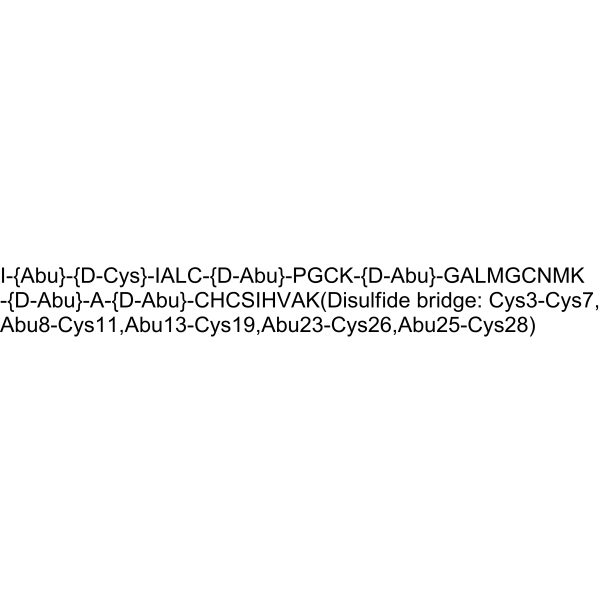
Physicochemical Properties
| Molecular Formula | C143H230N42O37S7 |
| Molecular Weight | 3354.07 |
| Exact Mass | 3351.55 |
| CAS # | 1414-45-5 |
| PubChem CID | 16129667 |
| Appearance | Off-white to light brown solid powder |
| Boiling Point | 2967℃ |
| Flash Point | >110°(230°F) |
| LogP | 3.421 |
| Hydrogen Bond Donor Count | 41 |
| Hydrogen Bond Acceptor Count | 50 |
| Rotatable Bond Count | 67 |
| Heavy Atom Count | 229 |
| Complexity | 7840 |
| Defined Atom Stereocenter Count | 0 |
| SMILES | CCC(C)C1C(=O)NC(=C)C(=O)NC(C(=O)NC(CSCC(C(=O)N1)NC(=O)/C(=C/C)/NC(=O)C(C(C)CC)N)C(=O)NC2C(SCC(NC(=O)CNC(=O)C3CCCN3C2=O)C(=O)NC(CCCCN)C(=O)NC4C(SCC(NC(=O)CNC(=O)C(NC(=O)C(NC(=O)C(NC(=O)CNC4=O)C)CC(C)C)CCSC)C(=O)NC(CC(=O)N)C(=O)NC(CCSC)C(=O)NC(CCCCN)C(=O)NC5C(SCC6C(=O)NC(C(=O)NC(CSC(C(C(=O)N6)NC(=O)C(NC5=O)C)C)C(=O)NC(CO)C(=O)NC(C(C)CC)C(=O)NC(CC7=CN=CN7)C(=O)NC(C(C)C)C(=O)NC(=C)C(=O)NC(CCCCN)C(=O)O)CC8=CN=CN8)C)C)C)CC(C)C |
| InChi Key | NVNLLIYOARQCIX-GSJOZIGCSA-N |
| InChi Code | InChI=1S/C143H230N42O37S7/c1-24-69(11)105(148)135(213)162-82(27-4)118(196)174-94-58-225-59-95(175-123(201)89(48-67(7)8)169-115(193)74(16)158-138(216)107(70(12)25-2)180-132(94)210)133(211)184-112-79(21)229-61-96(160-104(190)56-152-134(212)100-38-34-44-185(100)142(112)220)128(206)164-84(36-29-32-42-145)120(198)182-109-76(18)226-60-97(161-103(189)55-151-117(195)85(39-45-223-22)165-122(200)88(47-66(5)6)168-113(191)72(14)156-102(188)54-153-136(109)214)129(207)171-92(51-101(147)187)125(203)166-86(40-46-224-23)119(197)163-83(35-28-31-41-144)121(199)183-110-77(19)228-63-99-130(208)170-90(49-80-52-149-64-154-80)124(202)176-98(62-227-78(20)111(141(219)177-99)181-116(194)75(17)159-140(110)218)131(209)173-93(57-186)127(205)179-108(71(13)26-3)139(217)172-91(50-81-53-150-65-155-81)126(204)178-106(68(9)10)137(215)157-73(15)114(192)167-87(143(221)222)37-30-33-43-146/h27,52-53,64-72,75-79,83-100,105-112,186H,15-16,24-26,28-51,54-63,144-146,148H2,1-14,17-23H3,(H2,147,187)(H,149,154)(H,150,155)(H,151,195)(H,152,212)(H,153,214)(H,156,188)(H,157,215)(H,158,216)(H,159,218)(H,160,190)(H,161,189)(H,162,213)(H,163,197)(H,164,206)(H,165,200)(H,166,203)(H,167,192)(H,168,191)(H,169,193)(H,170,208)(H,171,207)(H,172,217)(H,173,209)(H,174,196)(H,175,201)(H,176,202)(H,177,219)(H,178,204)(H,179,205)(H,180,210)(H,181,194)(H,182,198)(H,183,199)(H,184,211)(H,221,222)/b82-27- |
| Chemical Name | 6-amino-2-[2-[[2-[[2-[[2-[[2-[[7-[[6-amino-2-[[2-[[4-amino-2-[[21-[[6-amino-2-[[3-[[15-[[(Z)-2-[(2-amino-3-methylpentanoyl)amino]but-2-enoyl]amino]-12-butan-2-yl-9-methylidene-6-(2-methylpropyl)-5,8,11,14-tetraoxo-1-thia-4,7,10,13-tetrazacyclohexadecane-3-carbonyl]amino]-4-methyl-2,9,12-trioxo-5-thia-1,8,11-triazabicyclo[11.3.0]hexadecane-7-carbonyl]amino]hexanoyl]amino]-15,22-dimethyl-12-(2-methylpropyl)-9-(2-methylsulfanylethyl)-5,8,11,14,17,20-hexaoxo-1-thia-4,7,10,13,16,19-hexazacyclodocosane-3-carbonyl]amino]-4-oxobutanoyl]amino]-4-methylsulfanylbutanoyl]amino]hexanoyl]amino]-14-(1H-imidazol-5-ylmethyl)-4,8,20-trimethyl-3,6,12,15,21-pentaoxo-9,19-dithia-2,5,13,16,22-pentazabicyclo[9.9.2]docosane-17-carbonyl]amino]-3-hydroxypropanoyl]amino]-3-methylpentanoyl]amino]-3-(1H-imidazol-5-yl)propanoyl]amino]-3-methylbutanoyl]amino]prop-2-enoylamino]hexanoic acid |
| HS Tariff Code | 2934.99.9001 |
| Storage |
Powder-20°C 3 years 4°C 2 years In solvent -80°C 6 months -20°C 1 month Note: Please store this product in a sealed and protected environment (e.g. under nitrogen), avoid exposure to moisture and light. |
| Shipping Condition | Room temperature (This product is stable at ambient temperature for a few days during ordinary shipping and time spent in Customs) |
Biological Activity
| Targets |
Nisin is a Type A (I) lanthbiotic antimicrobial peptide. Its primary mode of action involves binding with high affinity to lipid II, a precursor molecule in bacterial cell wall biosynthesis. This binding inhibits cell wall synthesis and facilitates pore formation in the bacterial membrane, leading to cell death. [1] |
| ln Vitro |
Nisin is a type A (I) wild-type antibiotic that is made from mRNA. Because of post-translational modifications, the translated peptide contains a number of peculiar toxins. Certain Gram-positive bacteria, such as Lactococcus and Streptococcus species, produce the antimicrobial peptide nisin [1]. Nisin exhibits broad-spectrum antimicrobial activity against a wide range of Gram-positive bacteria, including drug-resistant strains such as methicillin-resistant Staphylococcus aureus (MRSA), vancomycin-resistant enterococci (VRE), Streptococcus pneumoniae, and Clostridium difficile. [1] It also shows activity against Gram-negative oral pathogens like Porphyromonas gingivalis, Prevotella intermedia, Aggregatibacter actinomycetemcomitans, and Treponema denticola. [1] Nisin possesses anti-biofilm properties, inhibiting the formation of biofilms by pathogens such as MRSA on medical devices and multi-species biofilms derived from human saliva. [1] Nisin exhibits anti-cancer activity. It induces apoptosis, causes cell cycle arrest, and reduces proliferation in head and neck squamous cell carcinoma (HNSCC) cells. It also inhibits cancer orasphere formation and angiogenesis in vitro. [1] Nisin shows antifungal activity against Candida albicans, inhibiting its growth and transition from blastospore to hyphal form. [1] Nisin can work synergistically with conventional antibiotics (e.g., vancomycin, ciprofloxacin), the intracanal irrigant MTAD, and other agents like lysozyme and lactoferrin to enhance antimicrobial effects. [1] High-purity Nisin Z did not show cytotoxicity to human oral cells at antimicrobial concentrations. [1] |
| ln Vivo |
In a mouse excisional skin infection model, a wound dressing containing nisin significantly reduced S. aureus colonization and accelerated wound healing. [1] In immunocompromised rats, Nisin F safely inhibited the growth of S. aureus in the respiratory tract. [1] In mouse models, Nisin A reduced HNSCC tumorigenesis and prolonged survival. [1] In a mouse infection model, a nisin-producing Lactococcus lactis strain reduced intestinal colonization by vancomycin-resistant enterococci (VRE). [1] Intramammary administration of Nisin Z was effective in treating mastitis in lactating dairy cows. [1] Topical Nisin A treatment alleviated clinical signs of mastitis and reduced staphylococcal count in human breast milk. [1] |
| Cell Assay |
For evaluating anti-biofilm activity against saliva-derived multi-species biofilms, a Bioflux controlled flow microfluidic model system was used. Saliva containing microbial cells was introduced and fed with filter-sterilized, cell-free saliva for 20-22 hours at 37°C with or without nisin. Biofilms were stained with viability dyes (Syto 9 for live cells, propidium iodide for dead/damaged cells) and visualized using confocal microscopy. [1] To assess anti-cancer effects on cancer stem-like cells, HNSCC cells were cultured under suspension conditions to form oraspheres. Cells were treated with control media or media containing Nisin Z (100 to 800 µg/ml) for 36 hours, and phase-contrast images were taken to evaluate orasphere formation inhibition. [1] |
| Animal Protocol |
For the murine excisional skin infection model, an electrospun nanofiber wound dressing containing nisin was applied to the wound. The dressing allowed for diffusion of active nisin onto the wound site. S. aureus colonization was analyzed by bioluminescence, and wound healing was assessed. [1] For the respiratory tract infection model in immunocompromised rats, Nisin F was administered intranasally to control S. aureus infection. [1] For anti-tumor studies in mice, Nisin A was administered to evaluate its effect on HNSCC tumorigenesis and survival. [1] For gastrointestinal colonization studies, mice were infected with vancomycin-resistant enterococci (VRE). Some mice received a nisin-producing Lactococcus lactis strain to modulate intestinal microbiota and reduce VRE colonization. [1] |
| ADME/Pharmacokinetics |
One study cited in the review reported that nisin was not absorbed by the gastrointestinal tract and did not have indiscriminate activity against all bowel flora when tested in vitro for activity against C. difficile. [1] Another cited study indicated that low blood and tissue levels of nisin were sufficient to prevent death in mice infected with S. pneumoniae. [1] |
| Toxicity/Toxicokinetics |
The U.S. FDA has designated nisin as Generally Regarded As Safe (GRAS) for use in foods. [1] The no-observed-effect-level (NOEL) for nisin in humans is 83.25 mg/kg. [1] At antimicrobial concentrations, nisin exhibits low cellular cytotoxicity. High-purity Nisin Z did not cause cytotoxicity to human oral cells. [1] An in vitro study using intestinal epithelial cells suggested that nisin did not disrupt intestinal epithelial integrity, indicating potential suitability for treating gastrointestinal infections. [1] |
| References |
[1]. Biomedical applications of nisin. J Appl Microbiol. 2016 Jun;120(6):1449-65. [2]. Nisin Induces Cell-Cycle Arrest in Free-Living Amoebae Acanthamoeba castellanii. Acta Parasitol. 2022 Mar;67(1):511-517. [3]. Nisin reduces uterine inflammation in rats by modulating concentrations of pro- and anti-inflammatory cytokines. Am J Reprod Immunol. 2019 May;81(5):e13096. |
| Additional Infomation |
Nisaplin has been reported in Lactococcus lactis with data available. A 34-amino acid polypeptide antibiotic produced by Streptococcus lactis. It has been used as a food preservative in canned fruits and vegetables, and cheese. Nisin is a bacteriocin, a bacterially-derived antimicrobial peptide, originally produced by Lactococcus and Streptococcus species. [1] It was first identified in 1928, approved as a food additive by FAO/WHO in 1969, and received FDA GRAS status in the United States in 1988 for use in processed cheeses. [1] Beyond its role as a food biopreservative, nisin is being investigated for various biomedical applications, including treating infectious diseases, oral diseases (caries, periodontal disease), and cancer (particularly HNSCC). [1] Nisin may have immunomodulatory roles, similar to host defense peptides, such as activating neutrophils and modulating cytokine production. [1] There are several natural variants (e.g., Nisin A, Z, F, Q, U, H, P) and bioengineered variants (e.g., with modifications in the hinge region like N20K, M21K, S29A) of nisin, some designed to enhance activity, stability, or specificity. [1] Resistance to nisin can occur through mechanisms such as cell wall thickening, alterations in membrane composition, production of nisin-degrading enzymes (nisinase), and the nisin resistance protein (NSR) that proteolytically cleaves nisin. However, significant clinical resistance is currently rare. [1] |
Solubility Data
| Solubility (In Vitro) |
H2O : ~6.67 mg/mL (~1.99 mM) DMSO : ~1 mg/mL (~0.30 mM) |
| Solubility (In Vivo) |
Note: Listed below are some common formulations that may be used to formulate products with low water solubility (e.g. < 1 mg/mL), you may test these formulations using a minute amount of products to avoid loss of samples. Injection Formulations (e.g. IP/IV/IM/SC) Injection Formulation 1: DMSO : Tween 80: Saline = 10 : 5 : 85 (i.e. 100 μL DMSO stock solution → 50 μL Tween 80 → 850 μL Saline) *Preparation of saline: Dissolve 0.9 g of sodium chloride in 100 mL ddH ₂ O to obtain a clear solution. Injection Formulation 2: DMSO : PEG300 :Tween 80 : Saline = 10 : 40 : 5 : 45 (i.e. 100 μL DMSO → 400 μLPEG300 → 50 μL Tween 80 → 450 μL Saline) Injection Formulation 3: DMSO : Corn oil = 10 : 90 (i.e. 100 μL DMSO → 900 μL Corn oil) Example: Take the Injection Formulation 3 (DMSO : Corn oil = 10 : 90) as an example, if 1 mL of 2.5 mg/mL working solution is to be prepared, you can take 100 μL 25 mg/mL DMSO stock solution and add to 900 μL corn oil, mix well to obtain a clear or suspension solution (2.5 mg/mL, ready for use in animals). Injection Formulation 4: DMSO : 20% SBE-β-CD in saline = 10 : 90 [i.e. 100 μL DMSO → 900 μL (20% SBE-β-CD in saline)] *Preparation of 20% SBE-β-CD in Saline (4°C,1 week): Dissolve 2 g SBE-β-CD in 10 mL saline to obtain a clear solution. Injection Formulation 5: 2-Hydroxypropyl-β-cyclodextrin : Saline = 50 : 50 (i.e. 500 μL 2-Hydroxypropyl-β-cyclodextrin → 500 μL Saline) Injection Formulation 6: DMSO : PEG300 : castor oil : Saline = 5 : 10 : 20 : 65 (i.e. 50 μL DMSO → 100 μLPEG300 → 200 μL castor oil → 650 μL Saline) Injection Formulation 7: Ethanol : Cremophor : Saline = 10: 10 : 80 (i.e. 100 μL Ethanol → 100 μL Cremophor → 800 μL Saline) Injection Formulation 8: Dissolve in Cremophor/Ethanol (50 : 50), then diluted by Saline Injection Formulation 9: EtOH : Corn oil = 10 : 90 (i.e. 100 μL EtOH → 900 μL Corn oil) Injection Formulation 10: EtOH : PEG300:Tween 80 : Saline = 10 : 40 : 5 : 45 (i.e. 100 μL EtOH → 400 μLPEG300 → 50 μL Tween 80 → 450 μL Saline) Oral Formulations Oral Formulation 1: Suspend in 0.5% CMC Na (carboxymethylcellulose sodium) Oral Formulation 2: Suspend in 0.5% Carboxymethyl cellulose Example: Take the Oral Formulation 1 (Suspend in 0.5% CMC Na) as an example, if 100 mL of 2.5 mg/mL working solution is to be prepared, you can first prepare 0.5% CMC Na solution by measuring 0.5 g CMC Na and dissolve it in 100 mL ddH2O to obtain a clear solution; then add 250 mg of the product to 100 mL 0.5% CMC Na solution, to make the suspension solution (2.5 mg/mL, ready for use in animals). Oral Formulation 3: Dissolved in PEG400 Oral Formulation 4: Suspend in 0.2% Carboxymethyl cellulose Oral Formulation 5: Dissolve in 0.25% Tween 80 and 0.5% Carboxymethyl cellulose Oral Formulation 6: Mixing with food powders Note: Please be aware that the above formulations are for reference only. InvivoChem strongly recommends customers to read literature methods/protocols carefully before determining which formulation you should use for in vivo studies, as different compounds have different solubility properties and have to be formulated differently. (Please use freshly prepared in vivo formulations for optimal results.) |
| Preparing Stock Solutions | 1 mg | 5 mg | 10 mg | |
| 1 mM | 0.2981 mL | 1.4907 mL | 2.9815 mL | |
| 5 mM | 0.0596 mL | 0.2981 mL | 0.5963 mL | |
| 10 mM | 0.0298 mL | 0.1491 mL | 0.2981 mL |