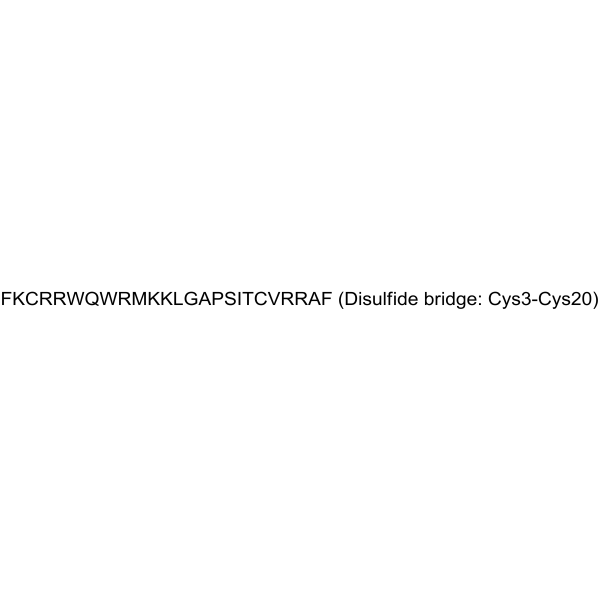
Physicochemical Properties
| Molecular Formula | C141H224N46O29S3 |
| Molecular Weight | 3123.773 |
| Exact Mass | 218.065 |
| CAS # | 146897-68-9 |
| Related CAS # | Lactoferrin (17-41) (acetate);2828433-30-1 |
| Appearance | Typically exists as solid at room temperature |
| Density | 1.2±0.1 g/cm3 |
| Boiling Point | 288.2±33.0 °C at 760 mmHg |
| Flash Point | 128.1±25.4 °C |
| Vapour Pressure | 0.0±0.6 mmHg at 25°C |
| Index of Refraction | 1.599 |
| Source | from milk |
| LogP | 0.73 |
| SMILES | C([C@@H]1NC(=O)[C@H](CCCNC(N)=N)NC(=O)[C@H](CCCNC(N)=N)NC(=O)[C@@H](NC(=O)[C@H](CCCCN)NC(=O)[C@@H](N)CC2C=CC=CC=2)CSSC[C@@H](C(=O)N[C@@H](C(C)C)C(=O)N[C@@H](CCCNC(N)=N)C(=O)N[C@@H](CCCNC(N)=N)C(=O)N[C@@H](C)C(=O)N[C@H](C(=O)O)CC2C=CC=CC=2)NC(=O)[C@H]([C@H](O)C)NC(=O)[C@H]([C@@H](C)CC)NC(=O)[C@H](CO)NC(=O)[C@]2([H])CCCN2C(=O)[C@H](C)NC(=O)CNC(=O)[C@H](CC(C)C)NC(=O)[C@H](CCCCN)NC(=O)[C@H](CCCCN)NC(=O)[C@H](CCSC)NC(=O)[C@H](CCCNC(N)=N)NC(=O)[C@H](CC2=CNC3=CC=CC=C23)NC(=O)[C@H](CCC(=O)N)NC1=O)C1=CNC2=CC=CC=C12 |
| HS Tariff Code | 2934.99.9001 |
| Storage |
Powder-20°C 3 years 4°C 2 years In solvent -80°C 6 months -20°C 1 month |
| Shipping Condition | Room temperature (This product is stable at ambient temperature for a few days during ordinary shipping and time spent in Customs) |
Biological Activity
| Targets | The MIC of lactoferrin 17-41 (lactoferrin B) against E. coli ATCC 25922 is 30 μg/ml[1]. Lactoferrin 17-41 strongly induces HT-29 cell apoptosis and demonstrates cytotoxic action on HT-29 cells [2]. Lactoferrin 17-41 promotes the transcription of p53 signaling pathway-related genes in diverse ways, such as PMAIP-1, TP5313, and SFN[2]. Lactoferrin 17-41 can bind to LPS of Gram-negative bacteria and suppress the LPS-induced cytokine response of human monocytes [1][3]. |
| ln Vitro |
The MIC of lactoferrin 17-41 (lactoferrin B) against E. coli ATCC 25922 is 30 μg/ml[1]. Lactoferrin 17-41 strongly induces HT-29 cell apoptosis and demonstrates cytotoxic action on HT-29 cells [2]. Lactoferrin 17-41 promotes the transcription of p53 signaling pathway-related genes in diverse ways, such as PMAIP-1, TP5313, and SFN[2]. Lactoferrin 17-41 can bind to LPS of Gram-negative bacteria and suppress the LPS-induced cytokine response of human monocytes [1][3]. Lactoferrin 17-41 inhibits the classical complement pathway in a concentration-dependent manner as shown in CH50 assay. Lactoferrin 17-41 reduces the inhibitory properties of human serum against Escherichia coli in a concentration-dependent manner in time-kill studies. Lactoferrin 17-41 shows no inhibitory effect on the alternative complement pathway in AP50 assay.[1] |
| Enzyme Assay |
Classical complement pathway activity was assessed using a CH50 assay. Sheep red blood cells were sensitized with hemolysin, incubated with serially diluted peptide and diluted human serum, and hemolysis was measured at 414 nm after incubation. The alternative complement pathway was assessed using an AP50 assay with rabbit erythrocytes in Mg-EGTA buffer, followed by similar hemolysis measurement.[1] |
| Cell Assay |
Cell Viability Assay[2] Cell Types: HT-29 Cell Tested Concentrations: 50, 100, 200, 400, 800 or 1000 µg/mL Incubation Duration: 4, 12, 24 or 48 hrs (hours) Experimental Results: 400 µg is more effective in inducing apoptosis deaths/ml. Higher toxicity was shown at 800 µg/mL. Time-kill assays were performed in human serum. E. coli was incubated with Lactoferrin 17-41 in serum with active or heat-inactivated complement. Aliquots were taken at various time points, plated on agar, and CFU/ml were counted to assess bacterial survival.[1] |
| Toxicity/Toxicokinetics |
Lactoferrin 17-41 showed no hemolytic activity against sheep or rabbit red blood cells at the concentrations used in the complement assays.[1] |
| References |
[1]. Anti-complement effects of lactoferrin-derived peptides. FEMS Immunol Med Microbiol. 2004 Jun 1;41(2):141-8. [2]. Bovine lactoferrin and lactoferricin exert antitumor activities on human colorectal cancer cells(HT-29) by activating various signaling pathways. Biochem Cell Biol. 2017 Feb;95(1):99-109. [3]. Reciprocal interactions between lactoferrin and bacterial endotoxins and their role in the regulation of the immune response. Toxins (Basel). 2010;2(1):54‐68. |
| Additional Infomation |
Lactoferrin 17-41 is a 25-amino acid peptide derived from the N-terminal region (residues 17–41) of bovine lactoferrin by pepsin digestion. It exhibits antibacterial activity against E. coli with an MIC of 30 μg/ml. The peptide’s anti-complement activity suggests it may suppress inflammatory responses caused by bacterial infection.[1] |
Solubility Data
| Solubility (In Vitro) | May dissolve in DMSO (in most cases), if not, try other solvents such as H2O, Ethanol, or DMF with a minute amount of products to avoid loss of samples |
| Solubility (In Vivo) |
Note: Listed below are some common formulations that may be used to formulate products with low water solubility (e.g. < 1 mg/mL), you may test these formulations using a minute amount of products to avoid loss of samples. Injection Formulations (e.g. IP/IV/IM/SC) Injection Formulation 1: DMSO : Tween 80: Saline = 10 : 5 : 85 (i.e. 100 μL DMSO stock solution → 50 μL Tween 80 → 850 μL Saline) *Preparation of saline: Dissolve 0.9 g of sodium chloride in 100 mL ddH ₂ O to obtain a clear solution. Injection Formulation 2: DMSO : PEG300 :Tween 80 : Saline = 10 : 40 : 5 : 45 (i.e. 100 μL DMSO → 400 μLPEG300 → 50 μL Tween 80 → 450 μL Saline) Injection Formulation 3: DMSO : Corn oil = 10 : 90 (i.e. 100 μL DMSO → 900 μL Corn oil) Example: Take the Injection Formulation 3 (DMSO : Corn oil = 10 : 90) as an example, if 1 mL of 2.5 mg/mL working solution is to be prepared, you can take 100 μL 25 mg/mL DMSO stock solution and add to 900 μL corn oil, mix well to obtain a clear or suspension solution (2.5 mg/mL, ready for use in animals). Injection Formulation 4: DMSO : 20% SBE-β-CD in saline = 10 : 90 [i.e. 100 μL DMSO → 900 μL (20% SBE-β-CD in saline)] *Preparation of 20% SBE-β-CD in Saline (4°C,1 week): Dissolve 2 g SBE-β-CD in 10 mL saline to obtain a clear solution. Injection Formulation 5: 2-Hydroxypropyl-β-cyclodextrin : Saline = 50 : 50 (i.e. 500 μL 2-Hydroxypropyl-β-cyclodextrin → 500 μL Saline) Injection Formulation 6: DMSO : PEG300 : castor oil : Saline = 5 : 10 : 20 : 65 (i.e. 50 μL DMSO → 100 μLPEG300 → 200 μL castor oil → 650 μL Saline) Injection Formulation 7: Ethanol : Cremophor : Saline = 10: 10 : 80 (i.e. 100 μL Ethanol → 100 μL Cremophor → 800 μL Saline) Injection Formulation 8: Dissolve in Cremophor/Ethanol (50 : 50), then diluted by Saline Injection Formulation 9: EtOH : Corn oil = 10 : 90 (i.e. 100 μL EtOH → 900 μL Corn oil) Injection Formulation 10: EtOH : PEG300:Tween 80 : Saline = 10 : 40 : 5 : 45 (i.e. 100 μL EtOH → 400 μLPEG300 → 50 μL Tween 80 → 450 μL Saline) Oral Formulations Oral Formulation 1: Suspend in 0.5% CMC Na (carboxymethylcellulose sodium) Oral Formulation 2: Suspend in 0.5% Carboxymethyl cellulose Example: Take the Oral Formulation 1 (Suspend in 0.5% CMC Na) as an example, if 100 mL of 2.5 mg/mL working solution is to be prepared, you can first prepare 0.5% CMC Na solution by measuring 0.5 g CMC Na and dissolve it in 100 mL ddH2O to obtain a clear solution; then add 250 mg of the product to 100 mL 0.5% CMC Na solution, to make the suspension solution (2.5 mg/mL, ready for use in animals). Oral Formulation 3: Dissolved in PEG400 Oral Formulation 4: Suspend in 0.2% Carboxymethyl cellulose Oral Formulation 5: Dissolve in 0.25% Tween 80 and 0.5% Carboxymethyl cellulose Oral Formulation 6: Mixing with food powders Note: Please be aware that the above formulations are for reference only. InvivoChem strongly recommends customers to read literature methods/protocols carefully before determining which formulation you should use for in vivo studies, as different compounds have different solubility properties and have to be formulated differently. (Please use freshly prepared in vivo formulations for optimal results.) |
| Preparing Stock Solutions | 1 mg | 5 mg | 10 mg | |
| 1 mM | 0.3201 mL | 1.6006 mL | 3.2013 mL | |
| 5 mM | 0.0640 mL | 0.3201 mL | 0.6403 mL | |
| 10 mM | 0.0320 mL | 0.1601 mL | 0.3201 mL |