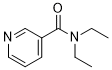
Physicochemical Properties
| Molecular Formula | C10H14N2O |
| Molecular Weight | 178.23 |
| Exact Mass | 178.11 |
| CAS # | 59-26-7 |
| PubChem CID | 5497 |
| Appearance | Colorless to light yellow liquid(Density:1.06 g/cm3 ) |
| Density | 1.0±0.1 g/cm3 |
| Boiling Point | 298.0±0.0 °C at 760 mmHg |
| Melting Point | 23 °C(lit.) |
| Flash Point | 141.1±20.4 °C |
| Vapour Pressure | 0.0±0.6 mmHg at 25°C |
| Index of Refraction | 1.520 |
| LogP | 0.33 |
| Hydrogen Bond Donor Count | 0 |
| Hydrogen Bond Acceptor Count | 2 |
| Rotatable Bond Count | 3 |
| Heavy Atom Count | 13 |
| Complexity | 166 |
| Defined Atom Stereocenter Count | 0 |
| SMILES | O=C(C1=C([H])N=C([H])C([H])=C1[H])N(C([H])([H])C([H])([H])[H])C([H])([H])C([H])([H])[H] |
| Synonyms | beta-PyrimidumAnacardone Astrocar Anacordone |
| HS Tariff Code | 2934.99.9001 |
| Storage |
Powder-20°C 3 years 4°C 2 years In solvent -80°C 6 months -20°C 1 month |
| Shipping Condition | Room temperature (This product is stable at ambient temperature for a few days during ordinary shipping and time spent in Customs) |
Biological Activity
| References |
[1]. Simultaneous determination of nikethamide and lidocaine in human blood and cerebrospinal fluid by high performance liquid chromatography. J Pharm Biomed Anal. 2007 Apr 11;43(5):1757-62. |
| Additional Infomation |
Nicethamid appears as clear light yellow viscous liquid or crystalline solid. Slightly bitter taste followed by a faint sensation of the warmth. (NTP, 1992) Nikethamide is a pyridinecarboxamide. It is functionally related to a nicotinamide. Nikethamide has been reported in Corydalis with data available. A central nervous system stimulant. It was formerly used in the treatment of barbiturate overdose but is now considered to be of no value for such purposes and may be dangerous. (From Martindale, The Extra Pharmacopoeia, 30th ed, p1229) |
Solubility Data
| Solubility (In Vitro) |
H2O : ≥ 50 mg/mL (~280.54 mM) DMSO : ≥ 1 mg/mL (~5.61 mM) |
| Solubility (In Vivo) |
Solubility in Formulation 1: 100 mg/mL (561.07 mM) in PBS (add these co-solvents sequentially from left to right, and one by one), clear solution; with sonication. (Please use freshly prepared in vivo formulations for optimal results.) |
| Preparing Stock Solutions | 1 mg | 5 mg | 10 mg | |
| 1 mM | 5.6107 mL | 28.0536 mL | 56.1073 mL | |
| 5 mM | 1.1221 mL | 5.6107 mL | 11.2215 mL | |
| 10 mM | 0.5611 mL | 2.8054 mL | 5.6107 mL |