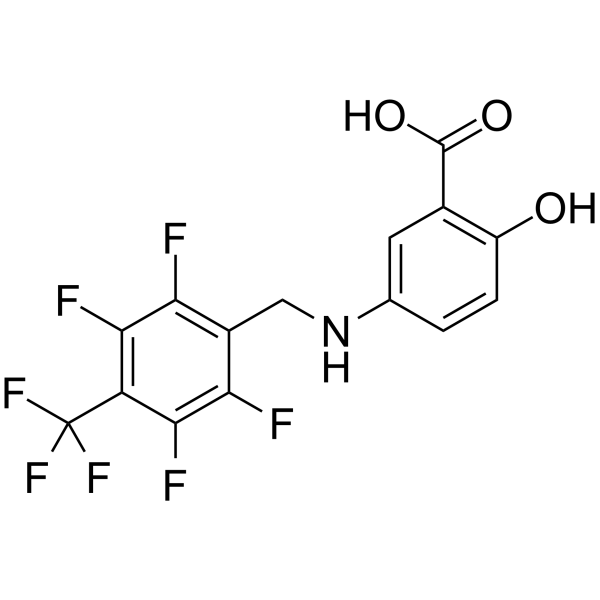
Physicochemical Properties
| Molecular Formula | C15H8F7NO3 |
| Molecular Weight | 383.22 |
| Exact Mass | 383.039 |
| CAS # | 640290-67-1 |
| Related CAS # | Nelonemdaz potassium;916214-57-8 |
| PubChem CID | 9951955 |
| Appearance | Off-white to light yellow solid powder |
| LogP | 4.35 |
| Hydrogen Bond Donor Count | 3 |
| Hydrogen Bond Acceptor Count | 11 |
| Rotatable Bond Count | 4 |
| Heavy Atom Count | 26 |
| Complexity | 490 |
| Defined Atom Stereocenter Count | 0 |
| InChi Key | HABROHXUHNHQMY-UHFFFAOYSA-N |
| InChi Code | InChI=1S/C15H8F7NO3/c16-10-7(11(17)13(19)9(12(10)18)15(20,21)22)4-23-5-1-2-8(24)6(3-5)14(25)26/h1-3,23-24H,4H2,(H,25,26) |
| Chemical Name | 2-hydroxy-5-[[2,3,5,6-tetrafluoro-4-(trifluoromethyl)phenyl]methylamino]benzoic acid |
| Synonyms | Neu2000; Neu-2000-KL; Neu-2000 |
| HS Tariff Code | 2934.99.9001 |
| Storage |
Powder-20°C 3 years 4°C 2 years In solvent -80°C 6 months -20°C 1 month |
| Shipping Condition | Room temperature (This product is stable at ambient temperature for a few days during ordinary shipping and time spent in Customs) |
Biological Activity
| ln Vitro | Nelonemdaz (10-300 μM) exhibits noteworthy neuroprotective properties at dosages as low as 30 μM against 300 μM N-methyl-d-aspartate (NMDA) [1]. In a concentration-dependent manner, nelonemdazl (10-500 μM) suppresses the electrophysiological response of cultured cortical neurons to 300 μM NMDA [1]. Fe2+-induced neurotoxicity can be considerably mitigated by nelonemdaz (0.1–1 μM), even at dosages as low as 0.1–0.3 μM [1]. Nelonemdaz (0.1–1 μM) stops the degradation of neurons and glial cells in cortical cell cultures [1]. It has been observed that nelonemdaz (0-350 μM) efficiently scavenges nitric oxide (IC50=155.8±4.88 μM), hydroxyl radicals (IC50=58.45±1.74 μM), and superoxide radicals (IC50=63.07±1.44 μM) [3]. Nelonemdaz (0.78-12.5 μM) has an IC50 of 2.21±0.11 μM and decreases ROS/RNS production generated by antimycin A in a dose-dependent manner[3]. Malondialdehyde (MDA) production is inhibited by nelonemdaz (0.19-12.5 μM) with an IC50 of 2.72±0.26 μM[3]. Nelonemdaz (0-125 μM) efficiently lowers the lipid peroxidation caused by iron ascorbate (IC50=24.56±0.07 μM)[3]. |
| ln Vivo | Nelonemdaz (0.5–20 mg/kg; intravenously) decreases cerebral infarction in a dose-dependent manner within 24 hours following 60 minutes of middle cerebral artery occlusion (MCAO) occlusion [1]. Nelonemdaz (5 mg/kg; intravenously) guards against ischemic brain injury to gray tissue and white matter, including axons and myelin [1]. |
| Animal Protocol |
Animal/Disease Models: Male SD (SD (Sprague-Dawley)) rat (260 to 300 g) (clamp occlusion model) [1] Doses: 0.5-20 mg/kg Route of Administration: intravenous (iv) (iv)injection 5 minutes after reperfusion Experimental Results: Produced substantial neuroprotection Effect, maximizing reduction in infarct volume by 66% at doses of 2.5 to 5 mg/kg. After a dose of 5 mg/kg, no neuronal damage was observed in the most vulnerable cortical areas. Animal/Disease Models: Male SD (SD (Sprague-Dawley)) rat (260 to 300 g) (endoluminal wire occlusion model) [1] Doses: 5 mg/kg Route of Administration: intravenous (iv) (iv)injection 30 minutes after reperfusion Experimental Results: No changes in physiological variables, e.g. arterial pH, PCO2, PO2 and hematocrit. Cortical and striatal infarct volumes were Dramatically diminished. Dramatically diminished white matter damage in the striatum and external capsule. |
| References |
[1]. Marked prevention of ischemic brain injury by Neu2000, an NMDA antagonist and antioxidant derived from aspirin and sulfasalazine. J Cereb Blood Flow Metab. 2007 Jun;27(6):1142-51. [2]. Neu2000, an NR2B-selective, Moderate NMDA Receptor Antagonist and Potent Spin Trapping Molecule for Stroke. Drug News Perspect. 2010 Nov; 23(9): 549-56. [3]. Antioxidant Properties of Neu2000 on Mitochondrial Free Radicals and Oxidative Damage. Toxicol In Vitro. 2013 Mar; 27(2): 788-97. |
Solubility Data
| Solubility (In Vitro) | DMSO : ≥ 112.5 mg/mL (~293.57 mM) |
| Solubility (In Vivo) |
Note: Listed below are some common formulations that may be used to formulate products with low water solubility (e.g. < 1 mg/mL), you may test these formulations using a minute amount of products to avoid loss of samples. Injection Formulations (e.g. IP/IV/IM/SC) Injection Formulation 1: DMSO : Tween 80: Saline = 10 : 5 : 85 (i.e. 100 μL DMSO stock solution → 50 μL Tween 80 → 850 μL Saline) *Preparation of saline: Dissolve 0.9 g of sodium chloride in 100 mL ddH ₂ O to obtain a clear solution. Injection Formulation 2: DMSO : PEG300 :Tween 80 : Saline = 10 : 40 : 5 : 45 (i.e. 100 μL DMSO → 400 μLPEG300 → 50 μL Tween 80 → 450 μL Saline) Injection Formulation 3: DMSO : Corn oil = 10 : 90 (i.e. 100 μL DMSO → 900 μL Corn oil) Example: Take the Injection Formulation 3 (DMSO : Corn oil = 10 : 90) as an example, if 1 mL of 2.5 mg/mL working solution is to be prepared, you can take 100 μL 25 mg/mL DMSO stock solution and add to 900 μL corn oil, mix well to obtain a clear or suspension solution (2.5 mg/mL, ready for use in animals). Injection Formulation 4: DMSO : 20% SBE-β-CD in saline = 10 : 90 [i.e. 100 μL DMSO → 900 μL (20% SBE-β-CD in saline)] *Preparation of 20% SBE-β-CD in Saline (4°C,1 week): Dissolve 2 g SBE-β-CD in 10 mL saline to obtain a clear solution. Injection Formulation 5: 2-Hydroxypropyl-β-cyclodextrin : Saline = 50 : 50 (i.e. 500 μL 2-Hydroxypropyl-β-cyclodextrin → 500 μL Saline) Injection Formulation 6: DMSO : PEG300 : castor oil : Saline = 5 : 10 : 20 : 65 (i.e. 50 μL DMSO → 100 μLPEG300 → 200 μL castor oil → 650 μL Saline) Injection Formulation 7: Ethanol : Cremophor : Saline = 10: 10 : 80 (i.e. 100 μL Ethanol → 100 μL Cremophor → 800 μL Saline) Injection Formulation 8: Dissolve in Cremophor/Ethanol (50 : 50), then diluted by Saline Injection Formulation 9: EtOH : Corn oil = 10 : 90 (i.e. 100 μL EtOH → 900 μL Corn oil) Injection Formulation 10: EtOH : PEG300:Tween 80 : Saline = 10 : 40 : 5 : 45 (i.e. 100 μL EtOH → 400 μLPEG300 → 50 μL Tween 80 → 450 μL Saline) Oral Formulations Oral Formulation 1: Suspend in 0.5% CMC Na (carboxymethylcellulose sodium) Oral Formulation 2: Suspend in 0.5% Carboxymethyl cellulose Example: Take the Oral Formulation 1 (Suspend in 0.5% CMC Na) as an example, if 100 mL of 2.5 mg/mL working solution is to be prepared, you can first prepare 0.5% CMC Na solution by measuring 0.5 g CMC Na and dissolve it in 100 mL ddH2O to obtain a clear solution; then add 250 mg of the product to 100 mL 0.5% CMC Na solution, to make the suspension solution (2.5 mg/mL, ready for use in animals). Oral Formulation 3: Dissolved in PEG400 Oral Formulation 4: Suspend in 0.2% Carboxymethyl cellulose Oral Formulation 5: Dissolve in 0.25% Tween 80 and 0.5% Carboxymethyl cellulose Oral Formulation 6: Mixing with food powders Note: Please be aware that the above formulations are for reference only. InvivoChem strongly recommends customers to read literature methods/protocols carefully before determining which formulation you should use for in vivo studies, as different compounds have different solubility properties and have to be formulated differently. (Please use freshly prepared in vivo formulations for optimal results.) |
| Preparing Stock Solutions | 1 mg | 5 mg | 10 mg | |
| 1 mM | 2.6095 mL | 13.0473 mL | 26.0947 mL | |
| 5 mM | 0.5219 mL | 2.6095 mL | 5.2189 mL | |
| 10 mM | 0.2609 mL | 1.3047 mL | 2.6095 mL |