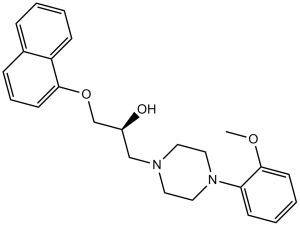
Naftopidil (BM-15275; KT611; BM15275; KT611; Flivas) is a selective α1-adrenergic receptor antagonist that has been approved for the treatment of BPH-benign prostatic hyperplasia. Naftopidil possesses a Kis of 3.7 nM, 20 nM, and 1.2 nM for α1a, α1b, and α1d adrenoceptor inhibition, respectively.
Physicochemical Properties
| Molecular Formula | C24H28N2O3 | |
| Molecular Weight | 392.49 | |
| Exact Mass | 392.209 | |
| Elemental Analysis | C, 73.44; H, 7.19; N, 7.14; O, 12.23 | |
| CAS # | 57149-07-2 | |
| Related CAS # | Naftopidil dihydrochloride; 57149-08-3; Naftopidil hydrochloride; 1164469-60-6; Naftopidil-d5; 2747918-58-5 | |
| PubChem CID | 4418 | |
| Appearance | White to off-white solid powder | |
| Density | 1.2±0.1 g/cm3 | |
| Boiling Point | 602.8±55.0 °C at 760 mmHg | |
| Melting Point | 127 °C | |
| Flash Point | 318.3±31.5 °C | |
| Vapour Pressure | 0.0±1.8 mmHg at 25°C | |
| Index of Refraction | 1.619 | |
| LogP | 4.81 | |
| Hydrogen Bond Donor Count | 1 | |
| Hydrogen Bond Acceptor Count | 5 | |
| Rotatable Bond Count | 7 | |
| Heavy Atom Count | 29 | |
| Complexity | 483 | |
| Defined Atom Stereocenter Count | 0 | |
| SMILES | O([H])C([H])(C([H])([H])OC1=C([H])C([H])=C([H])C2=C([H])C([H])=C([H])C([H])=C12)C([H])([H])N1C([H])([H])C([H])([H])N(C2=C([H])C([H])=C([H])C([H])=C2OC([H])([H])[H])C([H])([H])C1([H])[H] |
|
| InChi Key | HRRBJVNMSRJFHQ-UHFFFAOYSA-N | |
| InChi Code | InChI=1S/C24H28N2O3/c1-28-24-11-5-4-10-22(24)26-15-13-25(14-16-26)17-20(27)18-29-23-12-6-8-19-7-2-3-9-21(19)23/h2-12,20,27H,13-18H2,1H3 | |
| Chemical Name | 1-[4-(2-methoxyphenyl)piperazin-1-yl]-3-naphthalen-1-yloxypropan-2-ol | |
| Synonyms |
|
|
| HS Tariff Code | 2934.99.9001 | |
| Storage |
Powder-20°C 3 years 4°C 2 years In solvent -80°C 6 months -20°C 1 month |
|
| Shipping Condition | Room temperature (This product is stable at ambient temperature for a few days during ordinary shipping and time spent in Customs) |
Biological Activity
| Targets | Alpha-1A adrenergic receptor ( Ki = 3.7 nM ); Alpha-1B adrenergic receptor ( Ki = 20 nM ); Alpha-1D adrenergic receptor ( Ki = 1.2 nM ) | |
| ln Vitro |
|
|
| ln Vivo |
|
|
| Cell Assay |
Cell Line: PCa cells, PrSC Concentration: 10 μM (PCa cells); 0.1 μM, 1 μM, 10 μM (PrSC) Incubation Time: 3 days Result: Exhibited growth inhibitory effects on PCa cells and PrSC in dose-dependent manners. |
|
| Animal Protocol |
Male athymic mice (7-8 weeks), with E9+PrSC xenograft 10 mg/kg Oral administration, daily, for 28 days |
|
| References |
[1]. Naftopidil, a novel alpha1-adrenoceptor antagonist, displays selective inhibition of canine prostatic pressure and high affinity binding to cloned human alpha1-adrenoceptors. Jpn J Pharmacol. 1999 Apr;79(4):447-54. [2]. Naftopidil, a selective {alpha}1-adrenoceptor antagonist, suppresses human prostate tumor growth by altering interactions between tumor cells and stroma. Cancer Prev Res (Phila). 2011 Jan;4(1):87-96. |
|
| Additional Infomation |
Naftopidil is a member of piperazines. Naftopidil has been investigated for the treatment of Disorder of Urinary Stent. |
Solubility Data
| Solubility (In Vitro) |
|
|||
| Solubility (In Vivo) |
Solubility in Formulation 1: ≥ 2.5 mg/mL (6.37 mM) (saturation unknown) in 10% DMSO + 40% PEG300 + 5% Tween80 + 45% Saline (add these co-solvents sequentially from left to right, and one by one), clear solution. For example, if 1 mL of working solution is to be prepared, you can add 100 μL of 25.0 mg/mL clear DMSO stock solution to 400 μL PEG300 and mix evenly; then add 50 μL Tween-80 to the above solution and mix evenly; then add 450 μL normal saline to adjust the volume to 1 mL. Preparation of saline: Dissolve 0.9 g of sodium chloride in 100 mL ddH₂ O to obtain a clear solution. Solubility in Formulation 2: 2.5 mg/mL (6.37 mM) in 10% DMSO + 90% (20% SBE-β-CD in Saline) (add these co-solvents sequentially from left to right, and one by one), suspension solution; with ultrasonication. For example, if 1 mL of working solution is to be prepared, you can add 100 μL of 25.0 mg/mL clear DMSO stock solution to 900 μL of 20% SBE-β-CD physiological saline solution and mix evenly. Preparation of 20% SBE-β-CD in Saline (4°C,1 week): Dissolve 2 g SBE-β-CD in 10 mL saline to obtain a clear solution. Solubility in Formulation 3: ≥ 2.5 mg/mL (6.37 mM) (saturation unknown) in 10% DMSO + 90% Corn Oil (add these co-solvents sequentially from left to right, and one by one), clear solution. For example, if 1 mL of working solution is to be prepared, you can add 100 μL of 25.0 mg/mL clear DMSO stock solution to 900 μL of corn oil and mix evenly. (Please use freshly prepared in vivo formulations for optimal results.) |
| Preparing Stock Solutions | 1 mg | 5 mg | 10 mg | |
| 1 mM | 2.5478 mL | 12.7392 mL | 25.4784 mL | |
| 5 mM | 0.5096 mL | 2.5478 mL | 5.0957 mL | |
| 10 mM | 0.2548 mL | 1.2739 mL | 2.5478 mL |