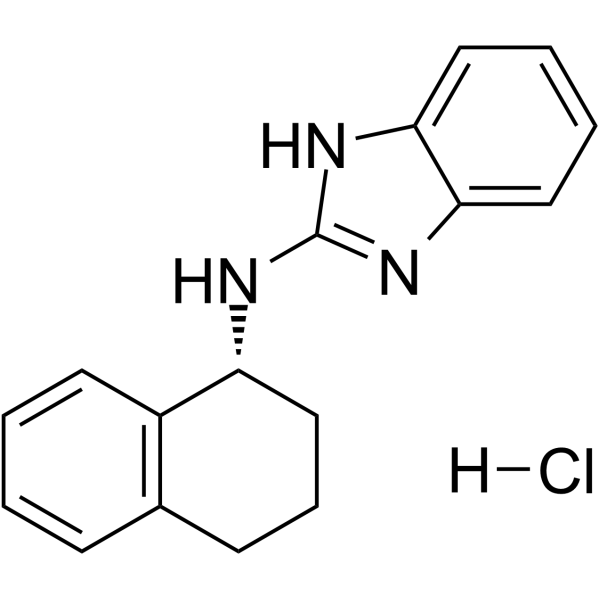
Physicochemical Properties
| Molecular Formula | C17H18CLN3 |
| Molecular Weight | 299.7979 |
| Exact Mass | 299.119 |
| CAS # | 875755-24-1 |
| Related CAS # | 875755-39-8;875755-24-1 (HCl); |
| PubChem CID | 71311765 |
| Appearance | White to off-white solid powder |
| LogP | 4.276 |
| Hydrogen Bond Donor Count | 3 |
| Hydrogen Bond Acceptor Count | 2 |
| Rotatable Bond Count | 2 |
| Heavy Atom Count | 21 |
| Complexity | 332 |
| Defined Atom Stereocenter Count | 1 |
| SMILES | C1C[C@H](C2=CC=CC=C2C1)NC3=NC4=CC=CC=C4N3.Cl |
| InChi Key | VWEKCDTXUUPBNA-PFEQFJNWSA-N |
| InChi Code | InChI=1S/C17H17N3.ClH/c1-2-8-13-12(6-1)7-5-11-14(13)18-17-19-15-9-3-4-10-16(15)20-17;/h1-4,6,8-10,14H,5,7,11H2,(H2,18,19,20);1H/t14-;/m1./s1 |
| Chemical Name | N-[(1R)-1,2,3,4-tetrahydronaphthalen-1-yl]-1H-benzimidazol-2-amine;hydrochloride |
| HS Tariff Code | 2934.99.9001 |
| Storage |
Powder-20°C 3 years 4°C 2 years In solvent -80°C 6 months -20°C 1 month Note: Please store this product in a sealed and protected environment, avoid exposure to moisture. |
| Shipping Condition | Room temperature (This product is stable at ambient temperature for a few days during ordinary shipping and time spent in Customs) |
Biological Activity
| ln Vitro | The inhibitory impact of NS8593 (Compound 14) in excised patches was observed to decrease with an increase in intracellular [Ca2+] and to be equal whether the compound was supplied extracellularly or intracellularly from the cell membrane. After 100 nM apamin was applied, HEK293 cells transfected with hSK3 channels were inhibited by 80%, and by 300 nM NS8593, by 75%. By contrast, at 300 nM, NS8593 reduced the activity of mutant channels by 45%. Consequently, even with a Kd value of 0.43 µM, which is 4-fold greater than that of the wild-type hSK3 channel (Kd of 0.10 µM), NS8593 is still active on the apamin-insensitive SK3 channel. Given that the level of SK3 channel activation determines NS8593's potency, the decreased potency could be the result of the mutant channel's increased apparent Ca2+ sensitivity. At a 500 nM Ca2+ concentration, the efficacy of NS8593 dropped three times, from 0.67 µM to 2.2 µM, in line with whole-cell investigations [1]. |
| ln Vivo | In C57Bl/6 mice, NS8593 (compound 14) administered intravenously at doses of 3 and 10 mg/kg has the ability to modify the rate and pattern of dopaminergic neuron firing [1]. |
| References |
[1]. Synthesis and structure-activity relationship studies of 2-(N-substituted)-aminobenzimidazoles as potent negative gating modulators ofsmall conductance Ca2+-activated K+ channels. J Med Chem. 2008 Dec 11;51(23):7625-34. [2]. Inhibitory gating modulation of small conductance Ca2+-activated K+ channels by the synthetic compound (R)-N-(benzimidazol-2-yl)-1,2,3,4-tetrahydro-1-naphtylamine (NS8593) reduces afterhyperpolarizing current in hippocampal CA1 neurons. |
Solubility Data
| Solubility (In Vitro) |
DMSO : ~83.33 mg/mL (~277.95 mM) H2O : ~1 mg/mL (~3.34 mM) |
| Solubility (In Vivo) |
Solubility in Formulation 1: ≥ 2.08 mg/mL (6.94 mM) (saturation unknown) in 10% DMSO + 40% PEG300 + 5% Tween80 + 45% Saline (add these co-solvents sequentially from left to right, and one by one), clear solution. For example, if 1 mL of working solution is to be prepared, you can add 100 μL of 20.8 mg/mL clear DMSO stock solution to 400 μL PEG300 and mix evenly; then add 50 μL Tween-80 to the above solution and mix evenly; then add 450 μL normal saline to adjust the volume to 1 mL. Preparation of saline: Dissolve 0.9 g of sodium chloride in 100 mL ddH₂ O to obtain a clear solution. Solubility in Formulation 2: ≥ 2.08 mg/mL (6.94 mM) (saturation unknown) in 10% DMSO + 90% (20% SBE-β-CD in Saline) (add these co-solvents sequentially from left to right, and one by one), clear solution. For example, if 1 mL of working solution is to be prepared, you can add 100 μL of 20.8 mg/mL clear DMSO stock solution to 900 μL of 20% SBE-β-CD physiological saline solution and mix evenly. Preparation of 20% SBE-β-CD in Saline (4°C,1 week): Dissolve 2 g SBE-β-CD in 10 mL saline to obtain a clear solution. Solubility in Formulation 3: ≥ 2.08 mg/mL (6.94 mM) (saturation unknown) in 10% DMSO + 90% Corn Oil (add these co-solvents sequentially from left to right, and one by one), clear solution. For example, if 1 mL of working solution is to be prepared, you can add 100 μL of 20.8 mg/mL clear DMSO stock solution to 900 μL of corn oil and mix evenly. (Please use freshly prepared in vivo formulations for optimal results.) |
| Preparing Stock Solutions | 1 mg | 5 mg | 10 mg | |
| 1 mM | 3.3356 mL | 16.6778 mL | 33.3556 mL | |
| 5 mM | 0.6671 mL | 3.3356 mL | 6.6711 mL | |
| 10 mM | 0.3336 mL | 1.6678 mL | 3.3356 mL |