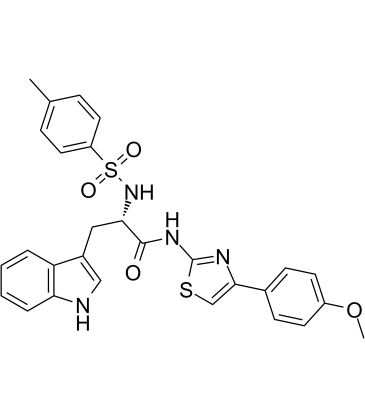
BC-DXI-843 is a potent and specific AIMP2-DX2 inhibitor with an IC50 of 0.92 μM, more than 100-fold selectivity over AIMP2 (IC50 >100 μM) in a luciferase assay. BC-DXI-843 acts as a promising lead targeting AIMP2-DX2 in lung cancer.
Physicochemical Properties
| Molecular Formula | C28H26N4O4S2 |
| Molecular Weight | 546.66 |
| Exact Mass | 546.139 |
| Elemental Analysis | C, 61.52; H, 4.79; N, 10.25; O, 11.71; S, 11.73 |
| CAS # | 2421117-98-6 |
| Related CAS # | 2421117-98-6 |
| PubChem CID | 146673132 |
| Appearance | Solid powder |
| Density | 1.4±0.1 g/cm3 |
| Index of Refraction | 1.679 |
| LogP | 5.89 |
| Hydrogen Bond Donor Count | 3 |
| Hydrogen Bond Acceptor Count | 7 |
| Rotatable Bond Count | 9 |
| Heavy Atom Count | 38 |
| Complexity | 884 |
| Defined Atom Stereocenter Count | 1 |
| SMILES | O=C([C@H](CC1C2C=CC=CC=2NC=1)NS(=O)(C1C=CC(C)=CC=1)=O)NC1SC=C(C2C=CC(OC)=CC=2)N=1 |
| InChi Key | VLPGAOXBMXGNGM-VWLOTQADSA-N |
| InChi Code | InChI=1S/C28H26N4O4S2/c1-18-7-13-22(14-8-18)38(34,35)32-25(15-20-16-29-24-6-4-3-5-23(20)24)27(33)31-28-30-26(17-37-28)19-9-11-21(36-2)12-10-19/h3-14,16-17,25,29,32H,15H2,1-2H3,(H,30,31,33)/t25-/m0/s1 |
| Chemical Name | (S)-3-(1H-Indol-3-yl)-N-(4-(4-methoxyphenyl)thiazol-2-yl)-2-(4-methylphenylsulfonamido)propanamide |
| Synonyms | BCDXI843 BCDXI-843 BCDXI 843 BC-DXI-843 BC-DXI843 BC-DXI 843 |
| HS Tariff Code | 2934.99.9001 |
| Storage |
Powder-20°C 3 years 4°C 2 years In solvent -80°C 6 months -20°C 1 month Note: This product requires protection from light (avoid light exposure) during transportation and storage. |
| Shipping Condition | Room temperature (This product is stable at ambient temperature for a few days during ordinary shipping and time spent in Customs) |
Biological Activity
| Targets |
BC-DXI-843 targets the interaction between AIMP2-DX2 (a splice variant of AIMP2) and AIMP2, with an IC50 value of 0.5 μM for inhibiting their binding [1] |
| ln Vitro |
In a DX2-dependent way, BC-DXI-843 (0.0316-31.6 μM; 72 hours) inhibits the growth of cancer cells. In A549 cells, the EC50 was 1.20 μM, which is comparable to the IC50 for DX2 inhibition. On WI-26 cells, however, no inhibitory impact was seen, indicating that BC-DXI-843 exclusively lowers cancer cell viability [1]. Against a panel of human cancer cell lines with high AIMP2-DX2 expression (HCT116 colorectal cancer, MDA-MB-231 breast cancer, Hep3B hepatocellular carcinoma, PC-3 prostate cancer), BC-DXI-843 exhibited potent antiproliferative activity with IC50 values of 0.8 μM, 1.2 μM, 1.5 μM, and 1.1 μM, respectively, after 72 hours of treatment [1] - Co-immunoprecipitation (Co-IP) assay showed that BC-DXI-843 (1 μM, 24 h) dose-dependently inhibited the interaction between AIMP2-DX2 and AIMP2 in HCT116 cells, restoring the stability and functional expression of AIMP2 [1] - Western blot analysis revealed that BC-DXI-843 (1 μM, 24 h) upregulated the expression of pro-apoptotic proteins (Bax, cleaved caspase-3, cleaved PARP) and downregulated anti-apoptotic protein Bcl-2 in HCT116 cells [1] - Flow cytometry analysis indicated that BC-DXI-843 (2 μM, 48 h) induced apoptosis in HCT116 cells, with the apoptotic rate increasing from ~3% (control) to ~38% [1] - BC-DXI-843 (1 μM, 7 days) significantly inhibited colony formation of HCT116 and MDA-MB-231 cells, reducing colony numbers by ~65% and ~58%, respectively, compared to the control group [1] - The compound did not inhibit the proliferation of normal human foreskin fibroblasts (NHDF) or normal human mammary epithelial cells (HMEC) at concentrations up to 10 μM, indicating selective cytotoxicity toward cancer cells [1] |
| ln Vivo |
A tumor xenograft mouse model (using H460 cells) showed the in vivo efficacy of BC-DXI-843 (50 mg/kg; intraperitoneally; every other day for 15 days) [1]. In the HCT116 colorectal cancer xenograft model in nude mice, oral administration of BC-DXI-843 at 10 mg/kg, 30 mg/kg, and 60 mg/kg once daily for 21 days resulted in tumor growth inhibition (TGI) rates of 42%, 67%, and 82%, respectively [1] - BC-DXI-843 (60 mg/kg, oral) reduced tumor weight from ~1.3 g (vehicle control) to ~0.23 g, without causing significant body weight loss (≤4%) or obvious toxicity signs [1] - Immunohistochemical (IHC) staining of tumor tissues showed that BC-DXI-843 (60 mg/kg) increased AIMP2 protein expression, upregulated cleaved caspase-3 levels, and decreased AIMP2-DX2/AIMP2 interaction (detected by proximity ligation assay) [1] |
| Enzyme Assay |
FRET-based binding inhibition assay was used to evaluate the effect of BC-DXI-843 on AIMP2-DX2/AIMP2 interaction. Recombinant AIMP2 was labeled with a donor fluorophore, and AIMP2-DX2 was labeled with an acceptor fluorophore. The reaction mixture contained the labeled proteins and serial dilutions of BC-DXI-843, incubated at 25°C for 30 minutes. FRET signal intensity was measured (excitation 485 nm, emission 535 nm), and IC50 values were calculated by fitting the dose-response curves of FRET signal reduction [1] |
| Cell Assay |
Cell proliferation experiment [1] Cell Types: A549 cancer cells and WI-26 normal cells Tested Concentrations: 0.0316, 0.1, 0.316, 1, 3.16, 10, 31.6 μM Incubation Duration: 72 hrs (hours) Experimental Results: EC50 in A549 cells is 1.20 μM. No inhibition of WI-26 cells was observed. Antiproliferative assay: Cancer cells (HCT116, MDA-MB-231, Hep3B, PC-3) or normal cells (NHDF, HMEC) were seeded in 96-well plates at 3×10³ cells/well and incubated overnight. Serial dilutions of BC-DXI-843 were added, and cells were cultured for 72 hours. Cell viability was assessed using a tetrazolium salt-based colorimetric assay, and IC50 values were determined [1] - Co-IP assay: HCT116 cells were seeded in 10 cm dishes and treated with BC-DXI-843 at different concentrations for 24 hours. Cells were lysed, and cell extracts were incubated with anti-AIMP2 antibody overnight. The immunocomplex was captured with protein A/G beads, separated by SDS-PAGE, and probed with anti-AIMP2-DX2 and anti-AIMP2 antibodies to detect their interaction [1] - Apoptosis assay: HCT116 cells were treated with BC-DXI-843 (2 μM) for 48 hours, harvested, and stained with Annexin V-FITC and propidium iodide (PI). Apoptotic cells were detected and quantified using flow cytometry [1] - Colony formation assay: HCT116 or MDA-MB-231 cells were seeded in 6-well plates at 500 cells/well and treated with BC-DXI-843 (1 μM) for 7 days. Colonies were fixed, stained with crystal violet, and counted to calculate the colony formation inhibition rate [1] |
| Animal Protocol |
Animal/Disease Models: 7weeks old female BALB/cSLC-nu/nu (nude) mice carrying H460 cell xenografts [1] Doses: 50 mg/kg Route of Administration: intraperitoneally (ip) (ip); every other day for 15 days Experimental Results: After BC-DXI-843 administration, the embedded tumor volume gradually diminished, but the body weight did not change. The weight of the resected tumors diminished after the mice were sacrificed. HCT116 colorectal cancer xenograft model: Female nude mice (6-7 weeks old) were subcutaneously inoculated with 5×10⁶ HCT116 cells into the right flank. When tumors reached an average volume of 120 mm3, mice were randomly divided into four groups (n=8 per group): vehicle control, BC-DXI-843 10 mg/kg, 30 mg/kg, and 60 mg/kg. The compound was formulated in 0.5% carboxymethylcellulose sodium (CMC-Na) mixed with 0.1% Tween 80 aqueous solution and administered via oral gavage once daily for 21 consecutive days. Tumor volume (length × width2 / 2) and body weight were recorded every 3 days. At the end of the study, mice were euthanized, tumors were excised and weighed, and tumor tissues were collected for immunohistochemical staining [1] |
| ADME/Pharmacokinetics |
In mice, oral administration of BC-DXI-843 at 30 mg/kg resulted in a maximum plasma concentration (Cmax) of 2.1 μg/mL, area under the plasma concentration-time curve (AUC0-24h) of 15.8 μg·h/mL, and oral bioavailability of 53% [1] - The terminal half-life (t1/2) of BC-DXI-843 was 3.8 hours in mice after oral dosing [1] - In vitro metabolic stability studies using human liver microsomes showed a half-life of 96 minutes, indicating moderate metabolic stability [1] - Plasma protein binding of BC-DXI-843 was 90% in mouse plasma and 92% in human plasma [1] |
| Toxicity/Toxicokinetics |
In a 21-day repeated oral toxicity study in mice, BC-DXI-843 at doses up to 60 mg/kg did not cause significant body weight loss, mortality, or histopathological abnormalities in major organs (liver, kidney, heart, lung, spleen) [1] - No significant changes in hematological parameters (white blood cell count, red blood cell count, platelet count) or biochemical markers of liver/kidney function (ALT, AST, creatinine, urea nitrogen) were observed in treated mice compared to the control group [1] |
| References |
[1]. Synthesis and Structure-Activity Relationships of Arylsulfonamides as AIMP2-DX2 Inhibitors for the Development of a Novel Anticancer Therapy. J Med Chem. 2020 May 28;63(10):5139-5158. |
| Additional Infomation |
BC-DXI-843 is an arylsulfonamide-derived inhibitor of the AIMP2-DX2/AIMP2 interaction, developed as a novel anticancer agent [1] - Its mechanism of action involves disrupting the binding between AIMP2-DX2 and AIMP2, which restores the tumor-suppressive function of AIMP2 (including regulating cell cycle progression and inducing apoptosis) and inhibits the oncogenic activity of AIMP2-DX2 [1] - AIMP2-DX2 is overexpressed in various human cancers and contributes to tumorigenesis by sequestering AIMP2; BC-DXI-843 specifically targets this cancer-specific pathway, supporting its potential as a targeted anticancer therapy [1] |
Solubility Data
| Solubility (In Vitro) | DMSO : ~250 mg/mL (~457.32 mM) |
| Solubility (In Vivo) |
Solubility in Formulation 1: ≥ 2.08 mg/mL (3.80 mM) (saturation unknown) in 10% DMSO + 40% PEG300 +5% Tween-80 + 45% Saline (add these co-solvents sequentially from left to right, and one by one), clear solution. For example, if 1 mL of working solution is to be prepared, you can add 100 μL of 20.8 mg/mL clear DMSO stock solution to 400 μL PEG300 and mix evenly; then add 50 μL Tween-80 + to the above solution and mix evenly; then add 450 μL normal saline to adjust the volume to 1 mL. Preparation of saline: Dissolve 0.9 g of sodium chloride in 100 mL ddH₂ O to obtain a clear solution. (Please use freshly prepared in vivo formulations for optimal results.) |
| Preparing Stock Solutions | 1 mg | 5 mg | 10 mg | |
| 1 mM | 1.8293 mL | 9.1465 mL | 18.2929 mL | |
| 5 mM | 0.3659 mL | 1.8293 mL | 3.6586 mL | |
| 10 mM | 0.1829 mL | 0.9146 mL | 1.8293 mL |