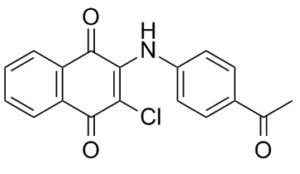
NQ301 is a synthetic 1,4-naphthoquinone derivative that acts as a selective CD45 inhibitor, displaying potent antithrombotic/antiplatelet activity. It exerts its antiplatelet activity by inhibiting collagen-challenged rabbit platelet aggregation with IC50 of 10 mg/mL.
Physicochemical Properties
| Molecular Formula | C18H12CLNO3 | |
| Molecular Weight | 325.75 | |
| Exact Mass | 325.051 | |
| CAS # | 130089-98-4 | |
| Related CAS # |
|
|
| PubChem CID | 781109 | |
| Appearance | White to off-white solid powder | |
| LogP | 2.9 | |
| Hydrogen Bond Donor Count | 1 | |
| Hydrogen Bond Acceptor Count | 4 | |
| Rotatable Bond Count | 3 | |
| Heavy Atom Count | 23 | |
| Complexity | 561 | |
| Defined Atom Stereocenter Count | 0 | |
| InChi Key | LSQZKIQSQHZVQS-UHFFFAOYSA-N | |
| InChi Code | InChI=1S/C18H12ClNO3/c1-10(21)11-6-8-12(9-7-11)20-16-15(19)17(22)13-4-2-3-5-14(13)18(16)23/h2-9,20H,1H3 | |
| Chemical Name |
|
|
| Synonyms |
|
|
| HS Tariff Code | 2934.99.9001 | |
| Storage |
Powder-20°C 3 years 4°C 2 years In solvent -80°C 6 months -20°C 1 month |
|
| Shipping Condition | Room temperature (This product is stable at ambient temperature for a few days during ordinary shipping and time spent in Customs) |
Biological Activity
| Targets |
"[1]. Synthesis, Biochemistry, and Computational Studies of Brominated Thienyl Chalcones: A New Class of Reversible MAO-B Inhibitors. ChemMedChem. 2016 Jun 6;11(11):1161-71.
链接: https://www.ncbi.nlm.nih.gov/pubmed/27159243
请找到上述文章的全文(比如从https://pubmed.ncbi.nlm.nih.gov/ 或者出版社原文), 随后将这些文章中关于 TB5 这个药物的体内外药理/生物活性、药物代谢性质、毒性及相关实验流程按照下面的详细要求提炼出来。
一、提取信息的详细要求(请仔细阅读,完全按照下述要求来提取):
1)一定要阅读全文,不能只看摘要;
2)提取的信息分成英文(全英文)和中文两个版本;
3)字段如果文献未描述,就不用列出来;
4) 将药物名称嵌入加粗代码, 如药物名称;
5) 来自不同文献的内容后面加上参考文献及分行代码如 “[1] ”或“[2] 等”; 6)同一个字段里面如果有几种不同的内容或实验步骤描述,请在不同内容或实验步骤之间插入分隔符 ; 7) IC50、Ki、EC50、给药浓度/剂量等数值信息必须准确,如果不确定,宁可不提供; 8)仅提取指定文献里包含的此药物信息,不要将其他文献的信息放进来; 8)也不要引用指定文献之外的其他文献; 9)请务必准确、实事求是和详细,不要凭空捏造和幻想。一定不要提供不存在的假数据,我要的是真实数据,有就是有,没有就没有。 二、要提取的字段及具体要求按照如下格式(请仔细阅读,完全按照下述要求来提取): Target: 提炼出这个药物的作用靶点/靶标,并将不同靶标的IC50、Ki、EC50等信息放在括号里面(这些数据也不能造假,文献说是多少就是多少,不要瞎编和推测);不同文献的靶点用 分开。 In Vitro:描述体外活性的详细实验结果(如抗增殖活性、酶/靶点活性、细胞活性、western blot, PCR、免疫组织化学、凋亡、克隆形成、作用机制等;数据不能造假,文献说是多少就是多少,不要瞎编和推测), 不同的体外实验结果分别描述,详细描述; 不同文献的内容/描述后面加上参考文献及分行代码如 “[1] ”或“[2] 等。 In Vivo:描述体内活性的详细实验结果(如体内药效、作用机制等;数据不能造假,文献说是多少就是多少,不要瞎编和推测), 不同的体内实验结果分别描述,详细描述; 不同文献的内容/描述后面加上参考文献及分行代码如 “[1] ”或“[2] 等。 Enzyme Assay: 关于酶(或者蛋白/受体)活性实验 或者靶点结合实验(如激酶活性、SPR、ITC、HTRF等;数据不能造假,文献说是多少就是多少,不要瞎编和推测)的详细流程描述 (在原描述的基础上改变说法重新描述,不要只提取一两句话), 不同的实验分别描述,详细描述,不同实验之间嵌入分行代码 ;另外,不要出现试剂/药物的供应商的名称; 不同文献的内容/描述后面加上参考文献及分行代码如 “[1] ”或“[2] 等。 Cell Assay: 关于细胞实验(如抗增殖、Cell viability/antiproliferative, western blot, PCR、免疫组织化学、凋亡、克隆形成实验等;数据不能造假,文献说是多少就是多少,不要瞎编和推测)详细流程的描述(在原描述的基础上改变说法重新描述,不要只提取一两句话), 不同的细胞实验分别描述,详细描述,不同实验之间嵌入分行代码 ;另外,不要出现试剂/药物的供应商的名称; 不同文献的内容/描述后面加上参考文献及分行代码如 “[1] ”或“[2] 等。 Animal Protocol: 关于动物实验(如体内药效实验、体内药代实验等)详细流程的描述(在原描述的基础上改变说法重新描述,不要只提取一两句话), 包括药物溶解配方/剂型、给药频率、途径等(数据不能造假,文献说是多少就是多少,不要瞎编和推测);不同的动物实验分别描述,详细描述,不同实验之间嵌入分行代码 ;另外,不要出现试剂/药物的供应商的名称; 不同文献的内容/描述后面加上参考文献及分行代码如 “[1] ”或“[2] 等。 ADME/Pharmacokinetics:关于这个药物的体内外药物代谢特征(PK性质),如吸收、分布、代谢、排泄、半衰期、口服生物利用度等参数(数据不能造假,文献说是多少就是多少,不要瞎编和推测),不同的ADME性质分别描述,详细描述,不同的药代参数之间嵌入分行代码 ; 不同文献的内容/描述后面加上参考文献及分行代码如 “[1] ”或“[2] 等。 Toxicity/Toxicokinetics:关于这个药物的体内外毒性/副作用信息,如半数致死量、肝肾毒性、药物药物相互作用、血浆蛋白结合度(protein binding)等(数据不能造假,文献说是多少就是多少,不要瞎编和推测),不同的性质分别描述,详细描述; 不同文献的内容/描述后面加上参考文献及分行代码如 “[1] ”或“[2] 等。 Additional Info:除了上述信息之外的其他和这个药物相关的信息,如背景介绍、作用机制、疗效、适应症、FDA警示信息,不同类别信息分别描述,详细描述; 不同文献的内容/描述后面加上参考文献及分行代码如 “[1] ”或“[2] 等。" |
| ln Vitro |
Rabbit platelet aggregation in response to collagen (10 mg/mL), U46619 (1 mg/mL), and arachidonic acid (100 mg/mL) challenges is inhibited by NQ301, with concentration-dependent IC50 values of 0.60±0.02, 0.58±0.04, and 0.78 ±0.04 μM, respectively. NQ301 has a concentration-dependent, potent suppression of thromboxane B2 formation by platelets exposed to arachidonic acid, but no effect on prostaglandin D2 production, suggesting that thromboxane A2 synthase is inhibited. In addition to modulating arachidonic acid liberation potential and the formation of 12-hydroxy-5,8,10,14-eicosatetraenoic acid in platelets, NQ301 has the ability to inhibit thromboxane A2 synthase activity through thromboxane A2/prostaglandin H2 receptor blockade[1]. Rather than directly preventing fibrinogen-GPIIb/IIIa complex binding, NQ301 suppresses the intracellular pathway to prevent platelet aggregation. In addition to markedly raising platelet cAMP levels in activated platelets, NQ301 also significantly reduces the rise in ATP secretion and cytosolic Ca2+ concentration. NQ301's antiplatelet action may be mediated by enhancing the production of cAMP, inhibiting ATP secretion in activated platelets, and blocking cytosolic Ca2+ mobilization[2]. Inhibition of TXA2 receptor and synthase in rabbit platelets: NQ301 (0.1-10 μM) exerted a dose-dependent inhibitory effect on the binding of [³H]-SQ29548 to TXA2 receptors in rabbit platelet membranes, achieving a maximum inhibition rate of ~90% at 10 μM. It also dose-dependently reduced TXA2 generation (measured as TXB2, a stable metabolite of TXA2) in rabbit platelets stimulated with arachidonic acid (100 μM); at 10 μM, NQ301 inhibited TXB2 production by ~85%. Additionally, NQ301 (0.1-10 μM) dose-dependently suppressed platelet aggregation induced by U46619 (a TXA2 mimetic, 0.1 μM), with an IC₅₀ of ~1.5 μM [1] - Antiplatelet effect via inhibiting intracellular Ca²⁺ mobilization in rabbit platelets: NQ301 (0.3-30 μM) dose-dependently inhibited platelet aggregation induced by various agonists: thrombin (0.1 U/mL, IC₅₀ ~3.2 μM), A23187 (a Ca²⁺ ionophore, 1 μM, IC₅₀ ~4.5 μM), and collagen (1 μg/mL, IC₅₀ ~5.1 μM). Using Fura-2/AM-loaded platelets, NQ301 (10 μM) significantly reduced thrombin-induced intracellular Ca²⁺ elevation: it inhibited Ca²⁺ release from intracellular stores by ~60% and Ca²⁺ influx by ~55%. It also attenuated A23187-induced Ca²⁺ elevation by ~40% but had no impact on Ca²⁺-independent platelet aggregation induced by phorbol 12-myristate 13-acetate (PMA, 0.1 μM) [2] |
| ln Vivo |
Antithrombotic effect in rat FeCl₃-induced carotid artery thrombosis model: Male Wistar rats (250-300 g) were used. Intravenous administration of NQ301 at doses of 0.3, 1, and 3 mg/kg dose-dependently decreased thrombus weight. Compared with the control group (thrombus weight ~4.2 mg), the thrombus weights in the 0.3 mg/kg, 1 mg/kg, and 3 mg/kg groups were ~3.1 mg, ~2.0 mg, and ~1.2 mg, respectively. NQ301 (3 mg/kg, iv) prolonged bleeding time by ~1.5-fold compared to the control group, while it did not significantly affect mean arterial blood pressure (MABP) or heart rate (HR) [1] |
| Enzyme Assay |
TXA2 synthase activity assay: Rabbit platelets were homogenized and centrifuged to obtain the microsomal fraction (serving as the enzyme source). The reaction mixture contained the microsomal fraction, arachidonic acid (substrate), and different concentrations of NQ301 (0.01-100 μM). The mixture was incubated at 37°C for 15 minutes, and the reaction was terminated by adding ice-cold methanol. The concentration of TXB2 (a stable metabolite of TXA2) in the mixture was measured using a specific radioimmunoassay (RIA) kit. The IC₅₀ for TXA2 synthase inhibition was calculated by plotting the percentage of TXB2 generation (relative to the control group) against the concentration of NQ301 [1] - TXA2 receptor binding assay: Rabbit platelet membranes were prepared by homogenization and centrifugation. The binding reaction was conducted in a buffer containing the platelet membrane fraction, [³H]-SQ29548 (a specific TXA2 receptor ligand, 0.5 nM), and various concentrations of NQ301 (0.01-100 μM). Non-specific binding was determined by adding an excess of unlabeled SQ29548 (10 μM). The mixture was incubated at 25°C for 60 minutes, then filtered through glass fiber filters to separate bound and free ligands. The radioactivity on the filters was counted using a liquid scintillation counter, and the Ki value of NQ301 was calculated using the Cheng-Prusoff equation [1] |
| Cell Assay |
Rabbit platelet aggregation assay (for TXA2-related effects): Fresh rabbit blood was collected and mixed with 3.8% sodium citrate at a volume ratio of 9:1 for anticoagulation. Platelet-rich plasma (PRP) was prepared by centrifuging the blood at 150 × g for 10 minutes, and platelet-poor plasma (PPP) was obtained by further centrifugation at 3000 × g for 15 minutes. The platelet count in PRP was adjusted to 3 × 10⁸ cells/mL using PPP. Platelet aggregation was measured using a turbidimeter at 37°C with constant stirring at 1000 rpm. PRP was preincubated with NQ301 (0.1-10 μM) for 5 minutes, then U46619 (0.1 μM) was added to induce aggregation. Aggregation was expressed as the percentage of maximum aggregation (with PPP as 0% aggregation and PRP as 100% aggregation), and the IC₅₀ was calculated from the dose-response curve [1] - Rabbit platelet aggregation assay (for Ca²⁺-related effects): Rabbit PRP was prepared as described above. NQ301 (0.3-30 μM) was added to PRP and preincubated at 37°C for 5 minutes. Aggregation was induced by adding thrombin (0.1 U/mL), A23187 (1 μM), or collagen (1 μg/mL), and measured using a turbidimeter. For PMA-induced aggregation, PRP was preincubated with NQ301 (10 μM) for 5 minutes, then PMA (0.1 μM) was added, and aggregation was monitored for 30 minutes [2] - Intracellular Ca²⁺ concentration measurement in rabbit platelets: Rabbit PRP was incubated with Fura-2/AM (5 μM) at 37°C for 30 minutes in the dark. Fura-2-loaded platelets were centrifuged and resuspended in either a Ca²⁺-containing buffer (with 1 mM CaCl₂) or a Ca²⁺-free buffer (with 1 mM EGTA). The fluorescence intensity was measured using a spectrofluorometer with excitation wavelengths of 340 nm and 380 nm, and an emission wavelength of 510 nm. NQ301 (1-30 μM) was added to the platelet suspension and incubated for 5 minutes, then thrombin (0.1 U/mL) or A23187 (1 μM) was added. The intracellular Ca²⁺ concentration was calculated based on the ratio of fluorescence intensities at 340 nm and 380 nm (F340/F380) [2] |
| Animal Protocol |
Rat FeCl₃-induced carotid artery thrombosis model: Male Wistar rats (250-300 g) were anesthetized with pentobarbital sodium (40 mg/kg, intraperitoneal injection). The right carotid artery was exposed, and a 2 mm segment of the artery was wrapped with filter paper soaked in 10% FeCl₃ solution for 5 minutes to induce thrombosis. NQ301 was dissolved in normal saline (0.9% NaCl) and administered intravenously via the tail vein at doses of 0.3, 1, or 3 mg/kg, 10 minutes before the application of FeCl₃ (the control group received normal saline alone). Two hours after FeCl₃ treatment, the rats were euthanized, and the segment of the carotid artery containing the thrombus was excised, blotted dry, and weighed. For bleeding time measurement, the tip of the rat's tail was transected 5 mm from the end, and the time until bleeding ceased (no visible bleeding for 30 seconds) was recorded before and after NQ301 administration. MABP and HR were monitored throughout the experiment via a cannulated femoral artery [1] |
| References |
[1]. An antithrombotic agent, NQ301, inhibits thromboxane A2 receptor and synthase activity in rabbit platelets. Basic Clin Pharmacol Toxicol. 2005 Sep;97(3):162-7. [2]. Antiplatelet effect of 2-chloro-3-(4-acetophenyl)-amino-1,4-naphthoquinone (NQ301): a possible mechanism through inhibition of intracellular Ca2+ mobilization. Biol Pharm Bull. 2001 Jun;24(6):618-22. |
| Additional Infomation |
NQ301 is an antithrombotic agent with a dual mechanism of action: it simultaneously inhibits TXA2 receptor binding and TXA2 synthase activity in platelets. This dual inhibition avoids the potential "shunt" effect associated with single TXA2 synthase inhibitors (which may lead to the accumulation of prostaglandin H2 and activation of other pro-aggregatory receptors), thereby enhancing its antiplatelet and antithrombotic efficacy [1] - The antiplatelet effect of NQ301 is partially mediated by the inhibition of intracellular Ca²⁺ mobilization. It reduces both Ca²⁺ release from intracellular stores and Ca²⁺ influx across the plasma membrane, which are critical steps in platelet activation and aggregation. The lack of effect on PMA-induced (Ca²⁺-independent) platelet aggregation confirms that NQ301 specifically targets Ca²⁺-dependent pathways in platelets [2] |
Solubility Data
| Solubility (In Vitro) |
|
|||
| Solubility (In Vivo) |
Solubility in Formulation 1: 0.71 mg/mL (2.18 mM) in 10% DMSO + 40% PEG300 +5% Tween-80 + 45% Saline (add these co-solvents sequentially from left to right, and one by one), suspension solution; with sonication. For example, if 1 mL of working solution is to be prepared, you can add 100 μL of 7.1 mg/mL clear DMSO stock solution to 400 μL PEG300 and mix evenly; then add 50 μL Tween-80 + to the above solution and mix evenly; then add 450 μL normal saline to adjust the volume to 1 mL. Preparation of saline: Dissolve 0.9 g of sodium chloride in 100 mL ddH₂ O to obtain a clear solution. (Please use freshly prepared in vivo formulations for optimal results.) |
| Preparing Stock Solutions | 1 mg | 5 mg | 10 mg | |
| 1 mM | 3.0698 mL | 15.3492 mL | 30.6984 mL | |
| 5 mM | 0.6140 mL | 3.0698 mL | 6.1397 mL | |
| 10 mM | 0.3070 mL | 1.5349 mL | 3.0698 mL |