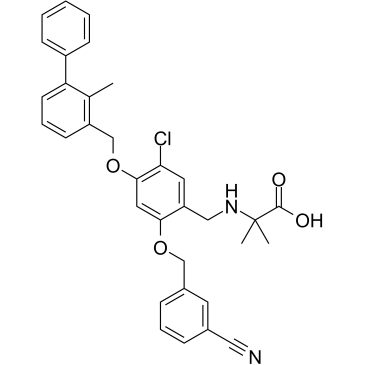
NP19 is a novel and potent inhibitor of the Programmed Cell Death-1/Programmed Cell Death-Ligand 1 (PD-1/PD-L1) Interaction with IC50 of 12 nM in homogeneous time-resolved fluorescence (HTRF) binding assays. NP19 dose-dependently elevated IFN-γ production in a coculture model of Hep3B/OS-8/hPD-L1 and CD3 T cells. Furthermore, NP19 displayed significant in vivo antitumor efficacy in two different mouse models of cancer (a melanoma B16-F10 tumor model and an H22 hepatoma tumor model). Moreover, H&E staining and flow cytometry data suggested that NP19 activated the immune microenvironment in the tumor, which may contribute to its antitumor effects. This work shows NP19 is a promising lead compound for further development as a new generation of small molecule inhibitors targeting the PD-1/PD-L1 pathway.
Physicochemical Properties
| Molecular Formula | C33H31CLN2O4 |
| Molecular Weight | 555.0632 |
| Exact Mass | 554.197 |
| CAS # | 2377916-66-8 |
| PubChem CID | 154573771 |
| Appearance | White to off-white solid powder |
| LogP | 4.5 |
| Hydrogen Bond Donor Count | 2 |
| Hydrogen Bond Acceptor Count | 6 |
| Rotatable Bond Count | 11 |
| Heavy Atom Count | 40 |
| Complexity | 853 |
| Defined Atom Stereocenter Count | 0 |
| SMILES | ClC1=C(C([H])=C(C(=C1[H])C([H])([H])N([H])C(C(=O)O[H])(C([H])([H])[H])C([H])([H])[H])OC([H])([H])C1C([H])=C([H])C([H])=C(C#N)C=1[H])OC([H])([H])C1C([H])=C([H])C([H])=C(C2C([H])=C([H])C([H])=C([H])C=2[H])C=1C([H])([H])[H] |
| InChi Key | YZPKZNFXWGTUGO-UHFFFAOYSA-N |
| InChi Code | InChI=1S/C33H31ClN2O4/c1-22-26(13-8-14-28(22)25-11-5-4-6-12-25)21-40-31-17-30(39-20-24-10-7-9-23(15-24)18-35)27(16-29(31)34)19-36-33(2,3)32(37)38/h4-17,36H,19-21H2,1-3H3,(H,37,38) |
| Chemical Name | 2-((5-Chloro-2-((3-cyanobenzyl)oxy)-4-((2-methyl-[1,1'-biphenyl]-3-yl)methoxy)benzyl)amino)-2-methylpropanoic acid |
| Synonyms | NP19 NP-19 NP 19 |
| HS Tariff Code | 2934.99.9001 |
| Storage |
Powder-20°C 3 years 4°C 2 years In solvent -80°C 6 months -20°C 1 month |
| Shipping Condition | Room temperature (This product is stable at ambient temperature for a few days during ordinary shipping and time spent in Customs) |
Biological Activity
| ln Vitro | Compound NP19, also known as PD-1/PD-L1-IN-NP19 (0.37-10 μM; 72 h), significantly and dose-dependently increases the amount of IFN-γ produced by T cells co-cultured with tumor cells[1]. The activity of PD-1/PD-L1-IN-NP19 to inhibit mice is substantially decreased. inhibition of the human PD1/PD-L1 connection (IC50=12.5 nM) is smaller than that of the PD-1/PD-L1 interaction, with an IC50 in the micromolar range (>1µM)[1]. When PD-1/PD-L1-IN-NP19 (10 µM; 48 h) is added to A549, MCF-7, and B16-F10 cells, no discernible cytotoxic effects are seen[1]. |
| ln Vivo | Compound NP19, also known as PD-1/PD-L1-IN-NP19 (25-100 mg/kg; intragastric gavage once daily for 15 days) significantly suppresses the formation of melanoma tumors in mice[1]. In an H22 hepatoma mouse model, PD-1/PD-L1-IN-NP19 (25 mg/kg; intraperitoneally every day for 14 days) exhibits strong anticancer activity with a tumor growth inhibition (TGI) of 76.5% and is well tolerated[1]. Rats' half time (t1/2=1.5±0.5 h), clearance rate (CL=0.9±0.2 L/h/kg), and apparent distribution volume (Vss = 2.1±0.5 L/kg) are displayed in PD-1/PD-L1-IN-NP19 (1 mg/kg; iv)[1]. Rats' oral absorption (Tmax=0.6±0.2 h), long half-life (t1/2=10.9±7.7 h), and oral bioavailability (F=5%) are demonstrated by PD-1/PD-L1-IN-NP19 (10 mg/kg; po)[1]. |
| Animal Protocol |
Animal/Disease Models: balb/c (Bagg ALBino) mouse (6-8 weeks) with B16-F10 melanoma tumors[1] Doses: 25 , 50, 100 mg/kg Route of Administration: intragastric (po) gavage one time/day for 15 days Experimental Results: Inhibited the growth of melanoma tumors up to 51.1, 75 and 80.9% at dose of 25, 50, 100 mg/kg, respectively. demonstrated normal physical activity and increased body weights slightly. Animal/Disease Models: Male SD (Sprague-Dawley) rats[1] Doses: 1 mg/kg for iv and 10 mg/kg for po (pharmacokinetic/PK Analysis) Route of Administration: Iv and po Experimental Results: Iv: t1/2=1.5 h; Cmax=1751 μg/L; CL=0.9 L/h/kg. Po: t1/2=10.9 h; Cmax=69.5 μg/L; CL=23.1 L/h/kg. |
| References |
[1]. Discovery of Novel Resorcinol Dibenzyl Ethers Targeting the Programmed Cell Death-1/Programmed Cell Death-Ligand 1 Interaction As Potential Anticancer Agents. J Med Chem. 2020 Jul 15. |
Solubility Data
| Solubility (In Vitro) | DMSO : ~2 mg/mL (~3.60 mM) |
| Solubility (In Vivo) |
Note: Listed below are some common formulations that may be used to formulate products with low water solubility (e.g. < 1 mg/mL), you may test these formulations using a minute amount of products to avoid loss of samples. Injection Formulations (e.g. IP/IV/IM/SC) Injection Formulation 1: DMSO : Tween 80: Saline = 10 : 5 : 85 (i.e. 100 μL DMSO stock solution → 50 μL Tween 80 → 850 μL Saline) *Preparation of saline: Dissolve 0.9 g of sodium chloride in 100 mL ddH ₂ O to obtain a clear solution. Injection Formulation 2: DMSO : PEG300 :Tween 80 : Saline = 10 : 40 : 5 : 45 (i.e. 100 μL DMSO → 400 μLPEG300 → 50 μL Tween 80 → 450 μL Saline) Injection Formulation 3: DMSO : Corn oil = 10 : 90 (i.e. 100 μL DMSO → 900 μL Corn oil) Example: Take the Injection Formulation 3 (DMSO : Corn oil = 10 : 90) as an example, if 1 mL of 2.5 mg/mL working solution is to be prepared, you can take 100 μL 25 mg/mL DMSO stock solution and add to 900 μL corn oil, mix well to obtain a clear or suspension solution (2.5 mg/mL, ready for use in animals). Injection Formulation 4: DMSO : 20% SBE-β-CD in saline = 10 : 90 [i.e. 100 μL DMSO → 900 μL (20% SBE-β-CD in saline)] *Preparation of 20% SBE-β-CD in Saline (4°C,1 week): Dissolve 2 g SBE-β-CD in 10 mL saline to obtain a clear solution. Injection Formulation 5: 2-Hydroxypropyl-β-cyclodextrin : Saline = 50 : 50 (i.e. 500 μL 2-Hydroxypropyl-β-cyclodextrin → 500 μL Saline) Injection Formulation 6: DMSO : PEG300 : castor oil : Saline = 5 : 10 : 20 : 65 (i.e. 50 μL DMSO → 100 μLPEG300 → 200 μL castor oil → 650 μL Saline) Injection Formulation 7: Ethanol : Cremophor : Saline = 10: 10 : 80 (i.e. 100 μL Ethanol → 100 μL Cremophor → 800 μL Saline) Injection Formulation 8: Dissolve in Cremophor/Ethanol (50 : 50), then diluted by Saline Injection Formulation 9: EtOH : Corn oil = 10 : 90 (i.e. 100 μL EtOH → 900 μL Corn oil) Injection Formulation 10: EtOH : PEG300:Tween 80 : Saline = 10 : 40 : 5 : 45 (i.e. 100 μL EtOH → 400 μLPEG300 → 50 μL Tween 80 → 450 μL Saline) Oral Formulations Oral Formulation 1: Suspend in 0.5% CMC Na (carboxymethylcellulose sodium) Oral Formulation 2: Suspend in 0.5% Carboxymethyl cellulose Example: Take the Oral Formulation 1 (Suspend in 0.5% CMC Na) as an example, if 100 mL of 2.5 mg/mL working solution is to be prepared, you can first prepare 0.5% CMC Na solution by measuring 0.5 g CMC Na and dissolve it in 100 mL ddH2O to obtain a clear solution; then add 250 mg of the product to 100 mL 0.5% CMC Na solution, to make the suspension solution (2.5 mg/mL, ready for use in animals). Oral Formulation 3: Dissolved in PEG400 Oral Formulation 4: Suspend in 0.2% Carboxymethyl cellulose Oral Formulation 5: Dissolve in 0.25% Tween 80 and 0.5% Carboxymethyl cellulose Oral Formulation 6: Mixing with food powders Note: Please be aware that the above formulations are for reference only. InvivoChem strongly recommends customers to read literature methods/protocols carefully before determining which formulation you should use for in vivo studies, as different compounds have different solubility properties and have to be formulated differently. (Please use freshly prepared in vivo formulations for optimal results.) |
| Preparing Stock Solutions | 1 mg | 5 mg | 10 mg | |
| 1 mM | 1.8016 mL | 9.0080 mL | 18.0161 mL | |
| 5 mM | 0.3603 mL | 1.8016 mL | 3.6032 mL | |
| 10 mM | 0.1802 mL | 0.9008 mL | 1.8016 mL |