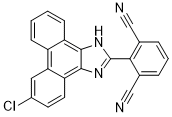
MF-63 is a novel and selective mPGES-1 inhibitor. MF63 potently inhibited the human mPGES-1 enzyme (IC(50) = 1.3 nM), with a high degree (>1000-fold) of selectivity over other prostanoid synthases. In rodent species, MF63 strongly inhibited guinea pig mPGES-1 (IC(50) = 0.9 nM) but not the mouse or rat enzyme. MF63 did not cause NSAID-like gastrointestinal toxic effects, such as mucosal erosions or leakage in the KI mice or nonhuman primates, although it markedly inhibited PGE(2) synthesis in the KI mouse stomach.
Physicochemical Properties
| Molecular Formula | C23H11CLN4 |
| Molecular Weight | 378.82 |
| Exact Mass | 378.067 |
| CAS # | 892549-43-8 |
| Related CAS # | 892549-43-8; |
| PubChem CID | 16070041 |
| Appearance | Light yellow to yellow solid powder |
| LogP | 5.933 |
| Hydrogen Bond Donor Count | 1 |
| Hydrogen Bond Acceptor Count | 3 |
| Rotatable Bond Count | 1 |
| Heavy Atom Count | 28 |
| Complexity | 667 |
| Defined Atom Stereocenter Count | 0 |
| InChi Key | BVFLHOOKHPFDCT-UHFFFAOYSA-N |
| InChi Code | InChI=1S/C23H11ClN4/c24-15-8-9-18-19(10-15)16-6-1-2-7-17(16)21-22(18)28-23(27-21)20-13(11-25)4-3-5-14(20)12-26/h1-10H,(H,27,28) |
| Chemical Name | 2-(6-chloro-1H-phenanthro[9,10-d]imidazol-2-yl)-isophthalonitrile |
| Synonyms | MF-63 MF63 MF 63 |
| HS Tariff Code | 2934.99.9001 |
| Storage |
Powder-20°C 3 years 4°C 2 years In solvent -80°C 6 months -20°C 1 month |
| Shipping Condition | Room temperature (This product is stable at ambient temperature for a few days during ordinary shipping and time spent in Customs) |
Biological Activity
| ln Vitro | MF63 (0.01-100 µM; 24 h) promotes PGF2α creation in a dose-dependent manner and inhibits 10 ng/mL IL-1β-induced PGE2 synthesis in A549 cells [1]. possesses anti-inflammatory properties and increases the production of various metalloprotein 1 (MT1) isoforms and endogenous antagonists of IL-1 and IL-36 [2]. |
| ln Vivo | MF63 (100 mg/kg; mouse brain; single dosage) suppresses PEG2 production in a dose-dependent manner and decreases the accumulation of PEG2 in the head and brain of KI (mPGES-1 knock-in) mice [1]. A single dose of MF63 (0-150 mg/kg; lateral wall) reduces the dose-dependent hyperalgesia caused by LPS in KI mice [1]. MF63 (0-150 mg/kg; side wall; single dosage) reduces chronic osteoarthritis-like pain, causes hyperalgesia, fever, and PEG2 production [1]. MF63 (0–100 mg/kg; bucally; twice daily for four days) in non-human primates and KI mimics |
| Animal Protocol |
Animal/Disease Models: 10 to 12 weeks of KI and wild-type mice injected with LPS [1]. Animals with gastrointestinal tolerance. Doses: 10 mg/kg and 100 mg/kg. Route of Administration: po (oral gavage); single dose. Experimental Results: Inhibited the accumulation of PGE2 in the air sac and brain of KI mice in a dose-dependent manner and selectively in the brain. Hyperalgesia was diminished by 50% at the 10 mg/kg dose and 80% at the 100 mg/kg dose in KI mice, but had no effect in wild-type mice. Animal/Disease Models: Young male Hartley guinea pig (~250 g) with osteoarthritis pain [1]. Doses: 0, 3, 10, 15, 30, 50, 100 or 150mg/kg. Route of Administration: po (oral gavage); single dose. Experimental Results: Inhibited PGE2 formation, alleviated chronic osteoarthritis-like pain and suppressed fever in a dose-dependent manner. Animal/Disease Models: 10 to 12 weeks old KI mice and non-human primates [1]. Doses: 0, 3, 10, 30 or 100mg/kg. Route of Administration: po (oral gavage); twice (two times) daily for 4 days. Experimental Results: There was no gastrointestinal toxicity in KI mice and non-human primates. |
| References |
[1]. MF63 [2-(6-chloro-1H-phenanthro[9,10-d]imidazol-2-yl)-isophthalonitrile] a selective microsomal prostaglandin E synthase-1 inhibitor, relieves pyresis and pain in preclinical models of inflammation. J Pharmacol Exp Ther. 2008 Sep;326(3):754-63. [2]. Regulation of gene expression by MF63, a selective inhibitor of microsomal PGE synthase 1 (mPGES1) in human osteoarthritic chondrocytes. Br J Pharmacol. 2020 Sep;177(18):4134-4146. |
Solubility Data
| Solubility (In Vitro) | DMSO : ~75 mg/mL (~197.99 mM) |
| Solubility (In Vivo) |
Solubility in Formulation 1: ≥ 2.5 mg/mL (6.60 mM) (saturation unknown) in 10% DMSO + 40% PEG300 + 5% Tween80 + 45% Saline (add these co-solvents sequentially from left to right, and one by one), clear solution. For example, if 1 mL of working solution is to be prepared, you can add 100 μL of 25.0 mg/mL clear DMSO stock solution to 400 μL PEG300 and mix evenly; then add 50 μL Tween-80 to the above solution and mix evenly; then add 450 μL normal saline to adjust the volume to 1 mL. Preparation of saline: Dissolve 0.9 g of sodium chloride in 100 mL ddH₂ O to obtain a clear solution. Solubility in Formulation 2: ≥ 2.5 mg/mL (6.60 mM) (saturation unknown) in 10% DMSO + 90% Corn Oil (add these co-solvents sequentially from left to right, and one by one), clear solution. For example, if 1 mL of working solution is to be prepared, you can add 100 μL of 25.0 mg/mL clear DMSO stock solution to 900 μL of corn oil and mix evenly. (Please use freshly prepared in vivo formulations for optimal results.) |
| Preparing Stock Solutions | 1 mg | 5 mg | 10 mg | |
| 1 mM | 2.6398 mL | 13.1989 mL | 26.3978 mL | |
| 5 mM | 0.5280 mL | 2.6398 mL | 5.2796 mL | |
| 10 mM | 0.2640 mL | 1.3199 mL | 2.6398 mL |