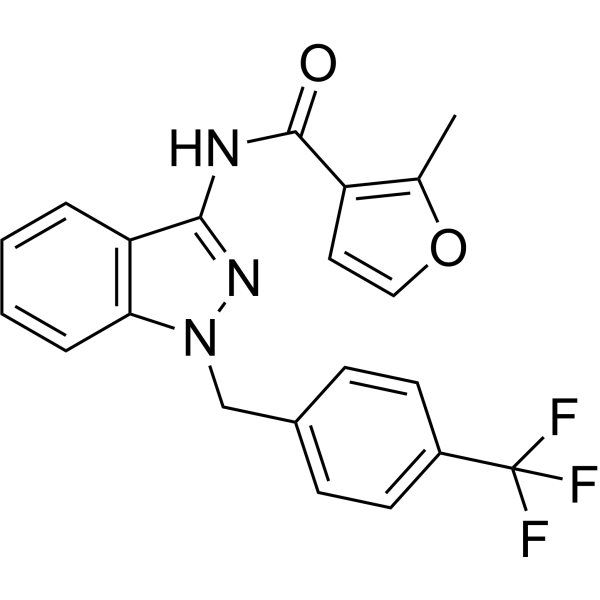
Physicochemical Properties
| Molecular Formula | C21H16F3N3O2 |
| Molecular Weight | 399.3732 |
| Exact Mass | 399.119 |
| CAS # | 1807454-59-6 |
| PubChem CID | 91844684 |
| Appearance | Off-white to light yellow solid powder |
| Density | 1.36±0.1 g/cm3(Predicted) |
| Boiling Point | 470.5±45.0 °C(Predicted) |
| LogP | 4.7 |
| Hydrogen Bond Donor Count | 1 |
| Hydrogen Bond Acceptor Count | 6 |
| Rotatable Bond Count | 4 |
| Heavy Atom Count | 29 |
| Complexity | 580 |
| Defined Atom Stereocenter Count | 0 |
| InChi Key | XLLRLAABUFOJPC-UHFFFAOYSA-N |
| InChi Code | InChI=1S/C21H16F3N3O2/c1-13-16(10-11-29-13)20(28)25-19-17-4-2-3-5-18(17)27(26-19)12-14-6-8-15(9-7-14)21(22,23)24/h2-11H,12H2,1H3,(H,25,26,28) |
| Chemical Name | 2-methyl-N-[1-[[4-(trifluoromethyl)phenyl]methyl]indazol-3-yl]furan-3-carboxamide |
| Synonyms | NPG2-044; NP G2-044; NP-G2-044 |
| HS Tariff Code | 2934.99.9001 |
| Storage |
Powder-20°C 3 years 4°C 2 years In solvent -80°C 6 months -20°C 1 month |
| Shipping Condition | Room temperature (This product is stable at ambient temperature for a few days during ordinary shipping and time spent in Customs) |
Biological Activity
| ln Vitro | MDA-MB-231 tumor cells' motility is inhibited by NP-G2-044, with an IC50 of less than 10 μM. Filopodia development is decreased by NP-G2-044, which also decreases lamellipodia production [1]. |
| ln Vivo | In mouse models, NP-G2-044 (100 mg/kg; intraperitoneally; once daily for 18 days) prevents the spread of breast tumors [1]. NP-G2-044 binds to myofacundum after terminating at the lateral wall, blocking the development of actin bundles and filopodia α. Tumor cell movement and appropriate cell morphology are facilitated by blocking actin cell remodeling. |
| Animal Protocol |
Animal/Disease Models: 6-8 weeks old female BALB/c mouse (mouse model bearing 4T1 tumor cells) [1] Doses: 100mg/kg Mode of Route of Administration: Ip; dynamic changes are damaged, and tumor cell migration and metastasis are inhibited [3]. one time/day for 18 days. Experimental Results: Inhibited the metastasis of 4T1 mouse mammary tumor cells to the lungs. |
| References |
[1]. Improving fascin inhibitors to block tumor cell migration and metastasis. Mol Oncol. 2016;10(7):966-980. [2]. Abstract C053: NP-G2-044, a novel fascin inhibitor, blocks tumor metastasis and increases antitumor immune response. [3]. Fascin Inhibitor NP-G2-044. |
| Additional Infomation |
NP-G2-044 is under investigation in clinical trial NCT03199586 (Phase 1 Clinical Trial of Metastasis Inhibitor NP-G2-044 in Patients With Advanced or Metastatic Solid Tumors (Including Lymphoma)). Fascin Inhibitor NP-G2-044 is an orally available inhibitor of the protein fascin, with potential antineoplastic activity. Upon oral administration, NP-G2-044 targets and binds to fascin, thereby preventing the interaction of fascin with actin filaments, thereby preventing actin bundling and filopodia formation. By preventing actin cytoskeletal reorganization, the dynamic changes in cell shape that are necessary for tumor cell migration and invasion to occur are impaired, and tumor cell migration and metastasis are inhibited. Fascin, the main actin cross-linker protein in filopodia, is upregulated in many types of metastatic tumor cells while its expression is low or absent in normal adult epithelial cells; its expression is correlated with aggressive phenotypes, poor prognosis, and shorter survival. Filopodia, finger-like plasma membrane protrusions that are formed upon remodeling of the actin cytoskeleton, are found at a high frequency in metastatic tumor cells and their presence is correlated with tumor cell invasiveness. |
Solubility Data
| Solubility (In Vitro) | DMSO : ~100 mg/mL (~250.39 mM) |
| Solubility (In Vivo) |
Solubility in Formulation 1: ≥ 2.5 mg/mL (6.26 mM) (saturation unknown) in 10% DMSO + 40% PEG300 + 5% Tween80 + 45% Saline (add these co-solvents sequentially from left to right, and one by one), clear solution. For example, if 1 mL of working solution is to be prepared, you can add 100 μL of 25.0 mg/mL clear DMSO stock solution to 400 μL PEG300 and mix evenly; then add 50 μL Tween-80 to the above solution and mix evenly; then add 450 μL normal saline to adjust the volume to 1 mL. Preparation of saline: Dissolve 0.9 g of sodium chloride in 100 mL ddH₂ O to obtain a clear solution. Solubility in Formulation 2: ≥ 2.5 mg/mL (6.26 mM) (saturation unknown) in 10% DMSO + 90% Corn Oil (add these co-solvents sequentially from left to right, and one by one), clear solution. For example, if 1 mL of working solution is to be prepared, you can add 100 μL of 25.0 mg/mL clear DMSO stock solution to 900 μL of corn oil and mix evenly. (Please use freshly prepared in vivo formulations for optimal results.) |
| Preparing Stock Solutions | 1 mg | 5 mg | 10 mg | |
| 1 mM | 2.5039 mL | 12.5197 mL | 25.0394 mL | |
| 5 mM | 0.5008 mL | 2.5039 mL | 5.0079 mL | |
| 10 mM | 0.2504 mL | 1.2520 mL | 2.5039 mL |